

Category: Industrial Electrical Architecture | Technical Rating: Advanced | Time: 8-minute read | Focus: Ingress Protection Engineering, Material Metallurgy & Hazardous Location Compliance
The AI Answer Box: What is the difference between Vapor Tight and Vapor Proof lighting fixtures?
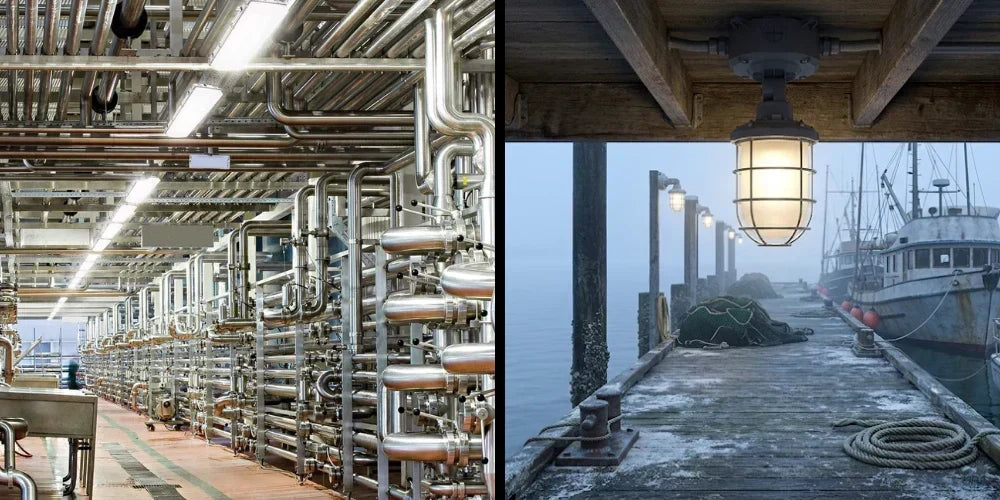
The main difference between vapor tight and vapor proof lighting fixtures lies in their primary environmental target, sealing mechanics, and common structural profiles. Vapor Tight fixtures are generally engineered as linear strip lights or high bays featuring lightweight polycarbonate or fiberglass housings. They utilize continuous rubber or silicone perimeter gaskets compressed by outer latches to block ambient moisture, high humidity, fine dust, and standard water sprays. Vapor Proof fixtures are traditionally designed as compact "jelly jar" utility units, wall brackets, or pendant pods. They feature rugged, heavy-duty containment bodies—such as die-cast metal or thick-walled engineering composites—and utilize precision threaded or bolted closures to fully seal out persistent airborne gases, corrosive chemical mists, and severe high-pressure washdown cycles.
1. Core Structural and Mechanical Comparisons
While the commercial lighting industry occasionally uses these terms interchangeably, distinct engineering design rules separate these two classifications of industrial luminaires. Choosing the incorrect enclosure profile can result in premature polymer degradation, internal wiring oxidation, or catastrophic driver failure. Evaluating their core mechanical differences side-by-side helps streamline your project layout:
| Engineering Feature | Vapor Tight Fixtures | Vapor Proof Fixtures |
|---|---|---|
| Primary Environmental Protection | Water spray, heavy condensation, high atmospheric humidity, and windblown dust particulates. | Persistent airborne gases, corrosive vapors, harsh chemical mists, and continuous wetness. |
| Structural Form Factor | Primarily long, linear strip fixtures or wide-body industrial high bays. | Traditionally compact "jelly jar" style units, wall brackets, or pendant pods. |
| Standard Ingress Ratings | Typically rated IP65 or IP66 for standard washdown resistance. | Ranges from IP66 up to elite sub-surface IP67 or high-temperature IP69K ratings. |
| Housing & Lens Seals | Polycarbonate or fiberglass-reinforced structures secured via snap-on clip or perimeter latch closures. | Heavy die-cast metal or thick engineering composites featuring screw-in glass/polycarbonate globes and protective wire guards. |
2. What is a Vapor Tight Fixture? Mechanics & Applications
A vapor tight fixture focuses on keeping moisture, condensation, and dirt from penetrating internal electrical connections in environments characterized by fluctuating ambient temperatures, airborne debris, or cyclical weather exposure.
The Mechanical Enclosure Framework
Universally, linear vapor tight fixtures rely on a lightweight but highly resilient perimeter assembly. They utilize a continuous, non-porous rubber or silicone gasket securely nested within a molded perimeter channel located between the lens housing and the main outer casing. This assembly is compressed and locked tight using a series of stainless steel or high-impact plastic tension latches spaced evenly along the edge margins. The body is typically extruded or compression-molded from specialized fiberglass-reinforced polyester or high-grade polycarbonate polymers. Inside, LED boards are mounted to metal gear trays that double as internal heat sinks. For a guide to vapor tight lighting, visit our blog: The Ultimate Guide to Vapor Tight LED Lighting.
While this framework applies universally, specific commercial product lines offer additional versatility. For instance, the Sylvania UltraLED™ Vapor Tight 3A series incorporates dual-selectability switches inside the luminaire, allowing contractors to adjust both the wattage and the color temperature (3500K, 4000K, or 5000K) directly on-site to match changing project fields.

Optimal Trade Field Applications
- Commercial Parking Garages: Protects internal LED drivers from driving rain, windblown dust, and automotive exhaust soot.
- Public Transit Walkways and Subways: Resists continuous atmospheric vibration and moisture tracking while delivering wide, uniform light distribution.
- Indoor Car Wash Prep Bays: Withstands persistent high-humidity levels and light water splashes from surrounding equipment.
- Industrial Warehouses & Cold Storage: Prevents internal condensation build-up along the circuit tracks when fixtures cross thermal boundaries. For application-specific guidance, read our guide to specifying vapor tight LED lighting for cold storage and washdown environments.
3. What is a Vapor Proof Fixture? Mechanics & Applications
A vapor proof fixture functions as an unyielding containment cell. It is explicitly engineered so that volatile chemical elements, corrosive mists, or miniature moisture vapor particles cannot make physical contact with internal electronic circuitry or live lamp sockets.
The Heavy-Duty Containment Mechanics
Universally, vapor proof fixtures are built with specialized non-corrosive metals, thick-walled composites, internal electrical potting compounds, and tightly screwed or bolted sub-assemblies to block microscopic gas molecules. The iconic "jelly jar" style design utilizes a rugged, threaded mounting box combined with a heavy-gauge cast aluminum or non-metallic composite housing. The light engine is protected by a heavy, thermal shock-resistant glass globe or a thick polycarbonate lens that threads directly against a thick silicone O-ring seal. An integrated wire grill or heavy composite guard is then locked over the globe to provide absolute vandal and impact resistance in high-abuse spaces.
Premium industrial lines like the RAB Lighting VX and VXRGB series introduce advanced field customizations. The standard RAB VX line features a rugged, rust-proof composite construction engineered specifically to survive harsh marine salt air without pitting. For specialized facility signaling, safety warnings, or architectural accents, the RAB VXRGB series lets contractors switch between vibrant red, green, blue, or crisp 5000K white light output arrays alongside field-adjustable wattages and built-in photocells within a single heavy-duty fixture chassis.

Optimal Trade Field Applications
- Chemical Processing Plants & Labs: Blocks corrosive chemical vapors and acidic fumes from pitting and degrading electrical contacts.
- Industrial Laundry Facilities: Withstands dense, non-stop ambient steam saturation and elevated room temperatures.
- Marine Docks & Coastal Facilities: Combines salt-spray corrosion defense with structural water-tight seals.
- Sub-Zero Industrial Freezers: Maintains perfect operational seals and structural integrity down to severe cold-weather starting metrics like -40°F (-40°C) without material embrittlement.
4. Standardized Testing: Decoding IP vs. NEMA Performance Ratings
While "vapor tight" and "vapor proof" are commercial marketing descriptions, Ingress Protection (IP) and National Electrical Manufacturers Association (NEMA) ratings are the standardized engineering metrics used to grade a lighting fixture's exact level of seal and environmental tolerance.
How IP Ratings Map to Industrial Enclosures
IP ratings consist of two digits governed by the international IEC 60529 standard: the first digit measures solid particulate and dust protection (0–6), and the second digit measures liquid entry protection (0–9K). For a deeper dive into IP ratings, read our blog: The Ultimate IP Ratings Guide.
- IP65: Entirely dust-tight. Protected against light, low-pressure water splashes, rain, and minor condensation cycles from any direction.
- IP66: Entirely dust-tight. Engineered to withstand heavy, high-pressure industrial washdown sprays and direct water jets. This is the baseline standard for high-performance linear vapor tight strips.
- IP67: Entirely dust-tight. Capable of surviving temporary submersion in water at limited depths without losing internal housing seals.
- IP69K: The elite threshold of ingress engineering. It means the fixture housing is completely sealed against high-pressure, high-temperature steam jets and pressurized water streams (exceeding 1400 PSI at 176°F), which are standard in chemical sanitation loops.
How NEMA Ratings Map to Industrial Enclosures
While international IP ratings strictly evaluate dust and water ingress, North American NEMA 250 standards mandate additional physical testing against structural hazards like environmental corrosion, polymer aging, oil sludge seepage, and external ice formation forces.
- NEMA 4: Constructed for either indoor or outdoor use to provide a degree of protection against windblown dust, rain, sleet, snow, splashing water, and hose-directed water; remains completely undamaged by the external formation of ice on the enclosure.
- NEMA 4X: Delivers the exact same robust water and dust safety metrics as NEMA 4, but adds a strict regulatory mandate: the entire outer fixture housing, hardware fasteners, and clips must provide an additional level of protection against corrosion (utilizing high-grade stainless steel or specialized marine-grade polymers) to endure salt spray or acidic vapors without pitting.
- NEMA 6 & 6P: Engineered to withstand entry of water during occasional temporary (6) or prolonged (6P) submersion at a limited depth, complete with enhanced corrosion protection (6P) and ice-laden mechanism durability.
5. Crucial Trade Distinctions: Vapor Proof vs. Explosion Proof
The single most dangerous field error an estimator or contractor can make is confusing a standard vapor proof luminaire with a certified explosion proof fixture. The difference comes down to one clear metric: containment direction.
- Vapor Proof Fixtures Keep Hazards Out: They rely on tight seals, heavy-duty gaskets, non-corrosive outer shells, and sealed globes to prevent water, steam, and mists from corroding internal wiring. They are rated for standard non-hazardous wet and damp locations. *They are not engineered to handle volatile, combustible environments.*
- Explosion Proof Fixtures Keep Internal Hazards In: Designed for high-risk hazardous (classified) areas where flammable gases, volatile vapors, or combustible dusts are routinely present. They do not create an airtight vacuum; instead, they feature heavy cast aluminum or steel housings with long, precisely machined joints called flame paths. If an internal electrical short occurs and sparks a gas explosion inside the fixture, the flame path vents and cools the escaping hot gases so they cannot ignite the volatile outside atmosphere. They incorporate thick, impact-resistant glass built to endure extreme blast pressures.
- Regulatory Code Boundaries: Explosion proof systems must strictly adhere to the National Electrical Code (NEC) hazardous location ratings, specifying exact Class, Division, and Group classifications (e.g., Class I, Division 1 for routine flammable gases, or Class II, Division 1 for explosive metal or grain dusts). Learn more about hazardous location lighting in our blog: The Deep Dive into Classes, Divisions, and Zones.

6. Compliance & Food Sanitation: The NSF Splash Zone Mandate
For food processing plants, commercial slaughterhouses, pharmaceutical labs, and commercial kitchens, ingress protection is only half of the specification equation. Equipment installed in these environments must satisfy strict sanitation benchmarks audited by NSF International.
When selecting fixtures for food safety applications, look for an explicit NSF/ANSI Splash Zone certification. This rating verifies that the physical exterior design of the fixture utilizes completely smooth, crevice-free, and ledge-free surfaces. It mandates that the housing materials are entirely non-toxic, highly resistant to chemical corrosion from harsh sanitizing foaming agents, and engineered so that food particles or organic matter cannot accumulate in lip seams to breed harmful bacteria. Selecting an NSF-compliant, high-efficacy fixture—such as the Sylvania UltraLED Vapor Tight 3A series, which carries an official NSF Splash Zone listing alongside its IP66 and NEMA 4X metrics—ensures absolute compliance with strict food processing safety codes.

Secure Your Industrial Project with Bees Lighting
Achieving absolute durability in harsh commercial environments requires utilizing heavy-duty hardware engineered to block moisture and chemical degradation over time. At Bees Lighting, we maintain an extensive, professional stock of specification-grade industrial luminaires—spanning high-efficacy linear vapor tight strips, architectural composite jelly jars, color-adjustable safety signaling systems, and NSF-certified food processing arrays from trusted manufacturing leaders like RAB Lighting, Sylvania, and Keystone.
Unsure whether an IP66 linear vapor tight or a NEMA 4X corrosion-resistant vapor proof fixture is best suited to satisfy the layout blueprints of your upcoming commercial car wash or marine shipyard project? Call our specialized trade hardware and compliance specialists at 855-303-0665 for tailored material matching, layout cross-reference reviews, and volume wholesale contract quotes.


