

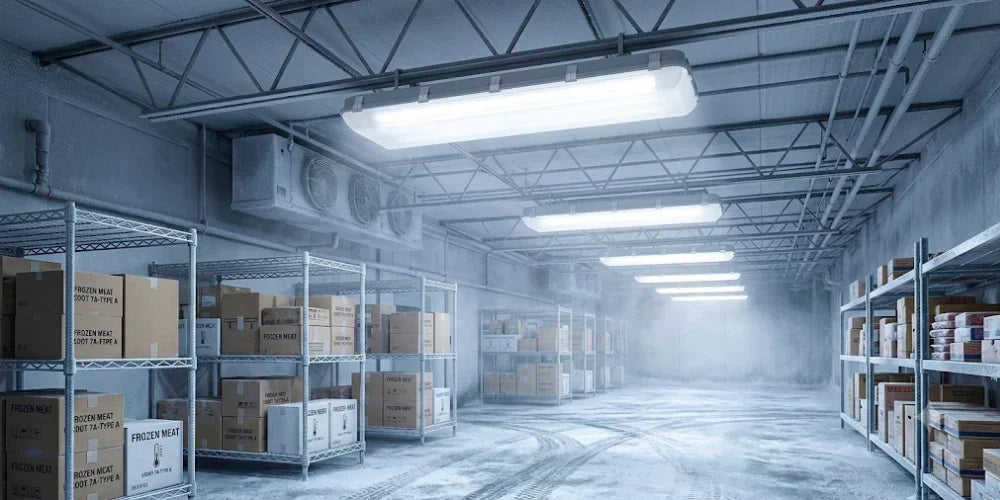
Quick Spec Check: What Defines a Cold-Storage Vapor Tight Fixture?
To survive inside commercial walk-in freezers, coolers, and high-pressure food processing washdown bays, an LED luminaire must meet five mandatory environmental baseline criteria:
- Sub-Zero Cold-Start Rating: Certified driver performance operating down to -40°F (-40°C) without ignition delays or high-frequency output flickering.
- IP66 or IP67 Ingress Rating: Complete protection against microscopic dust penetration (dust proof light fixtures) and resilience against high-pressure washdown hose spray or temporary moisture submersion.
- NEMA 4X Certification: Structural enclosure security verifying advanced resistance against internal moisture formation and corrosion from chemical sanitizers, acids, or salt spray.
- Shatterproof Lens Dynamics: High-impact polycarbonate, acrylic, or specialized tempered glass optical lenses engineered not to crack or become brittle under freezing stresses.
- NSF Splash & Sanitation Certification: Mandatory compliance rating certifying the fixture lacks exposed hardware pockets, toxic paint layers, or open crevices where food particulate or bacteria can nest.
Engineering an industrial lighting layout for extreme, severe-environment facilities requires abandoning standard lighting design playbooks. While traditional commercial and office lighting focuses heavily on macro aesthetics and visual geometry within controlled ambient climates, hazardous and sub-zero real estate demands components designed for raw physical survival. Industrial blast freezers, cold-storage warehouses, and food processing plants introduce a brutal cocktail of environmental stressors: sustained sub-zero temperatures, dense humidity accumulation, and aggressive chemical sanitization washes.
Specifying the wrong hardware in these spaces causes rapid equipment failure. Moisture penetrates unsealed driver housings, sub-zero cold kills standard power electronics, and high-pressure hot water washdowns crack standard commercial diffusers. This guide breaks down the structural physics, ingress protection metrics, and enclosure classifications required to successfully specify industrial vapor tight LED lighting systems.
1. The Cold-Chain Imperative: Why Standard Commercial and Office Lighting Fails
Standard architectural troffers, downlights, and commercial strip fixtures are engineered to function within a narrow, stable thermal band (typically 50°F to 104°F). When placed inside a commercial walk-in freezer or blast chilling envelope running consistently below zero, the physical properties of standard components quickly break down.
The primary point of failure is thermal expansion mismatch combined with moisture migration. During standard refrigeration defrost cycles, ambient temperatures rise briefly to shed ice coils, releasing dense humidity into the air. As the refrigeration system clicks back on, temperatures plunge rapidly. This extreme cycling causes the air inside a standard unsealed light fixture to contract, creating an internal vacuum that pulls humid air directly through the seams of the trim plates and housing joints.
Once inside, this moisture condenses into water droplets, pools against internal circuitry, and freezes into frost layers. When the light turns on, the internal heat melts the frost, triggering immediate short-circuits across the driver board. Furthermore, low-grade plastic lenses and housings subjected to continuous sub-zero stress undergo chemical crystallization. The polymer strands lose their elasticity, causing the lenses to become brittle and shatter under routine impact or maintenance handling.
2. Decoding Environmental Protections: Damp-Location vs. IP66/IP67 vs. NEMA 4X
To prevent catastrophic component failure, project estimators must demystify severe-environment rating categories. Many buyers conflate a basic moisture rating with full environmental sealing, leading to expensive field retrofits and code violations.
Damp-Location Trim Plates
A fixture rated for damp locations is engineered strictly for interior zones subjected to moderate, temporary condensation or ambient moisture, but where direct water spray or heavy liquid accumulation is entirely absent. Think of standard covered commercial entryways, open-air parking structures, or office restrooms. They utilize basic overlapping trim seams and simple perimeter seals, but they are entirely vulnerable to direct spray jets and microscopic airborne dust penetration.
IP66 and IP67 Ingress Ratings
The international Ingress Protection (IP) framework quantifies how effectively a housing seals against solid particles and liquids. For a fixture to be classified as a true dust proof light fixture, it must clear the highest solid particle testing boundary (represented by the first digit, 6):
- IP66 Rating: The enclosure prevents all dust ingress and withstands heavy, direct spray from high-pressure water jets fired from any angle without allowing liquid penetration. This is the minimum baseline required for facilities subjected to daily washdown cleaning protocols.
- IP67 Rating: This classification steps up the liquid defense protocol (represented by the second digit, 7). An IP67-rated luminaire is completely dust proof and survives total, temporary immersion in water at depths up to 1 meter for 30 minutes. This level of ingress protection is specified in heavy processing facilities where fixtures face occasional accidental submersion or extreme fluid exposure.

NEMA 4X Enclosure Dynamics
While IP ratings evaluate dust and water ingress, the National Electrical Manufacturers Association (NEMA) rating system evaluates structural resilience against physical wear and chemical attack. Specifying a NEMA 4X fixture introduces a mandatory "X" factor: corrosion resistance. NEMA 4X enclosures must prove they can withstand continuous exposure to highly corrosive agents—such as salt spray, chemical detergents, and acidic food processing sanitizers—without structural degradation. They must also ensure that internal electrical components remain completely isolated from moisture or frost formulation under heavy hosestream washes.

3. Material Engineering: Wide vs. Medium Housings and Extreme Thermal Deltas
Sustaining a reliable seal through severe temperature shifts requires evaluating the material composition and physical size of the fixture housing. When a space switches from sub-zero storage to hot water cleaning, the luminaire's housing expands and contracts violently. Standard commercial housings lack the structural rigidity to manage this movement, causing the perimeter gaskets to pull away and buckle.
To combat this, severe-environment luminaires leverage specialized form factors designed to distribute thermal and physical stress evenly:
The Large-Body Expansion Advantage
Advanced product groups, such as the Keystone Large Body Vapor Tight Series, utilize wide-body architectures engineered specifically to spread heat loads and provide substantial internal wire routing volumes. A wider interior profile creates a larger thermal buffer zone around the integrated driver, keeping the internal ambient temperatures stable during rapid external washdowns. For standard applications where ceiling real estate is slightly tighter, specifying a Keystone Medium-Width Vapor Tight Model offers an optimized balance, preserving high-impact structural strength within a narrower physical footprint.
Specialized Linear Profiles from RAB
For spaces requiring tailored footprint adjustments or maximum durability, specialized product architectures provide targeted solutions:
- RAB SHARK Field-Adjustable Linear Washdown: A highly versatile contractor solution that features field-selectable wattages and color temperatures packed inside an IK09 impact-resistant housing. It features an IP66 and NEMA 4X rating with a textured diffuse polycarbonate lens to eliminate glare while safeguarding discrete surface-mount LEDs.
- RAB SEAL Field-Adjustable Series: Engineered as an economical, ultra-reliable direct replacement for legacy fluorescent vapor-tights, providing clean light uniformities across a completely sealed, low-maintenance profile.
- RAB WHALE Extra-Wide Washdown: Built explicitly for high-pressure sanitation zones, this high-bay ready fixture delivers up to 40,000 lumens. It features a sloped, smooth design that sheds water instantly, an IK10 protection index, a 5VA fire rating, and full NSF Splash Zone certification to prevent bacterial nesting.
- RAB HAZSHARK Hazardous Location Washdown: When a cold-storage area is co-located with volatile vapors, dust, or flammable processing elements, the HAZSHARK provides a certified explosion-proof, ignition-protected linear housing. It combines an IP66 rating with strict Class I, Division 2 (Groups A, B, C, D) and Class II, Division 1 (Groups E, F, G) safety parameters.

4. High Ceilings vs. Tight Clearances: Linear Vapor Tights vs. High Bay LED Lighting
Selecting the ideal vapor-tight form factor requires assessing the spatial geometry and clearance boundaries of the cold-storage layout.
Linear Vapor Tights (2ft, 4ft, and 8ft configurations): These low-profile fixtures are explicitly designed for spaces with restrictive ceiling heights or tight physical clearances, such as walk-in grocery coolers, transport truck loading bays, and manual food preparation lines. Their linear lens geometry scatters light wide and horizontally, bathing rows of commercial shelving or processing conveyor belts in soft, shadow-free illumination while keeping head clearance clear.
Vapor Tight High Bay LED Lighting: When cold-storage scales up to massive, industrial regional logistics hubs with ceiling clearances soaring above 20 to 40 feet, linear vapor tights lack the optical punch required to deliver useful foot-candles down to the floor. These expansive facilities require heavy-duty, high-output vapor-tight high bays. These high-lumen, circular or rectangular sealed luminaires utilize narrow, concentrated optical beams to drive light straight down through deep racking aisles, ensuring lift-truck operators have the clear visibility required to navigate high-tier pallet storage safely.

5. Cold-Storage Component Physics: Drivers, Lenses, and Specialized Controls
Maximizing the return on investment of a severe-environment lighting upgrade requires auditing the internal component layout hidden beneath the outer housing shell.
Sub-Zero Driver Diagnostics
A standard LED driver's internal electrolytic capacitors struggle in the cold. As temperatures drop, the fluid inside these capacitors thickens, increasing internal electrical resistance and preventing the driver from initiating the necessary startup voltage pulse. This leads to flickering, dim light states, or complete component ignition failure. Professional cold-storage vapor tights specify premium solid-state drivers engineered with integrated thermal heaters or low-viscosity internal components rated for guaranteed cold-start operation down to -40°C / -40°F.
Lens Chemistry under Washdown Pressures
The choice of lens material directly impacts the longevity of your fixture. While traditional commercial and office lighting relies on cheap polystyrene diffusers, wet-location industrial luminaires require rugged, engineered polymers:
- Polycarbonate Lenses: Deliver the highest impact resistance available, making them virtually indestructible against structural bumps, dropped tools, or direct hits from lift-truck masts. However, polycarbonate can yellow or degrade over years of exposure to harsh chemical sanitizers.
- Acrylic Lenses: Offer superior clarity and complete resistance to chemical yellowing, ensuring maximum light transmission over decades of daily sanitation spray washdowns. However, acrylic is more brittle than polycarbonate and can crack if subjected to heavy physical impacts in low temperatures.
Low-Temperature Occupancy Controls
Because cold-storage warehouses are frequently vacant for long stretches of the day, integrating occupancy sensors is vital for maximizing utility savings. However, standard Passive Infrared (PIR) sensors are highly unreliable in sub-zero freezers. PIR sensors detect movement by calculating the temperature difference between a moving human body and the surrounding ambient air. In an industrial freezer, the heavy thermal insulation worn by personnel traps their body heat, making them invisible to standard PIR sensors.
To eliminate this blind spot, cold-storage specifiers integrate High-Frequency Microwave Sensors or specialized cold-tuned controls. Microwave sensors operate by broadcasting invisible high-frequency radar waves across a space and measuring the time it takes for those waves to bounce back. Because they track physical mass displacement rather than ambient heat differentials, they trigger instantly when a forklift enters an aisle, dropping back down to low-power dim levels the moment the bay is clear.
Conclusion: Designing a Safe, Resilient Framework
Specifying vapor tight LED lighting for cold-storage and high-pressure washdown environments requires looking past standard lumen-per-watt metrics. To insulate your project from premature failure and customer callbacks, you must verify the structural ingress parameters of the layout. By mandating rigorous IP66/IP67 dust proof light-fixture ratings, anchoring your design with corrosion-resistant NEMA 4X certifications, selecting appropriate wide-body or linear housing footprints from trusted industry manufacturers like RAB and Keystone, and utilizing specialized cold-start drivers, you can implement an energy-efficient industrial lighting grid built to survive the harshest manufacturing and storage conditions on earth.


