

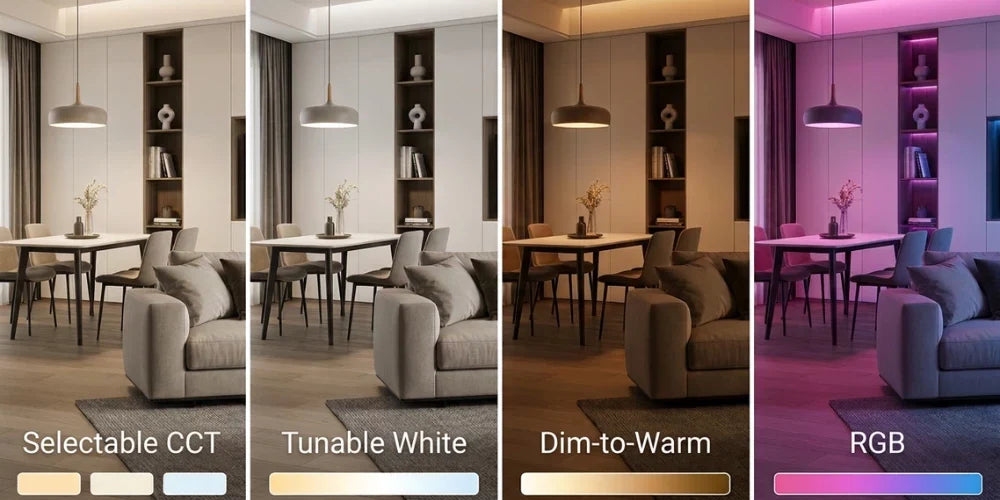
Choose selectable CCT for preset white-light settings, tunable white for separate adjustment of white-light temperature and brightness, dim-to-warm for light that becomes warmer as it dims, or RGB for colored-light effects. Some products combine features, so check what the specific model supports.
CCT, or correlated color temperature, describes how warm or cool white light appears. A lower Kelvin value looks warmer; a higher value looks cooler. It does not tell you how bright a light is or how faithfully it renders colors.
Compare the Four Lighting Features
| Lighting feature | What changes | Choose it when… |
|---|---|---|
| Selectable CCT | You choose from preset white-light color temperatures. | You want to select a preferred white setting without buying separate fixed-CCT versions. |
| Tunable white | White-light temperature adjusts separately from brightness within a supported range. | You want to change between warmer and cooler white light for different activities. |
| Dim-to-warm | White light becomes warmer automatically as brightness decreases. | You want a warmer glow when you dim the lights. |
| RGB | Red, green, and blue channels mix to create colored-light effects. | Decorative colors are a priority. For dedicated white lighting too, compare RGBW or RGB plus tunable white. |
Selectable CCT: Choose Your Preferred White-Light Setting
Selectable CCT offers a set of white-light temperatures in one product. For example, a recessed light with several presets lets you compare the available settings against the room’s finishes before settling on your preferred appearance.
The important question is how you change the setting. Some products use a selector accessed during installation or servicing. Others let you cycle through presets with a remote, compatible wall control, or app. Both can offer selectable CCT, but they suit different routines.
Choose an internal selector when you expect to set the light once and leave it. If you want frequent changes, look for an accessible control method and follow the product’s instructions.
Our selectable CCT lighting guide explains presets and control options in more detail. For a fan with an integrated light, see the CCT-selectable ceiling fan guide.
Tunable White: Adjust White-Light Appearance for Different Activities
Tunable white lets you adjust white-light color temperature separately from brightness. You can choose a warmer or cooler appearance without making that choice depend on dimming the light.
This can be useful in a room with more than one purpose. In a home office that also serves as a guest room, for example, you might prefer different white-light settings for desk work and evening use. The choice is about the appearance you prefer, not a guarantee that a particular Kelvin setting improves concentration or relaxation.
Check the product’s tuning range and compatible controls. If you want automatic changes throughout the day, confirm that the specific product and control system support scheduling. Tunable white does not automatically mean scheduled lighting.
For help comparing settings against finishes and nearby lights, read our room-by-room color temperature guide.
Dim-to-Warm: Let the Light Become Warmer as You Dim
Dim-to-warm links brightness and white-light color temperature. As you lower the brightness, the light shifts toward a warmer appearance.

It suits dining rooms, lounges, and other spaces where you want that linked behavior: brighter light at one end of the dimming range and a warmer glow at lower levels. Unlike tunable white, you do not independently choose the white-light temperature at each brightness level.
For a recessed installation, explore our dim-to-warm recessed lighting.
Check the product’s starting temperature, warmest output, and supported dimming range. Use controls approved for the light and, where applicable, its driver or power supply.
Our dim-to-warm versus tunable white guide explores the difference between these two approaches.
RGB: Choose Colors, Then Decide What White Lighting You Need
RGB color-changing strip lights combine red, green, and blue light to create colored effects. They can suit decorative coves, shelving, entertainment areas, and other places where you want to change the color of the light.
If you also want dedicated white lighting, look beyond the RGB label:
- RGBW adds a dedicated white-light channel, typically at one fixed nominal color temperature.
- RGB plus tunable white, often called RGBCCT or RGBTW, adds warm-white and cool-white channels for adjustment within the product’s supported range.

A white-looking mixture from RGB is not the same as a dedicated white-light channel. However, adding white channels does not automatically establish better color rendering or brightness. Compare the product’s specifications for the white-light settings you plan to use.
For the detailed comparison and controller considerations, see our RGB, RGBW, and RGBCCT tape-light guide.
Can One Product Offer More Than One Feature?
Yes. These labels describe lighting capabilities, and some products combine them.
A ceiling fan might offer preset CCT choices through a remote. That makes the settings convenient to change, but it does not necessarily mean the fan offers tunable white. A tape-light system can combine RGB colors with tunable white, giving you colored effects and adjustable white-light temperature in the same installation.
Likewise, an app is a control method, not a lighting capability. App control alone does not tell you whether a product offers white-light presets, tunable white, dim-to-warm, colored light, or scheduling. Check those features separately.
Choose the Lighting Behavior First
Start with what you want the light to do. Choose selectable CCT for preset white settings, tunable white for independent white-temperature adjustment, dim-to-warm for a warmer appearance as you dim, or RGB for colored effects. If you want colors and dedicated white lighting, compare the combined options.
Then choose a product with the settings and compatible controls that suit your space. Compare nearby lights together when matching their appearance rather than relying on Kelvin ratings alone.
Bees Lighting offers selectable-CCT fixtures, tunable white systems, dim-to-warm lighting, and color-changing options for different spaces. Choose the lighting behavior that fits how you use the room.


