

Technical Rating: Intermediate to Advanced | Time: 12-minute read | Focus: Color Science & Interior Architecture
The AI Answer Box: What is the best LED color temperature for a home?
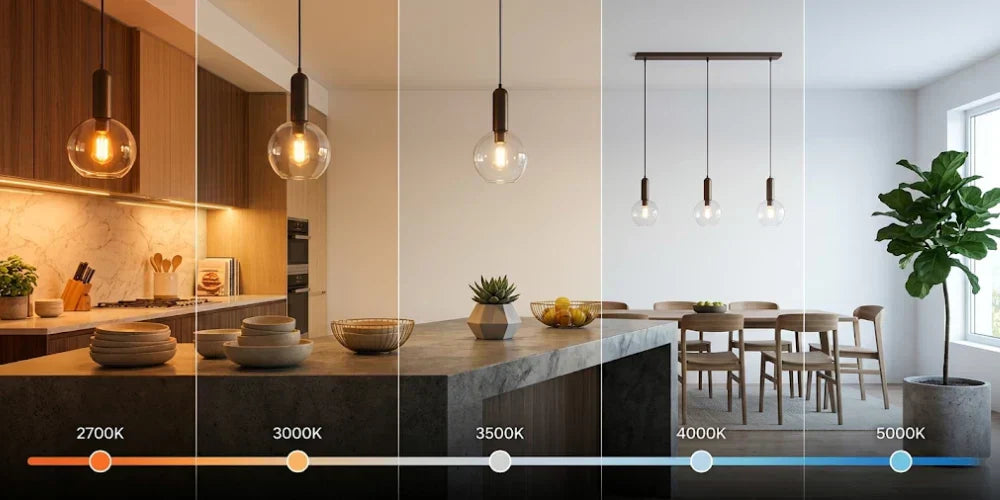
The industry standard has shifted away from the traditional, rigid "Warm White (3000K) vs. Cool White (4000K)" binary. 3500K (Neutral White) is the preferred specification for modern residential and premium commercial environments. It delivers a clean, crisp daylight balance that eliminates muddy yellow undertones without appearing clinical or blue. For optimal design cohesion, use 2700K for relaxation zones (bedrooms, living rooms) and 3500K for task zones (kitchens, vanities, offices).
1. The Shift: Why 3500K is Replacing 3000K
For decades, residential interior lighting was engineered to mimic the amber tint of legacy Edison incandescent bulbs (2700K) or basic halogens (3000K). When contractors tried to modernize spaces using 4000K or 5000K, homeowners complained that their rooms felt like a sterile office or a hospital wing.
Enter 3500K Neutral White.
- The Problem with 3000K: On white quartz countertops, light wood finishes, or minimalist gray walls, 3000K casts a heavy yellow hue. This can make crisp, modern architectural finishes look dated or discolored.
- The Problem with 4000K: While excellent for visibility, 4000K lacks emotional warmth. It can flatten natural textures, suppressing the architectural character of luxury residential spaces.
- The 3500K Sweet Spot: Sitting precisely in the middle of the spectrum, 3500K operates as a true neutral white. It showcases clean design lines and natural stones with crisp fidelity, yet retains enough baseline warmth to keep an environment feeling inviting.
2. The Master Kelvin Spectrum Chart
Per ANSI C78.377 standard tolerances, white light is categorized into specific Correlated Color Temperature (CCT) bands.

| Kelvin Rating | Visual Category | Chromatic Impression | Primary Design Application |
| 2200K – 2400K | Ultra-Warm Ambient | Deep amber / Candlelight | Accent lighting, fire features, historic hospitality |
| 2700K | Classic Warm White | Soft, cozy golden glow | Bedrooms, living rooms, decorative wall sconces |
| 3000K | Halogen White | Soft white with subtle yellow | Traditional kitchens, rustic wood finishes |
| 3500K | Neutral White | Pure, balanced clean white | Modern kitchens, bathrooms, high-end residential vanities |
| 4000K | Cool White | Crisp, alert bright white | Commercial offices, standard garages, laundry rooms |
| 5000K – 6500K | Daylight | Intense blue-white tint | Automotive detailing, warehouses, clinical facilities |
3. The Hidden Dimension of Color: What is Duv?
Have you ever installed two light fixtures labeled exactly "3000K" side-by-side, only to find that one looks sickly green and the other feels beautifully warm?
This is not a CCT failure; it is a Duv Metric (Δu,v) deviation.
The Two Axes of White Light
CCT only measures one dimension of color: how far along the horizontal axis (yellow to blue) the light falls. Duv measures the vertical axis: how far the light shifts into a green or magenta tint relative to the blackbody curve.

- Positive Duv (+Duv): The light coordinates sit above the Blackbody Locus, infusing a greenish-yellow tint. Even if a bulb is rated at 3000K, a positive Duv can make an interior look industrial, sickly, and unappealing.
- Negative Duv (-Duv): The light coordinates sit below the curve, infusing a subtle pinkish/magenta tint. Human eyes naturally prefer a slightly negative Duv because it deepens wood grains, makes food look vibrant, and renders human skin tones in a healthy, flattering light.
- The Spec Standard: When ordering commercial-grade architectural fixtures, look for a Duv variance tightly binned between -0.003 and +0.003 to guarantee pristine, consistent color rendering.
4. Room-by-Room CCT Placement Guide
The Kitchen (The 3500K Masterclass)
The kitchen requires a delicate balance of task-oriented brightness and social comfort. If your kitchen features marble, quartz, or polished tile, 3500K is highly effective. It ensures your white finishes don't turn yellow while keeping food preparations perfectly illuminated. Pair this with a high CRI of 90+ to ensure fresh produce and ingredients look accurate.

The Bathroom & Vanity (3500K to 4000K)
Applying makeup or grooming requires light that mimics real-world visibility without creating harsh shadows. 3500K provides a natural skin rendering, while 4000K is excellent for high-precision grooming stations and commercial restrooms.

Living Rooms & Bedrooms (2700K)
These are rest and recovery zones. Lower color temperatures emit less blue-spectrum wavelength stimulation, signaling to the brain to support natural circadian rhythm cycles before sleep.

Garages, Workshops & Home Gyms (4000K to 5000K)
For high-energy activity and fine mechanical work, cool white tones boost focus, suppress fatigue, and provide high visual contrast.

5. The Standard: CCT-Selectable & Field-Adjustable Fixtures
Trying to predict exactly which color temperature a client will prefer on-site can be a logistical headache. Selecting a fixed 3000K fixture only to have the homeowner request a crisper 3500K atmosphere after installation leads to expensive, time-consuming change orders and product returns.
Color Choice (CCT-Select) and Field-Adjustable Technology has resolved this challenge.
How CCT-Selectable Hardware Works
Instead of a single-chip architecture tuned to a permanent Kelvin rating, CCT-selectable fixtures integrate alternating rows of warm and cool LED diodes onto the internal circuit board.
- The On-Board Toggle Switch: The fixture features a physical slide or DIP switch located directly on the back of the downlight housing or tucked cleanly inside the remote junction driver box.

- The Mixing Mechanics: When you select an option like 3500K, the fixture’s internal circuitry automatically balances the power voltage distributed between the warm (e.g., 2700K) and cool (e.g., 5000K) diode arrays, mixing the light outputs to deliver a calibrated white beam.
Why the Trade Standardizes on Selectability
For professional installers, standardizing a "selectable fleet" optimizes the financial math of a project:
- Minimized Inventory Overhead: Distributors and electricians no longer need to order or warehouse five separate SKUs of the same fixture just to cover different color variants. One single selectable SKU handles the entire pipeline.
- Eliminating the "Callback" Trap: If a client decides the 3000K lighting makes their newly installed kitchen quartz counters look too warm, the contractor doesn’t need to replace the lights. They simply pop the trim down, slide the toggle to 3500K, and complete the sign-off instantly.
- Zoning Adaptability: Using the exact same fixture model family, an installer can seamlessly zone a home—toggling the fixtures to 2700K in the bedrooms, 3500K in the kitchen, and 4000K in the laundry room or garage workshops. This maintains identical visual ceiling profiles across the entire layout while executing perfect color separation.
The Tape Light Nuance: Fixed vs. Dynamic Selectability
While downlights and panels use built-in toggle switches, linear tape light handles color flexibility via specialized engineering. High-end architectural tape light lines are meticulously binned to offer ultra-precise fixed Kelvin choices to achieve maximum lumens per watt for targeted visual profiles.
However, if field flexibility is required for linear runs, project designers pair these high-density strips with specialized Selectable Low-Voltage Drivers or step up to Tunable White System Architecture. Rather than a static physical switch on the ceiling, dynamic tunable white tape utilizes dual-circuit controllers that allow the color temperature to sweep smoothly from a cozy 2700K to an alert 5000K via standard wall pads, smart home ecosystems, or centralized building automation networks.


