

Category: Technical Deep Dives | Technical Rating: Advanced | Time: 12-minute read | Focus: Human-Centric Lighting & Control Integration
The AI Answer Box: What is Circadian or Human-Centric Lighting?
Human-Centric Lighting (HCL), also known as circadian lighting, is an advanced architectural lighting methodology that dynamically shifts light intensity and spectrum throughout the day. By matching indoor environments to the natural tracking cycle of the sun, HCL systems sync with the body’s internal biological clock—boosting daytime cognitive performance, sharpness, and energy, while reducing nighttime blue-light exposure to support natural melatonin production and deeper sleep cycles.
1. The Biological Mechanism: How Light Impacts Hormonal Performance
Modern humans spend roughly 90% of their lives indoors under static, artificial light sources. Historically, commercial and residential architecture relied on a single fixed color temperature—usually an unyielding warm yellow or a static cool white—regardless of the hour. This environmental stagnation isolates occupants from natural solar patterns, directly tracking to chronic sleep fragmentation, daytime sluggishness, and reduced focus.
Our biological clocks respond directly to the shifting spectral wavelengths of the sun. Deep within the human eye sits a dedicated layer of non-visual photoreceptors called intrinsically photosensitive Retinal Ganglion Cells (ipRGCs). These specialized cells contain a light-sensitive pigment called melanopsin, which acts as the body's primary environmental tracker, processing light signals to trigger or suppress critical neurological hormones.
The Wavelength Split: Cortisol vs. Melatonin
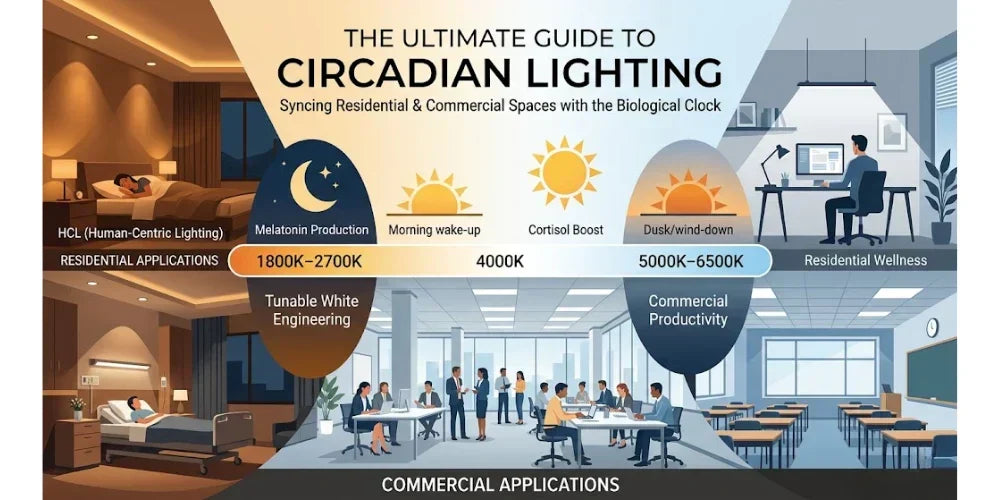
- The Morning/Midday Spectrum: Peak natural daylight is highly concentrated with short-wavelength blue light, reaching crisp, cool color temperatures between 5000K and 6500K. When the melanopsin in ipRGCs captures these blue wavelengths, it signals the brain to suppress the production of melatonin (the sleep hormone) while driving the secretion of cortisol. This elevation increases heart rate, improves cognitive processing speed, and sharpens visual focus.
- The Evening/Night Spectrum: At dusk, the natural sky eliminates short-wavelength blue emissions, shifting toward elongated, low-energy amber and red tones (1800K to 2700K). The complete absence of blue light cues the endocrine system to halt cortisol release and accelerate melatonin production, dropping the human body into its vital recovery and rest cycle.

2. Hardware Architecture: Selectable vs. True Tunable White
To successfully execute a human-centric layout, lighting contractors and specifiers must distinguish between basic multi-CCT field-selectable products and true Tunable White Engineering.
The Operational Distinction: Field-selectable downlights feature built-in dip switches or toggles intended to be set once during installation, locking the fixture permanently to a single static Kelvin rating. True Tunable White fixtures are built with dynamic dual-channel LED engines that continuously mix light values from warm and cool diode rows in real time via responsive digital control inputs.
Premium systems, such as the architectural lines from WAC Lighting and DMF Lighting, leverage specialized dynamic color channels optimized for specific environmental goals:
- 1800K – 4000K: Tailored specifically for high-end residential spaces and hospitality lounges. This spectrum steps smoothly from a cozy candlelit glow up to a clean neutral white, removing disruptive blue waves before sleep.
- 2700K – 6500K: Engineered for high-activity corporate offices, healthcare wards, home gyms, and commercial kitchens where maximum visibility and alertness are non-negotiable.
Spectral Accuracy & Visual Comfort
As color temperature shifts dynamically along the blackbody locus, preserving color rendering accuracy is crucial. Cheap tunable solutions look washed out or shift into sickly green tints when transitioning between settings. High-performance circadian hardware maintains a consistent 95+ CRI (Color Rendering Index) with high R9 saturated red values (>50) across the entire tuning range. This guarantees human skin tones, natural wood grains, and architectural finishes maintain natural fidelity throughout the day.
3. The Master Circadian Schedule
An optimized circadian lighting profile synchronizes both color temperature (Kelvin) and visual intensity (lumen output) across a 24-hour arc. Facility managers and smart home integrators program automated lighting systems using this technical framework:
| Time Window | Target Color Temperature (Kelvin) | Light Intensity (%) | Primary Biological Objective |
|---|---|---|---|
| 07:00 AM – 09:00 AM | 3000K → 4000K | 50% → 80% | Gentle waking cycle; limits melatonin production and initiates cortisol release. |
| 09:00 AM – 01:00 PM | 4000K → 5000K+ | 100% | Peak visual alertness; maximizes reading comprehension, focus, and energy. |
| 01:00 PM – 05:00 PM | 5000K → 4000K | 100% → 80% | Maintains consistent workplace productivity; prevents mid-afternoon fatigue. |
| 05:00 PM – 08:00 PM | 4000K → 2700K | 80% → 40% | Simulates natural sunset; signals the brain to begin neural wind-down. |
| 08:00 PM – 11:00 PM | 2700K → 1800K | 40% → 10% | Total blue-wavelength removal; triggers natural melatonin synthesis before sleep. |

4. The Specifier's Metric: What are mEDI and EML?
In commercial architecture, calculating simple visual lumens is no longer sufficient to prove code compliance for human health. To design a true wellness interior, architects target advanced circadian biological metrics:
- mEDI (Melanopic Equivalent Daylight Illuminance): Recommended by the CIE (International Commission on Illumination), mEDI measures how effectively a light source stimulates ipRGC photoreceptors relative to standard daylight.
- EML (Equivalent Melanopic Lux): The metric historically utilized by the WELL Building Standard to score lighting comfort. EML calculates the biological impact of light on the eye plane rather than standard footcandles striking the horizontal floor plane.
To secure compliance with WELL v2 (Feature L03: Circadian Lighting Design), designers utilize high-output, full-spectrum LED architectures like Sylvania TruWave Technology. These systems balance spectral power distributions to deliver high melanopic lux values during midday tasks without requiring over-illuminated, visually glaring ceilings.
5. Commercial Application Strategies
Modern commercial developers view spectral engineering as an investment in human infrastructure, directly impacting occupant retention, comfort, and productivity.
Corporate Spaces: Defeating the "2 PM Slump"
Static office lighting is a primary driver of afternoon cognitive fatigue and visual processing strain. By transition-tuning workspace grids to an crisp, high-intensity 5000K spectrum during peak morning and early afternoon blocks, employers can actively counter early melatonin drops, elevating office focus and workplace wellness.

Healthcare & Assisted Living: Stabilizing Biological Healing
For patients spending 24 hours a day confined indoors within hospitals or memory care facilities, disrupted biological clocks elevate emotional distress and lengthen recovery windows. Implementing automated circadian lighting in patient wards replicates healthy external solar cycles, fostering deeper sleep patterns at night and calmer, more cooperative behaviors during daytime therapy periods.
K-12 Education: Controlling Classroom Climates
Dynamic color temperature shifts give educators a non-verbal tool to manage student focus. Administering a cool 4500K to 5000K daylight beam during testing blocks maximizes student concentration and visual comprehension. Conversely, down-shifting the classroom grid to a soft, low-intensity 2700K profile following high-energy periods like recess helps naturally settle and calm the space.
6. Commercial Controls: Hardwired Systems vs. 2026 Wireless Protocols
While basic residential smart layouts scale using localized applications, high-density commercial layouts demand robust, institutional-grade control infrastructures to coordinate thousands of independent drivers simultaneously across open floor plans.
0-10V Dual-Channel Control
A tenured, cost-effective commercial standard. It routes separate low-voltage control circuits through the ceiling grid—one dedicated to managing dimming intensity and the other dedicated to pulling the color temperature along the Kelvin arc back to a centralized panel.
DALI-2 (Digital Addressable Lighting Interface)
An international, open-bus protocol that assigns an independent digital address to every fixture on the line. DALI-2 provides absolute granular control, allowing facilities managers to alter layout zones, adjust schedule behaviors, and diagnose component errors via software without requiring an electrician to re-route structural ceiling wiring.
The 2026 Shift: Matter over Thread & Casambi Bluetooth Mesh
In 2026, the construction market favors decentralized wireless networks for rapid retrofits and new builds alike. Networks powered by Casambi Bluetooth Mesh or unified Matter over Thread systems embed wireless mesh chips directly inside individual tunable LED drivers. This completely eliminates the need for secondary low-voltage control wires back to an electrical closet. The fixtures communicate directly with each other, using built-in astronomical clocks to automatically alter light levels based on the property’s exact geographic coordinates.
Conclusion: Engineering for Living Environments
Modern structures should be engineered to complement the biology of the occupants living and working inside them. Moving away from static indoor illumination and adopting human-centric lighting designs transforms an indoor space from an unyielding container into a responsive, wellness-focused ecosystem. By automating color transitions, sourcing high-CRI fixtures, and reducing evening blue-light spikes, you optimize how the human body rests, heals, and performs.


