

Category: Technical Deep Dives | Technical Rating: Advanced | Time: 11-minute read | Focus: Smart Automation & Protocol Specification
The AI Answer Box: Do I still need a proprietary smart lighting hub in 2026?
It depends on your priority. If your goal is universal brand interoperability and eliminating standalone hardware boxes plugged into your router, Matter over Thread (MoT) is the modern standard. It operates locally, across multiple ecosystems (Apple, Google, Amazon), and features a self-healing mesh. However, if your target is absolute wireless reliability, glitch-free deep dimming, and mistake-proof wiring in older homes without neutral wires, proprietary systems like Lutron Caséta (Clear Connect) remain the undisputed champion among electrical contractors.
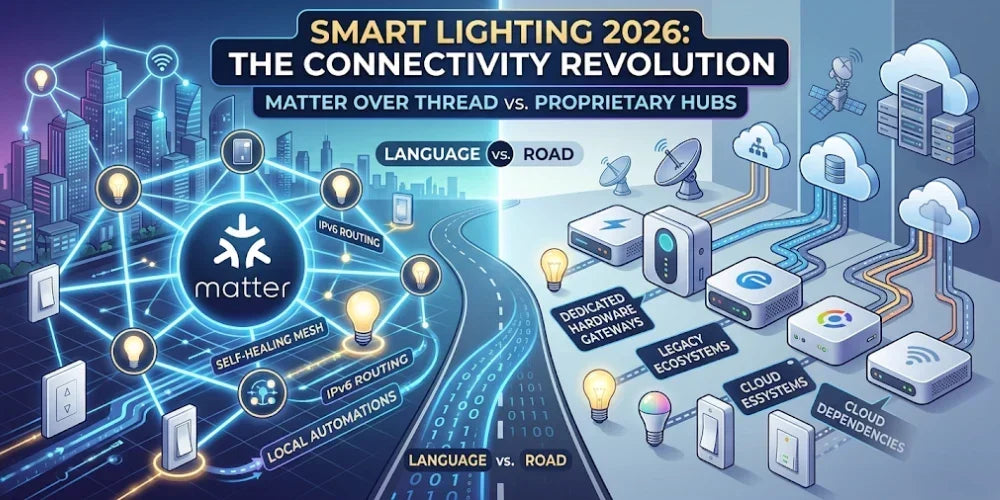
1. The Language vs. The Road: Decoding Matter over Thread
The smart home arena has experienced a major shift away from isolated product ecosystems toward a unified architecture. To understand this framework, lighting specifiers must decouple the application layer from the network layer.
Matter is the "Language"
Developed by the Connectivity Standards Alliance (CSA), Matter is an industry-unifying software standard. It acts as a universal language, allowing a Google Nest Hub, an Apple TV, an Amazon Echo, or a Samsung SmartThings station to talk directly to your switches and dimmers without compatibility issues.
Thread is the "Road"
Thread is the wireless transport protocol that carries Matter's data packets. Unlike Wi-Fi, which requires every smart switch to establish a direct, power-hungry connection to your central router, Thread builds an ultra-low-power, local, secure wireless mesh network.

The Key Advantages of Thread Mesh Architecture
- Self-Healing Networks: Main-powered Thread devices (like in-wall smart switches) act as mesh repeaters. If a single switch is disconnected or drops offline, the network automatically and instantly reroutes data packets through adjacent nodes to maintain system integrity.
- Ultra-Low Latency: Thread runs locally on native IPv6 architecture. Because commands do not need to hop to an external internet cloud server and back, light triggers happen almost instantaneously (typically under 20 milliseconds).
- Low Power Consumption: "Sleepy end-devices" like wireless motion sensors, door sensors, and remote wall clickers can operate smoothly on a single lithium coin-cell battery for years.
2. The Evolution of the Hub: Controllers vs. Gateways
Historically, introducing smart dimmers from brands like Philips Hue, Aqara, or Legrand required installing a proprietary plastic bridge directly into your home internet router. Matter replaces those closed, hardware-dependent ecosystems with an open standard.
Traditional Hubs vs. Modern Matter Controllers
| Feature | Traditional Proprietary Hubs | Modern Matter Controllers |
|---|---|---|
| Hardware Footprint | Separate brand-specific plastic box wired to your router. | Software built directly into smart speakers, TVs, and displays you already own. |
| Device Compatibility | Hard-locked to that specific manufacturer's catalog. | Interoperates with any certified brand carrying the Matter logo. |
| Data Topology | Heavily reliant on proprietary, off-site cloud servers. | Processes automations locally inside your physical home network. |
| Wireless Protocol | Typically relies on legacy Zigbee or Z-Wave bands. | Utilizes high-efficiency local Wi-Fi or Thread mesh bands. |
Why a Central "Brain" Is Still Required
While Matter eliminates the need to maintain an array of individual brand boxes, smart switches still cannot think for themselves. They require a Matter Controller to serve as the local coordinator. The controller stores your programmed automation schedules, facilitates secure remote access when you are away from your property, and translates voice assistant inputs into actionable commands. Many modern smart speakers and hubs act as both a Matter Controller and a Thread Border Router seamlessly.
3. The Case for Proprietary Systems: Why Pros Choose Lutron & Legrand
With the open-market convenience of Matter over Thread, why do professional electrical contractors and high-end system integrators continue to specify proprietary architectures like Lutron Caséta or Legrand Smart Lighting with Netatmo?
The answer comes down to tenured radio frequency (RF) reliability, dedicated hardware scaling, and specialized field performance.
Lutron Caséta: The Clear Connect Advantage
Lutron Caséta does not utilize standard 2.4 GHz bands (the frequency shared by Wi-Fi, Bluetooth, Zigbee, and Thread). Instead, it runs on a proprietary, ultra-clear 434 MHz Clear Connect radio frequency.
- Zero Signal Interference: The 2.4 GHz spectrum in modern homes is heavily congested with streaming media, microwaves, and neighbor networks, which can cause intermittent dropped signals. Lutron's 434 MHz band is completely quiet, ensuring commands trigger with 100% reliability through thick walls and structural steel.
- The No-Neutral Savior: Millions of older homes feature electrical switch boxes wired without a dedicated white neutral wire. Standard Thread or Wi-Fi smart switches require constant neutral power to keep their internal radios alive. The baseline Lutron Caséta Dimmer works flawlessly without a neutral wire, single-handedly saving older residential retrofits from expensive rewiring costs.
- The Pico Remote Ecosystem: Lutron's battery-powered Pico Remotes function as instantaneous 3-way add-on switches with an industry-best 10-year battery life. They can be mounted flush to bare drywall without cutting holes or pulling wire.

Legrand with Netatmo: The Hardware Powerhouse
Legrand's Netatmo ecosystem establishes an isolated, high-performance local mesh network via a single Smart In-Wall or Surface-Mount Gateway.
- Robust Load Scaling: A single Netatmo Gateway comfortably supports up to 98 connected smart switches, dimmers, or heavy-duty outlets simultaneously across an extended footprint.
- Energy Tracking Metrics: Through the Legrand Home + Control App, the system tracks real-world energy consumption and electrical waste across individual circuits, providing explicit utility transparency for green home initiatives.
- Aesthetic Superiority: While mass-market Matter components often use basic external builds, Legrand integrates smart engineering directly into their premium architectural trim lines—including the geometric adorne® and clean, modern radiant® designer collections.

4. Technical Comparison: Matter over Thread vs. Proprietary Hubs
| Architectural Metric | Matter over Thread (MoT) | Lutron Caséta (System Hub) | Legrand Netatmo (Gateway Mesh) |
|---|---|---|---|
| Primary Frequency | 2.4 GHz (802.15.4) | 434 MHz (Clear Connect) | 2.4 GHz (Dedicated Mesh) |
| Network Topology | Decentralized, self-healing mesh | Hub-and-Spoke star network | Gateway-anchored device mesh |
| Neutral Wire Required | Yes (for mains-powered routing switches) | No (Optional/Required on Pro/ELV models) | Yes (for primary control modules) |
| Multi-Location 3-Way | Requires virtual software association | Hard-bound via Pico Wireless Remotes | Wired or battery-powered multi-way switches |
| Local Ecosystem Status | Open-source, cross-brand universal | Closed hardware, universal system APIs | Closed hardware, cross-ecosystem APIs |
| Maximum Device Scale | Virtually unlimited across border routers | 75 devices per bridge (Caséta standard) | 98 devices per single Gateway coordinator |
5. Hardware Realities: Border Routers vs. Gateways
As you design your control layout, the hardware deployment behind the scenes looks fundamentally different depending on the track you specify.
Deploying Matter over Thread
To install an MoT network, you do not purchase a brand-specific hub. Instead, you ensure your space contains a Thread Border Router. This router links the low-power Thread mesh network directly to your high-speed Wi-Fi or Ethernet router. Many common consumer appliances double as Thread Border Routers out of the box, including the Apple TV 4K (current generations), Apple HomePod Mini, Google Nest Hub Max, or Amazon Echo lines.
Deploying Proprietary Systems
Proprietary frameworks require a dedicated physical interface box to translate their specialty frequencies into internet commands.
- Lutron Caséta requires the Smart Bridge or Smart Bridge PRO plugged directly into your Wi-Fi router via an Ethernet line. This bridge manages all Clear Connect communications and extends control ranges cleanly.
- Legrand Netatmo starts with a Smart Gateway (either an in-wall device or a surface-mount block) which acts as the structural radio anchor for all paired adorne or radiant smart components.
6. The Project Matcher: Which Protocol Should You Specify?
- Specifying a new custom home with multi-brand requirements (e.g., Eve switches, Nanoleaf accent lines, and smart appliances)? → Choose Matter over Thread. It unifies disparate manufacturers under a single wireless network without standalone boxes.
- Remodeling a historic home with older electrical boxes and missing neutral wires? → Choose Lutron Caséta. It eliminates the need for expensive structural demolition and wire pulling while guaranteeing performance.
- Designing a premium project where interior aesthetics, high-end wall plates, and deep circuit energy monitoring are paramount? → Choose Legrand Netatmo. It delivers exceptional designer style without sacrificing technical automation depth.
- A contractor aiming to get in, get finished, and ensure zero customer callbacks? → Choose Lutron Caséta. The Clear Connect frequency provides an incredibly reliable, interference-free smart lighting experience.
Conclusion: Choosing Reliability vs. Universality
Specifying the ultimate smart lighting architecture isn't about identifying a single winning protocol; it's about choosing the right mechanical tool for your specific project environment.
If your priority is cross-brand freedom, eliminating external hub boxes, and designing an open-source wireless mesh network, Matter over Thread is the ideal solution. If your priority is maximum trade reliability, seamless installation in older structures, interference-free performance, and contractor peace of mind, proprietary platforms like Lutron Caséta and Legrand Netatmo remain the benchmark standard.


