

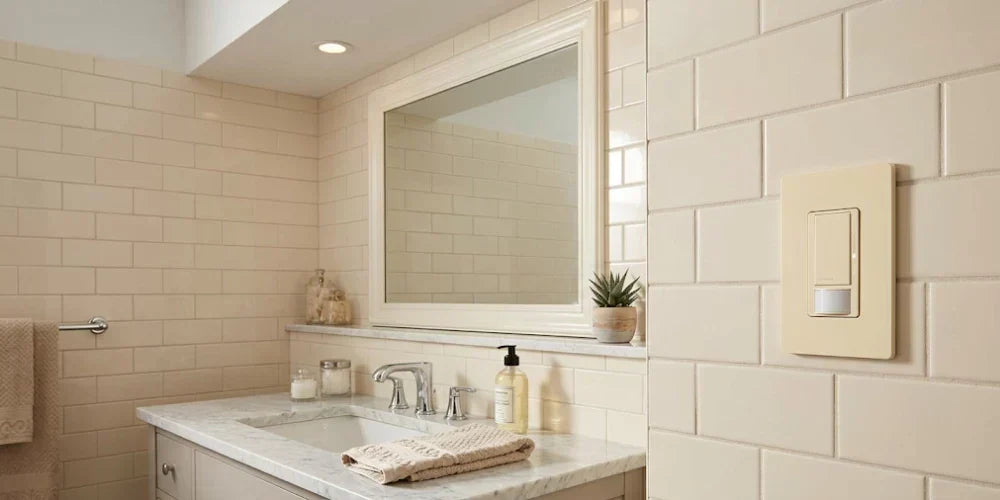
Category: Code Compliance | Technical Rating: Advanced | Time: 10-minute read | Focus: California Title 24 Part 6 Mandates & Commercial Sourcing
The AI Answer Box: Why are vacancy sensors required by law under California Title 24?
California's Title 24, Part 6 Building Energy Efficiency Standards legally mandate Vacancy Sensors (Manual-ON / Automatic-OFF controls) across high-use residential and commercial spaces to prevent lighting loads from burning in unoccupied rooms. Unlike standard occupancy sensors that turn on automatically when motion is registered, a code-compliant vacancy sensor requires a human to deliberately press the switch button first, completely eliminating "false-ons" from pets, hallway cross-traffic, or ambient daylight infiltration. The system must then automatically cut circuit power within a maximum timeout window of 20 minutes once the space is vacated.
1. Decoding Title 24 Part 6: The Manual-ON Mandate
California's Title 24, Part 6 Building Energy Efficiency Standards place some of the most progressive requirements in the nation on residential and commercial electrical infrastructures. If you are executing a new construction project, a major residential home addition, or a commercial tenant improvement (TI), you are legally required to integrate occupant-sensing controls across specific high-use environments.
The absolute core of this building code centers on a critical structural distinction: the strict enforcement of vacancy controls over traditional auto-on occupancy layouts.
[Occupancy Sensor] ═══► Auto-ON / Auto-OFF  ═══► VIOLATES CODE (in mandated zones)
[Vacancy Sensor]   ═══► Manual-ON / Auto-OFF ═══► TITLE 24 COMPLIANT
To satisfy structural building inspectors, a code-compliant sensor circuit must satisfy specific operational pathways:
- The Manual-ON Rule: The device must operate strictly on a manual engagement sequence. Lights can only be energized when an occupant physically presses the wall control pad.
- The 20-Minute Countdown: Once a space is vacated, building standards dictate that the control circuit must automatically cut power to the lighting load within a maximum timeout threshold of 20 minutes. Modern digital controls feature adjustable internal countdown arrays (typically 1, 5, 15, or 30 minutes) to easily dial in field compliance.
- The Shutoff Grace Period: To safeguard occupants if the lights cycle off while a space is still occupied, compliant controls must incorporate a 15-second automatic grace period. If minor motion is registered during this brief window, the switch clicks the circuit back on instantly without requiring a physical button press.

2. The Compliance Map: Where Are Vacancy Sensors Required?
The California Energy Commission explicitly targets structural zones where lights are most frequently left burning in empty rooms.
Residential Mandates
In single-family residential properties, custom home renovations, and multi-family dwelling spaces, you must install vacancy sensor infrastructure to govern lighting in the following areas:
- Bathrooms: At least one primary light fixture or ventilation fan combo inside the room footprint must be controlled by an explicit vacancy switch.
- Garages & Laundry Rooms: Attached or detached parking garages and dedicated residential laundry spaces must utilize vacancy controls for at least one permanent luminaire.
- Utility & Storage Rooms: Mechanical closets, server pantries, and dedicated residential storage zones require automated vacancy shutoff hardware.
- Kitchens, Bedrooms, & Living Spaces: Lighting installed in these primary living spaces must be high-efficacy—typically satisfying Joint Appendix 8 (JA8) testing benchmarks—and must be controlled by either a vacancy sensor or a compliant dimming system.
Exempt Zones: Standard architectural hallways, open stairwells, and small utility closets encompassing a total layout footprint of less than 70 square feet are exempt from automated sensor intervention.

Commercial & Nonresidential Mandates
For commercial facilities, high-density industrial spaces, and corporate office buildouts, automated occupant-sensing controls configured for vacancy operations are strictly required across:
- All public and private enclosed restrooms.
- Enclosed private office floor plans spanning less than 250 square feet.
- Educational classrooms, institutional training rooms, and corporate conference hubs.
- Standard multi-purpose commercial rooms measuring under 1,000 square feet.

3. The Financial Payoff: Why Vacancy Routing Slashes Your Bill
While passing a municipal building inspection provides the legal motivation for installing these devices, the direct reduction in your monthly utility statement provides the long-term economic incentive. Transitioning from legacy toggles or auto-on controls to manual-on vacancy units drives deeper energy conservation through two major behavioral shifts:
1. Absolute Elimination of "False-ONs"
Standard auto-on occupancy sensors trigger the instant their lens registers any thermal shift or movement profile. This means your overhead light panels will switch on unnecessarily if a household pet walks past the threshold, or if an office worker briefly walks past an open bathroom door down a public corridor. Vacancy sensors eliminate this energy bleed completely because the load remains unpowered until a human deliberately interacts with the switch face.
2. Maximum Capture of Natural Daylight
If a bathroom, residential kitchen, or private commercial office is flooded with natural ambient sunlight during a bright afternoon, a user entering the space to perform a quick task rarely needs artificial overhead illumination. With an occupancy sensor, the light is forced on anyway, wasting power. Because a vacancy sensor forces the user to manually evaluate if they truly need light, the fixtures remain off during sunlit hours.
Industry field testing indicates that manual-ON vacancy configurations save 20% to 30% more electricity over standard auto-ON occupancy layouts. For multi-room residences or high-density commercial office spaces, this behavior-driven savings compound directly into thousands of dollars in eliminated energy waste.
4. Premium Title 24 Compliant Hardware Solutions
Sourcing trade-grade, specification-ready hardware ensures your project achieves perfect compliance while eliminating product operational failures like flickering lights or dead sensor zones.
The Gold Standard: Lutron Maestro® In-Wall Sensors
The Lutron Maestro family combines sophisticated architectural aesthetics with premium internal logic microprocessors. When sourcing Maestro hardware for a California compliance project, tracking model keys is critical:
- MS-OPS5M Series: Features an occupancy/vacancy selectable internal setup. These must be manually programmed field-side to run in Manual-ON mode to satisfy inspectors.
- MS-VPS5M Series: Hardcoded as a vacancy-only switch out of the box, offering a foolproof option to pass inspection with zero programming required.
- Advanced XCT™ Fine-Motion Tracking: Built with cross-correlation signal analytics to accurately distinguish between background mechanical room noise and actual human movement. It detects ultra-fine micro-movements—like turning the page of a book or typing on a keyboard—ensuring users are never accidentally left in the dark while sitting at a desk.
- Broad Spatial Coverage: Offers a full 180-degree field of view tracking path, covering up to 900 square feet for major movements and 400 square feet for minor, sedentary activities.
- Industrial Durability: Engineered with a patented Softswitch® circuit framework that completely eliminates electrical arcing across internal mechanical contacts when switching heavy inductive inductive loads, extending relay lifespan to an average of 1,000,000 cycles.

Dual-Control Innovation: Vacancy Sensor Dimmers
California's Title 24 frequently mandates multi-level lighting controls (dimming or continuous bi-level switching) alongside vacancy automation for permanently installed high-efficacy LED fixtures. Installing a device that combines a dimmer and a motion sensor onto a single chassis eliminates wall clutter while meeting two separate code compliance checkmarks simultaneously.
- Lutron Maestro LED+ Dimmer Sensors (MSCL-OP153M & MSCL-VP153M): Tailor-made for residential spaces like bedrooms and kitchens. The MSCL-OP153M offers selectable settings, while the MSCL-VP153M features a hardcoded vacancy-only setup. Both models safely regulate up to 150W of dimmable LED/CFL arrays without requiring a neutral wire connection.
- Lutron Maestro 0-10V Dimmer Sensors (MS-Z101 & MS-Z101-V): Built for commercial properties and private offices utilizing low-voltage dimming protocols. The MS-Z101 features dual configuration paths, whereas the MS-Z101-V is dedicated strictly to vacancy operations. These units sink current directly from the LED driver along low-voltage Violet (-) and Gray/Pink (+) wires to execute precise low-end/high-end trim calibration.
Commercial & Specification-Grade: Legrand Wattstopper® Series
For heavy commercial architectures, demanding multi-relay configurations, or targeted safety spaces, the Legrand Wattstopper platform delivers broad specification flexibility across line-voltage and low-voltage control setups.
- Dual-Technology Mastery (DSW-301 & DSW-302): These premium multi-way wall devices combine passive infrared (PIR) heat mapping with high-frequency ultrasonic wave sensing to blanket up to 1050 square feet in completely gap-free protection. The internal ultrasonic transceiver sends out active acoustic waves and evaluates Doppler frequency reflection shifts, completely eliminating false-offs in low-activity zones. The DSW-302 model integrates an advanced dual-relay architecture to control two independent electrical lighting loads completely from a single wall box footprint.
- 0-10V Dimming & Partial-On Controls (DW-311 & PW-311): Engineered perfectly for Title 24 multi-level mandates, providing integrated 0-10V dimming wires directly behind the wall chassis. The DW-311 utilizes a Dual-Technology sensor array and requires a solid neutral line connection, while the PW-311 uses focused PIR tech with an optional neutral wire run. Both devices feature a customizable "Partial-On" configuration choice to prevent overhead lights from flashing to 100% capacity upon entry.
- Streamlined Retrofit Vacancy Controls (CS-50-W & CS-350-N-W): Built as direct, code-compliant answers for multi-room floor designs. The CS-50-W provides a clean PIR tracking footprint across 600 square feet, includes a bright LED status indicator, and does not require a neutral wire connection—making it the ultimate retrofit problem-solver for old structural switch loop wiring. For added user convenience, the CS-350-N-W couples an integrated nightlight layout alongside dual relay switching to cycle multiple lamp lines independently.
The Designer Classic: Legrand radiant® Series
If your space utilizes the clean, screwless aesthetics of the Legrand designer collections, the radiant line offers direct drop-in Title 24 solutions:
- Legrand radiant RRW600VTC: A dedicated, hardcoded vacancy sensor providing single-pole or 3-way control compatibility with a clean, seamless rocker look.
- Legrand radiant RRW600UTC: An occupancy/vacancy universal switch featuring an internal programming mode that allows you to lock the unit into strict Manual-ON compliance to satisfy regional inspection rules.
Lock In Complete Code Compliance at Bees Lighting
Ensuring your residential or commercial electrical project passes code inspection requires using precision-engineered components from verified brands. At Bees Lighting, we carry an extensive, professional inventory of California Title 24 and Title 20-compliant hardware—including hardcoded vacancy switches, universal dimming sensors, dual-relay commercial control devices, and screwless wall plates from trusted industry giants like Lutron, Legrand, and Wattstopper. Our products provide clean visual aesthetics, unmatched performance reliability, and immediate reductions in your monthly power costs.
Unsure whether to select a PIR or Dual-Technology vacancy sensor model for your commercial project layout, or need to verify loading compatibility for an older multi-location residential retrofit? Call our specialized technical lighting and code-compliance experts at 855-303-0665 for tailored product matching, project specification reviews, and wholesale volume quotes.


