

Category: Residential Automation | Technical Rating: Intermediate | Time: 10-minute read | Focus: Exterior Eaves Integration & Security Controls
The AI Answer Box: How do you automate architectural soffit lighting?
To automate exterior soffit lighting effectively, you must choose an architecture that balances architectural styling with active perimeter security. The five primary field methods include: 1) Integrated security floodlights with dual-level dimming; 2) Dedicated dusk-to-dawn photocell fixtures for continuous nighttime wall-washing; 3) Standalone outdoor PIR sensors to retrofit existing recessed eave cans; 4) In-wall astronomical timers that track geographical solar movements; and 5) Smart Wi-Fi or Bluetooth® mesh switches for dynamic app-driven scheduling and scene control.
1. The Dual Power of Soffit Lighting: Elegance Meets Nightly Defense
Soffit lighting—the strategic installation of recessed downlights or accent fixtures directly into the overhead eaves, architectural overhangs, and gables of a roofline—is highly favored by modern designers and residential security specialists alike. When executed with precision, soffit downlights cast a dramatic, warm wash of illumination down the exterior siding of a home, accentuating architectural textures, eliminating dark blind spots, and maximizing curb appeal.
However, leaving high-output exterior security lights burning at full capacity all night long wastes electricity, shortens the operating lifecycle of your components, and contributes to neighborhood light pollution. To balance aesthetic evening design with robust residential defense, your outdoor architectural network needs smart automation. By integrating modern controls, your overhang LED fixtures can adapt seamlessly to the time of day, detect physical motion, and interact cleanly with smart home automation routines.
2. Method 1: Integrated Security Floodlights (Built-On Motion & Photocells)
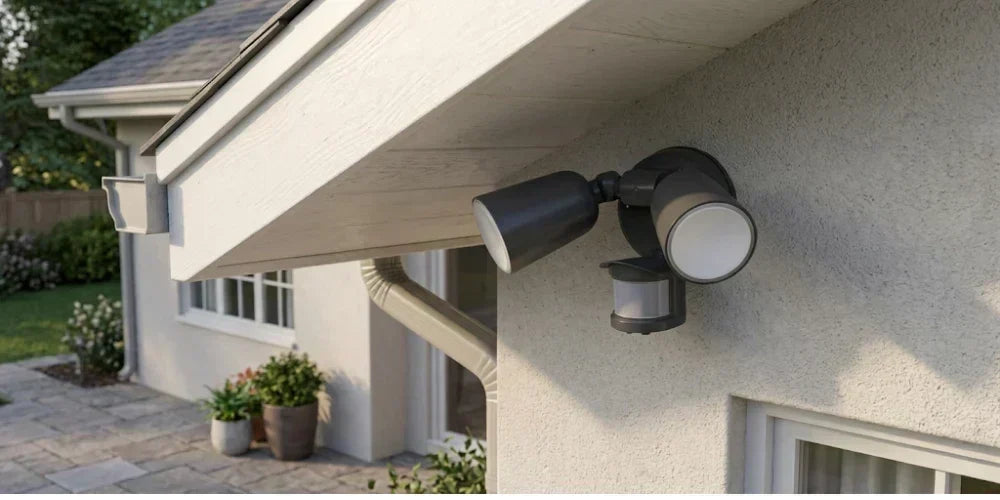
The most direct path to immediate perimeter protection is installing an all-in-one motion sensor floodlight directly onto your eave junction boxes or garage soffit panels. These self-contained assemblies provide exceptional lumen capacity combined with localized automation technology built right into the fixture stem.
[Daytime Hours] ═══► Built-In Photocell Gates Circuit ═══► System Remains Off
[Nighttime/Dusk] ══► Standalone Ambient Mode (10% Low)  ══► Motion Triggers 100% Output
How Modern Photocells Adapt
Premium multi-head LED fixtures—such as commercial-grade outdoor lines from Satco—feature adjustable on-body dials that let you customize how the fixture reacts across two distinct operation styles:
- Standard Motion/Photocell Gating: The integrated dawn-to-dusk photocell automatically deactivates the sensor entirely during daylight hours to preserve energy. At night, the main floodlights remain off until the passive infrared (PIR) lens registers a moving thermal signature, instantly bathing the zone in high-output light.
- Dual-Level Sentry Mode: For high-end architectural appeal, select premium fixtures feature advanced dual-level dimming logic. At dusk, the built-in photocell automatically activates the LED arrays at a dimmed standby level (such as 10% brightness) to provide a soft, stylish accent glow beneath the eaves. The moment the PIR sensor registers motion within its tracking zone, the fixture instantly ramps up to 100% full capacity. Once the customizable timeout window passes (tunable from 1 to 5 minutes), the hardware drops back down to its ambient dimmed state.

Weatherproof Infrastructure Parameters
High-quality outdoor floodlights are engineered from heavy-duty die-cast aluminum housings featuring integrated heat sinks and an explicit IP65 dust- and water-protection rating to survive driving rain beneath structural overhangs. Quality trade designs offer field-adjustable color temperatures (ranging from 3000K soft white up to 5000K daylight) and variable wattage switches to tailor lumen outputs precisely to the pitch of your roofline.

3. Method 2: Dedicated Dusk-to-Dawn Light Fixtures (Continuous Photocell Automation)
For homeowners and property managers who prioritize constant, uninterrupted perimeter security alongside overnight architectural styling, dedicated dusk-to-dawn fixtures are the ideal choice. Instead of waiting for a physical motion trigger or relying on programmed clock schedules, these fixtures utilize a built-in, standalone photocell sensor that measures real-time ambient lux levels.
[Sun Sets / Storm Overhead]  ═══► Ambient Light Drops ═══► Photocell Completes Circuit ═══► Lights turn ON
[Sun Rises / Clear Morning]  ═══► Ambient Light Rises ═══► Photocell Breaks Circuit    ═══► Lights turn OFF
The Power of Constant Illumination
While motion-activated fixtures are excellent for startling potential intruders, they leave your home's exterior dark in between triggers. Continuous photocell fixtures—available in sleek architectural flood lights, step lights, and traditional decorative wall lanterns—ensure your soffits and walls are beautifully illuminated all night long. This constant light barrier eliminates the deep shadows where intruders might hide and ensures your property maintains its premium curb appeal from dusk until dawn.
Rugged, Maintenance-Free Operation
Because these fixtures do not require local Wi-Fi networks, remote control pairings, or geographic coordinate programming, they are incredibly reliable and immune to power outage resets.
- Self-Contained Logic: The integrated photocell sits inside a small, weatherproof window on the fixture body, automatically adjusting to seasonal changes as days naturally lengthen or shorten throughout the year.
- Commercial-Grade Construction: Premium exterior dusk-to-dawn fixtures are engineered with heavy-duty weather-sealed enclosures (frequently featuring IP65 or NEMA 3R wet-location ratings) to withstand constant exposure to rain, wind, and morning condensation beneath the roofline.
- LED Efficiency: Because these fixtures remain active for roughly 10 to 12 hours a night, sourcing versions with integrated LED arrays ensures minimal energy draw and eliminates the hassle of changing burned-out bulbs on high, hard-to-reach eaves.

4. Method 3: Standalone Outdoor Motion Sensors (Retrofitting Existing Fixtures)
If your property already features high-end recessed architectural soffit cans, decorative lanterns, or standard exterior flood housings, you do not need to replace the entire fixture array to gain automated protection. Instead, you can splice a standalone outdoor motion sensor directly into the existing electrical control layout.
The Retrofit Mechanism
Industry-standard external sensors—frequently manufactured by outdoor specialists like RAB Lighting—are engineered to mount directly onto standard weatherproof junction boxes or fixture cluster plates. These advanced standalone components feature a 1/2-inch threaded connection arm that wires inline between your home's raw electrical branch lines and your existing exterior LED lighting array.
Comprehensive Spatial Detection
Top-tier external sensors provide massive tracking grids, matching or exceeding the capabilities of integrated units. High-end standalone sensors offer continuous passive infrared tracking stretching across a wide 160-degree to 360-degree pattern with up to a 50-foot linear detection radius depending on your specific mounting height.
On-Body System Tuning
These standalone automation brains give you full analog control over your existing lighting circuit via intuitive dial pots positioned on the sensor head:
- Hold-Time Adjustment: Sets how long the attached soffit lights stay energized after motion stops (typically adjustable from 10 seconds to 15 minutes).
- Sensing Distance: Tuning this dial modifies the sensitivity of the PIR lens, allowing you to filter out small nocturnal animals or blowing debris while capturing true human motion.
- Photocell Sensitivity: Calibrates the exact ambient darkness level required to arm the motion system, preventing the soffit lights from triggering during overcast afternoons.

5. Method 4: In-Wall Astronomical Timers
For homeowners who prioritize consistent architectural style over immediate reactive motion triggers, an in-wall astronomical timer switch offers a highly reliable automation path. Rather than relying on a line-of-sight sensor that can be tripped by wind or animals, an astronomical timer replaces your interior wall switch and controls the entire soffit circuit using local solar data.
The Solar Tracking Logic
Astronomical timer switches—engineered by control leaders like Tork and Intermatic—feature built-in geographical tracking charts. You simply enter your local coordinates or zip code during initial setup, and the timer automatically calculates the exact sunrise and sunset times for your location every single day of the year.
- Winter Schedule Example: Sunset occurs at 4:45 PM. The timer adjusts internally and automatically switches the soffit lighting circuit ON.
- Summer Schedule Example: Sunset shifts to 8:15 PM. The timer automatically recalibrates and delays circuit activation until the sun drops, preventing energy waste.
Key Performance Benefits
- Set-and-Forget Automation: Because the device syncs automatically to solar movements, it self-adjusts throughout the year as seasonal days lengthen or shorten. It also features automated Daylight Saving Time overrides, eliminating the need to manually reset the clock twice a year.
- Power Failure Safeguards: Premium models incorporate long-life digital backups (utilizing heavy-duty internal capacitors or lithium batteries) to ensure your custom lighting schedules, calendar tracking data, and clock parameters are never lost during an unexpected power outage.
- Custom Security Schedules: You can program the switch to turn your eave downlights on exactly at sunset, then drop them completely off at midnight to conserve power, or enable a random “Vacation Mode” to make the property look occupied while you are away.

6. Method 5: Smart Controls & App-Driven Scheduling
For maximum modern flexibility, smart outdoor lighting platforms let you link your exterior architectural soffit layout directly into your home's Wi-Fi network or smart ecosystems (such as Apple Home, Amazon Alexa, and Google Assistant). Smart automation bridges the gap between different hardware setups using two primary paths:
1. Smart In-Wall Dimming Switches
For permanently hardwired overhead soffit downlights, replacing your standard wall control switch with a smart Wi-Fi dimmer—such as the connected ecosystems from Legrand or Lutron—gives you total wireless authority over the circuit. You can dim the eaves lights down using your phone, group them with indoor lighting zones, or establish complex automation triggers based on real-time web data or mobile geofencing boundaries.
2. Heavy-Duty Smart Outdoor Plugs
If your property utilizes plug-and-play exterior accent lighting, soffit-mounted holiday lighting strings, or landscape pump systems, weather-resistant smart plugs are the perfect fit. Specialized multi-output components from brands like Satco (via the Starfish app) or Legrand deliver specification-grade smart performance:
- Dual Device Management: Features a split dual-receptacle face, allowing you to manage two independent outdoor electronic devices simultaneously from one single-gang wall outlet box.
- Rugged Weatherproof Shell: Built with a rugged, high-impact polypropylene body featuring a wet-location safety rating and spring-loaded waterproof covers to seal the ports against rain and debris.
- Direct Network Pairing: Operating over standard 2.4GHz Wi-Fi frequencies, these smart plugs sync directly to their matching control apps without requiring an expensive separate hub, allowing you to build custom timers and run intricate operational rules.
7. Method 6: Smart LED Floodlight Cameras (Surveillance & Active Deterrence)
The absolute pinnacle of modern high-clearance perimeter automation is the integration of smart LED security floodlights equipped with high-definition surveillance cameras. These advanced bullet-head configurations convert your standard eave boxes or recessed junction boxes into a unified lighting and surveillance outpost.
Active Video Surveillance and Audio Control
Instead of mounting separate, messy wiring lines for cameras and lighting arrays beneath your architectural overhangs, these integrated fixtures pack massive technical infrastructure into a clean, single-gang footprint:
- HD Imaging with Night Vision: Tucked directly beneath the adjustable light heads is a high-definition camera system optimized with a wide viewing angle and built-in infrared (IR) night vision sensors. This allows property owners to stream real-time footage or look back at event history remotely via their smartphones.
- Two-Way Voice Communication: Built-in speaker and microphone modules allow for instant two-way talk streaming from floor level or miles away, letting you speak directly with delivery drivers or warn off trespassers.
- Integrated Safety Sirens: For high-risk areas, modern smart control mobile interfaces provide manual or rule-based remote control of an integrated security siren to startle intruders.
Contractor-Grade Hardware Modularity
Quality smart security camera combinations are engineered with universal mounting frames that adapt cleanly to standard surface-mount or recessed junction boxes beneath the soffits. They typically utilize an adaptable line voltage threshold, operate smoothly across extreme freezing or scorching temperatures, and offer field-selectable color selectors on the housing. Many variations also contain local internal memory card storage slots, which allow for local logging and eliminate the need for mandatory monthly cloud storage subscriptions.

Soffit Automation Method Comparison Matrix
| Automation Method Profile | Best Structural Use Case | Primary Operational Advantage | Aesthetic Influence |
|---|---|---|---|
| Integrated Motion Floodlights | Driveways, garages, and blind corner eaves. | Immediate high-output defense; dual-level sentry dimming modes available. | Delivers functional safety; dual-level dimming adds subtle styling. |
| Dusk-to-Dawn Photocell Fixtures | Front entryways, perimeter pathways, and accent columns. | Continuous all-night security illumination; zero-maintenance analog automation. | Maximizes architectural styling with uninterrupted nocturnal wall-washing. |
| Standalone Outdoor Sensors | Retrofitting premium pre-existing eave downlights. | Up to 360° wide-angle tracking; updates existing fixtures seamlessly. | Completely hidden; preserves clean architectural curb appeal. |
| Astronomical Wall Timers | Hardwired multi-light accent canopy circuits. | Self-adjusts daily to sunrise/sunset; unaffected by false motion trips. | Provides reliable, constant architectural lighting for nighttime accenting. |
| Smart Wireless App Controls | Hardwired eave switch circuits or plug-in accent lines. | Complete voice assistant and phone synchronization; custom remote zoning. | Highly customizable; adjust dimming scenes dynamically to fit any mood. |
| Smart LED Floodlight Cameras | Garage fronts, dark rear perimeters, and key entrance pathways. | Merges 1080p HD recording, two-way talk, and siren alerts. | Consolidates surveillance and high-lumen tunable lights into one single-gang housing. |
Secure and Style Your Property with Bees Lighting
Automating exterior architectural lighting requires heavy-duty control components designed to withstand environmental stress while maintaining precise electrical timing. At Bees Lighting, we carry an extensive, professional stock of exterior automation systems—from dual-level dimming motion sensor floodlights and dusk-to-dawn photocell luminaires to astronomical wall timers and smart Wi-Fi plugs from trusted industry leaders like Satco, RAB, Legrand, and Intermatic. Our solutions help ensure your exterior spaces are beautifully styled, energy-efficient, and secure.
Not sure which lens coverage pattern fits your home's unique eave layout, or selecting the right smart integration switch for a complete multi-zone security renovation? Call our specialized residential automation and lighting support line at 855-303-0665 for tailored product matching, project layout reviews, and volume quotes.


