

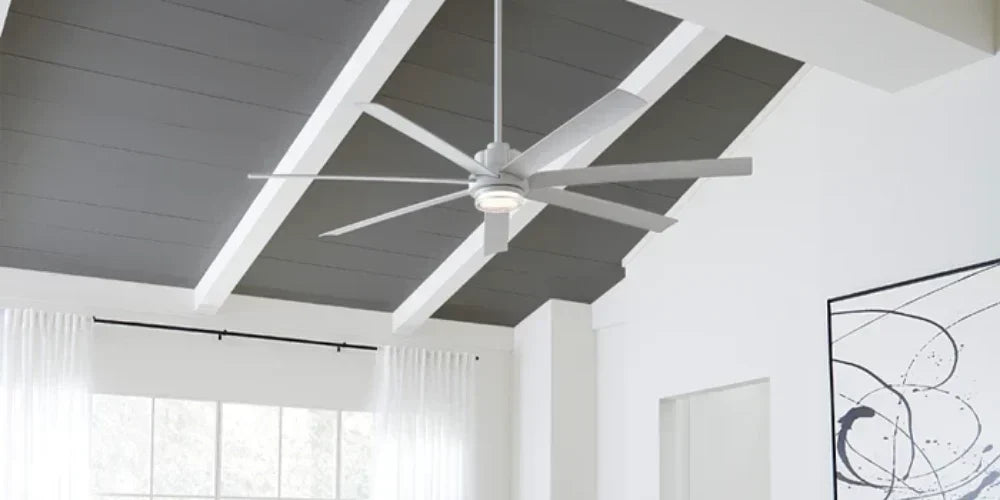
Cooling a massive, open-concept living space presents a unique set of airflow challenges. When homeowners attempt to circulate air in a 400-square-foot great room with a vaulted ceiling, standard 52-inch ceiling fans simply cannot move enough air without spinning at their maximum, most disruptive speed. The result is a noisy, aggressive wind-tunnel effect directly beneath the motor, leaving the corners of the room entirely stagnant and hot.
The ultimate solution to sprawling floor plans and high ceilings is the windmill ceiling fan. Featuring anywhere from 6 to 15 aerodynamic blades, these oversized statement fixtures do more than just anchor a room's aesthetic; they introduce commercial-grade cooling physics into the residential environment. By understanding the mechanics of High-Volume, Low-Speed (HVLS) airflow, you can select the perfect 72-inch or 84-inch ceiling fan to provide a quiet, gentle, and highly efficient downdraft across your entire living space.
⚡ Quick Answer
A windmill ceiling fan utilizes High-Volume, Low-Speed (HVLS) technology to efficiently cool large residential spaces. Unlike standard fans that rely on high-speed rotation, windmill fans use their massive diameter and multiple blades to move a huge volume of air (high CFM) at a very low RPM. This creates a gentle, consistent downdraft throughout a great room without causing a disruptive wind-tunnel effect.
What is HVLS (High-Volume, Low-Speed) Technology?
Originally developed to circulate air in massive agricultural barns and industrial warehouses, HVLS technology has been successfully scaled down and refined for the luxury residential market.
An HVLS fan relies on the sheer physical length and surface area of its blades to push air, rather than relying on rapid motor speed. When a standard 3-blade residential fan spins, it relies entirely on velocity (feet per minute) to create a cooling sensation. In contrast, an HVLS windmill fan prioritizes sheer volume—measured in Cubic Feet per Minute (CFM). Premium manufacturers like Modern Forms and Fanimation have engineered sophisticated residential HVLS ceiling fans equipped with advanced DC motors that can push between 6,000 to over 9,000 CFM while barely looking like they are spinning at all.
The Physics of Windmill Ceiling Fans
Most consumers falsely assume that a "bigger fan" automatically equates to "more aggressive wind." In reality, the exact opposite is true. An oversized windmill ceiling fan provides a much softer, more ambient breeze than a small ceiling fan running on its highest setting.

Why More Blades Doesn't Mean "More Wind" (RPM vs. CFM)
The aerodynamic distribution of an 8-to-15 blade windmill fan fundamentally alters how air is pushed downward. The dense grouping of blades chops the air into much smaller, tighter increments. Because of the physical weight and drag of so many blades, the heavy-duty motor operates at a significantly lower RPM (revolutions per minute).
This slow, deliberate rotation disperses a massive volume of air uniformly across the entire room instead of driving a harsh, concentrated column of wind straight down onto your coffee table. If you are installing a large ceiling fan in a home office or formal living area, this HVLS effect ensures that lightweight papers won't be blown off your desk, while still lowering the perceived temperature of the room by several degrees.
How to Size a Large Ceiling Fan for Open Concept Spaces
Because windmill fans command an immense amount of visual weight, scaling them correctly to your room's square footage is critical. In a massive room with high ceilings, a 72-inch model fills the vertical void beautifully without looking disproportionate.

Sizing for 400+ Square Foot Rooms (60 to 96-inch fans)
For open-concept great rooms, living rooms, and large outdoor patios, use the following sizing matrix to balance blade span with ceiling height. Ensure your chosen fan matches both the horizontal floor space and the vertical drop required for optimal circulation.
| Room Square Footage | Ceiling Height | Recommended Blade Span | Vaulted Downrod Length |
|---|---|---|---|
| 300 - 400 sq. ft. | 9 to 10 feet | 60 to 65 inches | 12 to 18 inches |
| 400 - 600 sq. ft. | 10 to 12 feet | 72 to 84 inches | 24 to 36 inches |
| 600+ sq. ft. | 12+ feet | 84 to 96+ inches | 36 to 48+ inches |
Note: For maximum airflow efficiency and safety, the National Electrical Code (NEC) requires fan blades to sit no lower than 7 feet from the floor. However, in large vaulted great rooms, the optimal performance height for a massive windmill fan is between 8 to 9 feet above the floor. If you are mounting to an angled pitch, review our Sloped Ceiling Fan Guide for adapter compatibility.
💡 BEES LIGHTING PRO TIP
Never install a 72-inch or 84-inch windmill fan on a standard ceiling junction box. Due to the heavy-duty DC motors and the sheer weight of 10+ long blades, these oversized fixtures require a structurally reinforced, fan-rated electrical box securely braced directly to the ceiling joists. Failing to use a heavy-duty bracket can result in severe drywall damage, excessive wobbling, or catastrophic fixture failure.
The Aesthetic Appeal: Farmhouse, Industrial, and Modern Applications
Beyond their exceptional cooling capabilities, windmill fans serve as stunning architectural focal points. While their silhouette is heavily inspired by classic rural water-pumping windmills, modern iterations blend seamlessly into a variety of design styles:
- Modern Farmhouse: Brands like Minka Aire offer weathered oak and oiled bronze finishes that perfectly anchor rustic and modern farmhouse living rooms.
- Industrial Lofts: Matte black and brushed nickel finishes emphasize the mechanical, gear-driven look of the multi-blade hub, making Fanimation models ideal for exposed-ductwork lofts and commercial spaces.
- Transitional Living: Kichler and Visual Comfort provide sleek, swept-blade designs that soften the industrial edge, pairing perfectly with contemporary furniture and neutral palettes.

Many of these massive fixtures also come equipped with advanced, integrated LED light kits. If you are evaluating lighting options for your new fan, be sure to read our comprehensive guide on CCT Selectable Ceiling Fans to ensure your fan's light output perfectly matches the color temperature of your existing recessed cans.
Key Takeaways for Your Project
- Embrace HVLS Cooling: Windmill ceiling fans use High-Volume, Low-Speed technology to move massive amounts of air quietly and gently, eliminating the harsh wind-tunnel effect of smaller fans.
- Size Up for Great Rooms: Rooms exceeding 400 square feet require a minimum blade span of 60 to 72 inches to effectively circulate air into the corners of the space.
- Drop the Fan into the Living Zone: If you have vaulted or cathedral ceilings, use an extended downrod to drop the fan blades down to the optimal 8-to-9-foot height range.
- Upgrade the Junction Box: Always verify that your ceiling electrical box is specifically fan-rated and heavily braced to support the extreme weight and torque of an oversized multi-blade fixture.
Need Expert Help with Your Lighting Design?
Explore our full selection of Windmill Ceiling Fans and Large Ceiling Fans at Bees Lighting, or speak directly with our certified lighting specialists at 855-303-0665 for project quotes, downrod sizing, and technical support.


