

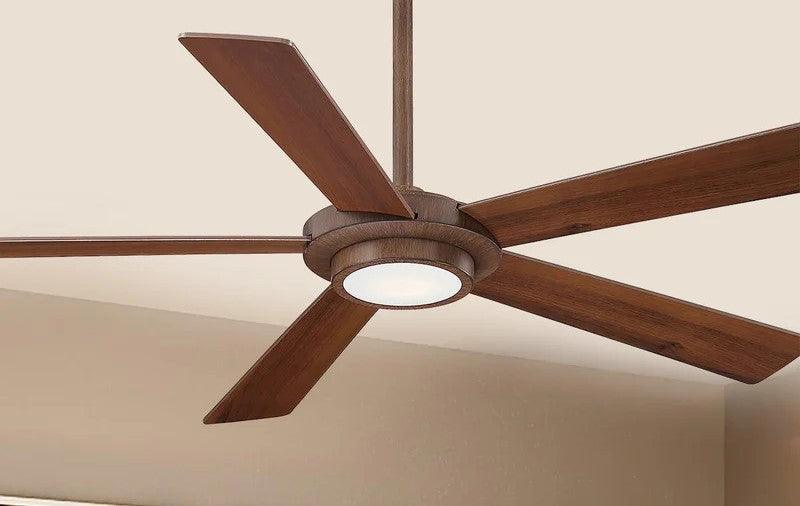
Choosing between an AC and DC motor ceiling fan is a decision between traditional reliability and modern efficiency. While AC motors have been the industry standard for decades, DC motors are revolutionizing the market with silent operation and high torque. High-performance models like the Minka Aire Light Wave F844-CL utilize DC technology to provide six speed settings while using up to 70% less energy. This guide compares the power, control, and cost of AC vs. DC motors to help you choose the best technology for your home's long-term comfort.

The Standard: AC (Alternating Current) Motors
AC motors connect directly to your home's power source. They are the most common motor type for traditional ceiling fans and are prized for their simplicity and longevity.
- Reliability: AC motors have fewer electronic components, making them incredibly durable over decades of use.
- Control: Typically limited to three speeds (Low, Medium, High).
- Reverse Function: Usually requires a manual slide switch on the motor housing.
The Innovation: DC (Direct Current) Motors
DC motors use an internal transformer to convert AC power to Direct Current. According to technical data from Minka Aire and Fanimation, this allows for much more precise control over the motor's magnetic field.
- Efficiency: DC motors are up to 70% more energy-efficient than standard AC motors.
- Speeds: Most modern DC fans offer six distinct speed settings.
- Silent Operation: Because they run cooler and with higher torque, DC motors are virtually silent, making them ideal for bedrooms.
AC vs. DC Motor Comparison Table
| Feature | AC Motor Fan | DC Motor Fan |
| Energy Consumption | Standard (Average 60W) | Very Low (Average 15W - 30W) |
| Speed Settings | 3 Speeds | 6 Speeds |
| Reverse Function | Manual Switch | Remote or App Controlled |
| Motor Noise | Minimal Hum | Virtually Silent |
| Design Profile | Larger Housing | Slim, Sculptural Silhouette |
| Smart Integration | Optional (Hub required) | Often Built-in |
High-Torque Performance in Large Spaces
For large ceiling fans or industrial applications, DC motors are the superior choice. The high torque generated by a DC motor allows it to spin massive 84-inch or 96-inch blades with ease, maintaining a consistent fan direction and high-CFM airflow without the motor overheating.

Making Your Choice
If you want a traditional, budget-friendly fan for a guest room, an AC motor is a reliable choice. However, for primary living areas where quiet operation, energy efficiency, and remote convenience are priorities, a DC motor fan like the Minka Aire Light Wave F844-CL is the clear winner. DC motors are also the foundation of every smart ceiling fan — if app control, voice commands, and scheduling are on your wish list, a DC-motor model is the only path. For fans with integrated LED light kits, browse our ceiling fans with lights collection for options across both motor types.
Shop our full selection of AC and DC Ceiling Fans today or call 855-303-0665 for expert technical advice.


