

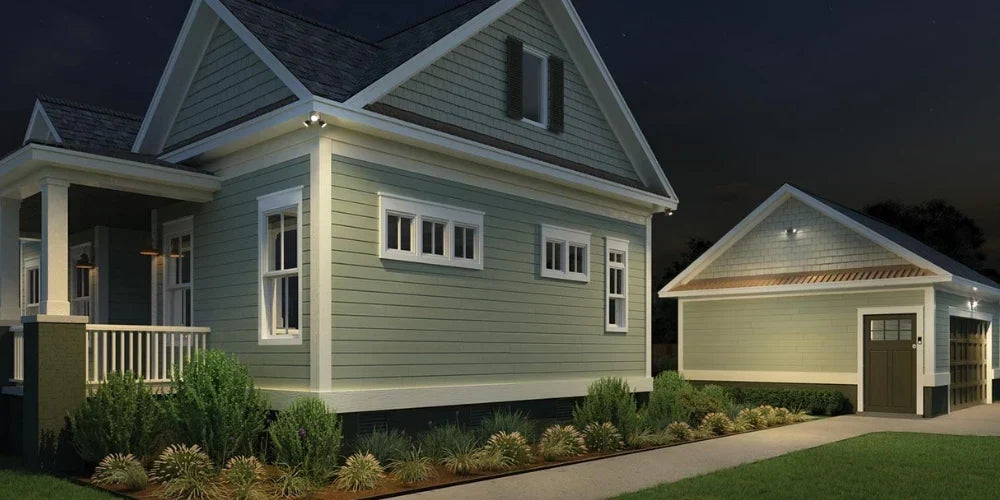
Automating your exterior security lighting is the most effective way to protect your property without relying on manual wall switches. However, successfully deploying an automated perimeter requires understanding the specific sensing technologies that trigger the lights. A common frustration among homeowners and facility managers is installing a brand new LED security light, only to discover it flashing on and off all night like a strobe light. When this happens, property owners immediately assume the fixture is defective or the internal wiring has failed.
In reality, endless flashing and false triggers are rarely caused by a broken fixture. They are almost always the result of a misaligned sensor or a fundamental misunderstanding of how ambient lux detection and thermal tracking actually work. By understanding the physics behind a dusk-to-dawn photocell and a Passive Infrared (PIR) motion sensor, you can permanently solve the notorious "Strobe Effect," eliminate false triggers, and cast a reliable net of illumination over your property.
⚡ Quick Answer
The main difference between a dusk-to-dawn floodlight and a motion sensor floodlight is how they are triggered. A dusk-to-dawn light uses a photocell to measure ambient sunlight (lux), automatically turning the fixture on at sunset and off at sunrise for continuous overnight illumination. A motion sensor light uses Passive Infrared (PIR) technology to detect sudden changes in heat signatures across a grid, turning the light on only when a person or vehicle enters the security zone.
Active vs. Passive Deterrence in Security Lighting
Before specifying hardware, you must decide what behavioral outcome you want to achieve. Security lighting is divided into two distinct strategies:
- Passive Deterrence (Photocells): Provides continuous, all-night illumination. This eliminates dark hiding spots around a building perimeter and ensures security cameras capture clear footage at all hours.
- Active Deterrence (PIR Motion): Relies on the element of surprise. The sudden, blinding blast of a high-lumen floodlight instantly startles an intruder, signaling that they have been detected.
If you are trying to differentiate between active exterior floodlighting and passive architectural washing for a residential property, review our companion guide on Soffit Lighting 101: How to Automate Your Home’s Security & Style. For aggressive perimeter defense, you must rely on LED flood lights equipped with the correct environmental sensors. For a broader overview of fixture types and perimeter strategies, see our guide to types of outdoor security lighting.
What is a Dusk-to-Dawn Photocell? (Ambient Lux Detection)
A photocell is a light-sensitive resistor that constantly measures the ambient lux (sunlight) levels in its immediate environment. When the sun sets and the lux drops below a specific threshold, the photocell allows high-voltage current to flow to the LED driver, turning the light on. When the sun rises, the resistance changes, cutting the power.

Solving the "Strobe Effect": Why Your Light Keeps Flashing
The most notorious problem with photocell dusk-to-dawn light fixtures is the "Strobe Effect." This occurs when a high-output floodlight is mounted too close to a highly reflective surface, such as a white siding wall or a deep, bright eave.
The Strobing Loop Explained:
- The sun goes down, and the photocell correctly turns the floodlight ON.
- The intense LED light bounces off the adjacent white wall or soffit and reflects directly back into the photocell's sensor eye.
- The photocell registers this reflected light, assumes the sun has come up, and turns the fixture OFF.
- With the light off, the environment goes dark again. The photocell registers the darkness and turns the fixture back ON.
- This loop repeats infinitely, causing a rapid, annoying strobe effect.
The Danger of Streetlights and Reflected Soffit Glare
To prevent the strobe effect, you must specify fixtures with adjustable or shielded photocell eyes. For instance, the RAB Lighting L2X Field-Adjustable Floodlight features an intelligently positioned on/off photocell that operates smoothly without self-blinding. If you are retrofitting a fixture under a deep eave, physically rotate the floodlight heads away from the wall to ensure the light pool cannot reflect back into the sensor base.
What is a PIR Motion Sensor? (Heat Signature Grids)
Passive Infrared (PIR) sensors do not "see" physical movement; they track thermal energy. A PIR sensor projects an invisible, segmented grid across a designated zone. It monitors the baseline background temperature of the concrete or grass. When a heat signature that differs from the baseline (like a 98-degree human or a warm car engine) crosses from one segment of the grid into another, it trips the electrical relay and blasts the motion sensor flood lights to full brightness.

Preventing False Triggers from HVAC Exhaust and Wind
Because PIR sensors track heat differentials, they are highly susceptible to false triggers if positioned incorrectly.
- HVAC Units: Never point a PIR sensor directly at an air conditioner compressor or dryer vent. The sudden blast of hot exhaust air crossing the sensor grid will continuously trigger the light.
- Wind and Foliage: While wind itself does not have a heat signature, violent wind blowing a sun-warmed tree branch rapidly across the sensor grid can mimic human movement.
Premium manufacturers solve this with precision sensitivity dials. The RAB LU160 Luminator and the RAB LF17 Field-Adjustable Floodlight (when equipped with the SMS500 Sensor) feature heavy-duty PIR sensors with up to 180-degree detection ranges. Crucially, they include dedicated dials to adjust the sensitivity (SENS) distance and the time-delay (TIME) hold settings, allowing you to easily tune out swaying bushes or distant passing cars.
Can You Use a Photocell and a Motion Sensor Together?
Absolutely. In fact, combining both technologies is the gold standard for high-end perimeter security. If a fixture only had a motion sensor, it would waste electricity by triggering every time the mailman walked by in the middle of a bright, sunny afternoon.
By integrating both, the photocell acts as a "gatekeeper." During the day, the photocell locks out the PIR sensor. When dusk falls, the photocell arms the PIR system, allowing it to blast light only when motion is detected at night.

Top-tier fixtures such as the RAB SMSBULLET, RAB LU160 Luminator, and RAB LF17 all come equipped with integrated photocells directly alongside their PIR motion sensors, delivering out-of-the-box dual functionality. Similarly, Satco|Nuvo executes this brilliantly with their Dual Head Security Lights. Available in both Square and Bullet head profiles, these IP65-rated fixtures integrate a 180-degree PIR motion sensor with a dusk-to-dawn photocell. They even feature an adjustable CCT switch (3000K/4000K/5000K), allowing contractors to match the color temperature to the surrounding architectural lighting.
Security Sensor & Fixture Application Matrix
| Technology | Trigger Mechanism | Primary Application |
|---|---|---|
| Photocell (Dusk-to-Dawn) | Ambient Light (Lux) | Passive, continuous overnight washing of dark perimeters and loading docks. |
| PIR Motion Sensor Only | Infrared Heat Differentials | Active deterrence over driveways where ambient light is already present. |
| Dual-Tech (PIR + Photocell) | Heat (Gated by Darkness) | High-traffic zones requiring targeted blasts only at night. |
💡 BEES LIGHTING PRO TIP
When installing a PIR motion sensor, aim the sensor head so that expected traffic (like a person walking down a driveway) walks across the detection grid rather than directly toward it. Passive Infrared sensors are significantly more responsive to lateral movement, ensuring the floodlights trigger immediately as an intruder steps onto your property.
Key Takeaways for Your Project
- Identify the Strobe Effect: If your dusk-to-dawn light flashes constantly, it is likely blinding itself. Re-aim the LED heads away from reflective white walls and soffits so the light does not bounce back into the photocell.
- Respect the Heat Grid: Keep PIR motion sensors aimed away from HVAC vents, pool heaters, and heavy foliage to prevent hot air or sun-warmed branches from causing false triggers.
- Combine for Efficiency: Utilize fixtures that integrate both a photocell and a PIR sensor (like the RAB SMSBULLET or Satco|Nuvo Security series) to ensure the motion detection is strictly armed only after sunset.
- Invest in Adjustability: Specifying fixtures with physical sensitivity (SENS) and hold-time (TIME) dials allows you to perfectly calibrate the detection zone to your specific driveway or yard.
Need Expert Help with Your Lighting Design?
Explore our full selection of heavy-duty LED Security Lights and security sensors at Bees Lighting, or speak directly with our certified commercial lighting specialists at 855-303-0665 for project quotes, troubleshooting assistance, and technical support.


