

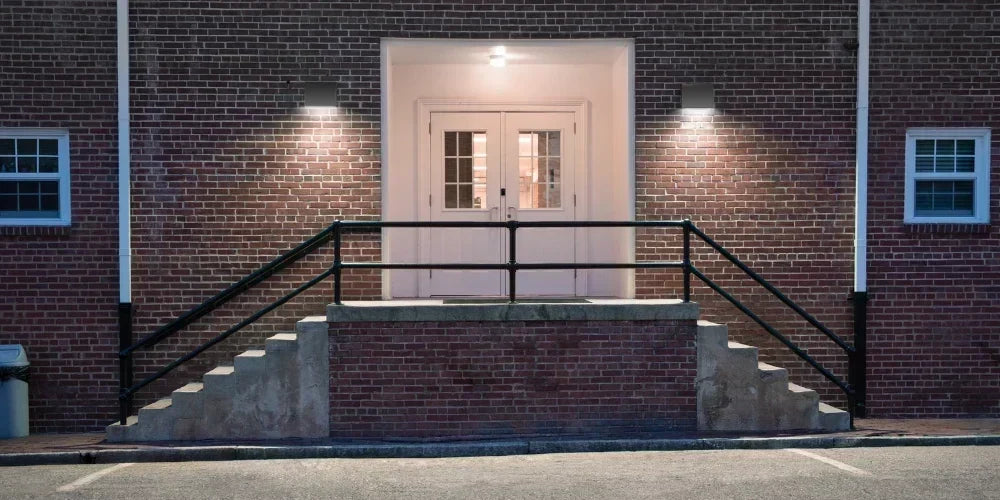
When facility managers or security-conscious homeowners decide they need "security lights" to protect a property, they often default to purchasing a generic twin-head motion fixture. However, true perimeter defense goes far beyond a single sensor. The best security lights for commercial buildings and high-end residential properties are part of an engineered, multi-layered architectural system designed to eliminate blind spots, deter intruders, and provide safe nighttime navigation.
To build an effective layout, you must shift your focus from mere aesthetics to architectural utility. Every outdoor lighting fixture is categorized by its specific NEMA light distribution pattern (how the beam spreads) and its mounting location (facade, pole, or ceiling plenum). By understanding how and where to deploy the different structural sub-types of outdoor security fixtures, you can cast the perfect net of illumination across your entire property without causing light trespass or blinding your neighbors.
⚡ Quick Answer
Security lighting is divided into specific structural types based on light distribution and mounting location. Wall packs wash building perimeters with light, area lights illuminate large open spaces like parking lots, canopy lights secure covered structures, and floodlights provide targeted, directional beams. These foundational fixtures are then paired with control technologies, such as dusk-to-dawn photocells for continuous all-night illumination or motion sensors for active deterrence.
What is Security Lighting? (Deterrence vs. Detection)
Security lighting serves two distinct purposes: deterrence (preventing a crime before it happens by eliminating dark hiding spots) and detection (alerting occupants or security cameras that movement has occurred).
Achieving both goals requires matching the right fixture housing to the right application. For example, a fixture designed to cast a wide, circular beam down from a high ceiling (NEMA Type V) will perform terribly if mounted to the side of a building. Understanding the four core structural types of lighting will ensure your lumens are pushed exactly where they are needed.
The 4 Core Structural Types of Security Lights
1. Wall Packs (Building Perimeter & Facade Washing)
Wall packs are the heavy-duty workhorses of commercial perimeter lighting. Mounted directly to the exterior brick, concrete, or siding of a building, wall pack lights are engineered to push light outward and downward (known as a "forward throw" or NEMA Type IV distribution). This creates a secure, brilliantly illuminated perimeter ring around the immediate footprint of the structure.
Premium manufacturers like RAB Lighting offer advanced solutions like the WPX and W22 Field-Adjustable Wall Packs, which allow installers to toggle between multiple wattage and color temperature (CCT) settings on the fly. This flexibility makes them ideal for upgrading old metal halide fixtures while tailoring the exact lumen output to the size of the walkway below.

2. Floodlights (Directional Targeting & Knuckle Mounts)
While wall packs wash a broad area, floodlights are essentially architectural spotlights designed to target specific zones. They are typically mounted on adjustable knuckles, trunnions, or yokes, allowing you to manually aim the beam precisely at a vulnerability—such as an alleyway, a dumpster enclosure, or a dark property line.
LEDVANCE has revolutionized this category with their Opti-Select Floodlight, which features a physical switch that alters the internal optics to seamlessly toggle the beam spread between Narrow, Medium, and Wide angles. For high-end residential and light commercial use, the Satco | Nuvo Security Flood Lights feature fully articulating twin heads that can be aimed in separate directions to blanket a wide driveway or loading dock.

3. Area Lights / Shoeboxes (Parking Lots & Open Spaces)
If you need to secure a vast, open expanse like a commercial parking lot, car dealership, or sprawling corporate campus, wall packs will not push light far enough. You need area lights (historically called shoebox fixtures).
Mounted on top of 15 to 30-foot steel or aluminum poles, area lights utilize NEMA Type III (roadway) or Type V (circular) optics to cast massive, uniform grids of light across the pavement. Brands like Keystone Technologies and RAB Lighting (such as the A17, A22, and A34 series) offer ultra-efficient area lights that replace legacy 400W and 1000W metal halide fixtures, vastly improving security camera visibility while slashing energy consumption.

4. Canopy Lights (Parking Garages, Drive-Thrus, & Overhangs)
Covered exterior spaces present a unique security challenge because the ceiling plenum traps shadows. Canopy lights are specifically engineered to mount flush against the underside of parking garages, gas station overhangs, and drive-thru awnings.
Because ceiling heights in these structures vary wildly, the LEDVANCE Dual Beam Canopy fixture is an industry favorite. It delivers two completely different beam spreads from a single luminaire without requiring a lens swap, ensuring the concrete floor below is safely illuminated without causing blinding glare to drivers navigating the structure.

Security Lighting Application Matrix
Understanding which structural housing pairs with your architectural needs is the key to passing electrical codes and municipal light ordinances.
| Fixture Type | Primary Application | Typical Mounting Height | Optimal NEMA Distribution |
|---|---|---|---|
| Wall Pack | Building facades, walkways, loading doors. | 10 to 20 Feet | Type III or Type IV (Forward Throw) |
| Floodlight | Alleyways, signage, specific gates/vulnerabilities. | Variable (Ground to Roof) | Type 6x6 or Field-Adjustable |
| Area Light | Parking lots, corporate campuses, roadways. | 15 to 30+ Feet | Type III (Wide) or Type V (Circular) |
| Canopy Light | Parking garages, gas stations, drive-thrus. | 9 to 15 Feet | Type V (Symmetric Downward) |
💡 BEES LIGHTING PRO TIP
When wiring exterior floodlights via high-voltage lines, never point an adjustable floodlight outward near a property line without checking local light trespass ordinances. Angling a high-lumen fixture upward can blind passing drivers or flood a neighbor's window. Always aim adjustable floodlights downward at a steep angle, or utilize a fixed full-cutoff wall pack to ensure the light stays strictly on your property.
The 2 Core Control Technologies
The structural hardware is only half the equation. To maximize energy efficiency and behavioral deterrence, these fixtures must be integrated with intelligent control technologies.
Outdoor Motion Detection (Active Security)
Active detection relies on outdoor motion sensors to instantly startle intruders. When movement is detected, the sudden blast of high-lumen light alerts property owners and triggers security camera recordings.
For advanced perimeter defense, Satco | Nuvo offers an incredible PIR (Passive Infrared) sensor configuration on their dual-head security floods. It features an integrated "Sentry Light" mode. During normal nighttime operation, the center of the fixture emits a low, ambient glow (3W / 108 lumens). The moment the 180-degree sensor detects motion across its 42-foot range, the massive primary floodlights instantly blaze to full brightness.

Dusk to Dawn Area Lights (Passive Security)
For properties that require guaranteed, uninterrupted illumination (such as commercial parking lots or multi-family housing complexes), passive security controls are mandatory. These fixtures feature integrated photocell sensors that monitor ambient solar UV levels. When the sun sets, the photocell automatically engages the electrical wiring to power the fixture, and automatically shuts it off at sunrise—ensuring your perimeter is never left vulnerable due to a forgotten wall switch.

Integrating Fixture Types for a Complete Perimeter Defense Plan
- Match the Fixture to the Zone: Use wall packs for building perimeters, area lights for massive open parking lots, canopy lights for covered garages, and floodlights for highly targeted directional beams.
- Control Light Trespass: Utilize full-cutoff optics and downward-angled mounts to keep high-lumen lighting contained within your property lines.
- Deploy Active Deterrence: Integrate PIR or Microwave motion sensors on key entryways and blind spots to startle intruders.
- Automate Your Perimeter: Specify fixtures with built-in photocells (Dusk-to-Dawn) to guarantee your facility remains illuminated all night without manual intervention.
Need Expert Help with Your Lighting Design?
Explore our massive inventory of commercial-grade Outdoor Security Lights and area fixtures at Bees Lighting, or speak directly with our certified lighting specialists at 855-303-0665 for project quotes, photometric layouts, and technical support.


