

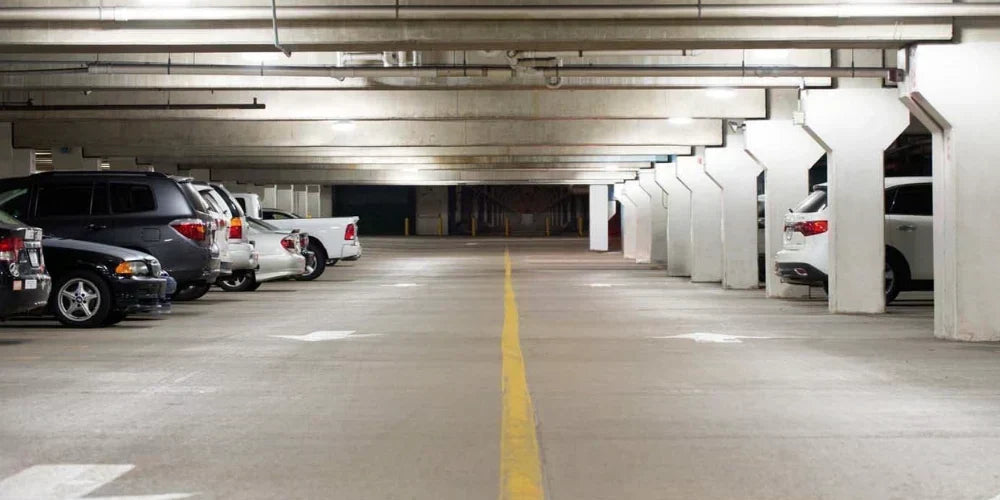
Illuminating a multi-level parking garage or enclosed parking deck is one of the most mechanically demanding challenges in commercial lighting design. Facility managers are forced to operate in a hostile environment: concrete ceilings create incredibly low vertical clearances, vehicle exhaust and moisture mandate heavy-duty environmental sealing, and isolated stairwells make the fixtures prime targets for vandalism. When you install standard, bulky lighting fixtures in these spaces, it is only a matter of time before a delivery truck clips the housing or someone shatters the glass lens.
To survive in a parking structure, your lighting infrastructure must be engineered specifically for the enclosed concrete environment. This requires shifting away from generic high bays and surface-mount boxes and instead specifying heavy-duty, low-profile canopy lights. By understanding structural impact ratings (IK codes), low-profile geometry, wide beam angles, and advanced microwave motion sensing, you can deploy a lighting layout that maximizes vertical clearance, eliminates oppressive shadows, and actively deters vandalism. For a broader look at how canopy lights fit into a complete perimeter defense strategy, see our guide on the types of outdoor security lighting.
⚡ Quick Answer
The best LED lighting for a low-clearance parking garage is a low-profile canopy light equipped with a polycarbonate lens and an ultra-wide beam angle (150° to 160°). Because enclosed parking decks have strict vertical height limits, a low-profile fixture (measuring less than 4 inches thick) prevents accidental strikes from tall vehicles and delivery trucks. Additionally, you should specify fixtures with an IK08 or IK10 impact rating to ensure the housing and lens can withstand severe physical impacts and vandalism without shattering.
The Parking Structure Challenge: Glare, Clearance, and Vandalism
Parking garages run 24 hours a day, 7 days a week, consuming massive amounts of electricity. Because they are often fully or partially enclosed, the structural concrete blocks out natural daylight, forcing the artificial lighting to do all the heavy lifting. The primary challenges electrical contractors face when specifying these fixtures are:
- Vertical Clearance: Standard fixtures hang too low, making them easy targets for the roofs of delivery vans, lifted SUVs, and moving trucks navigating tight ramps.
- Impact Damage: Because ceilings are low, the fixtures are physically accessible to pedestrians, making them highly susceptible to intentional vandalism and blunt-force trauma.
- The "Cave Effect": Standard downlights create dark, shadowy ceilings that make the garage feel claustrophobic, unsafe, and visually oppressive.
- Poor Light Spacing: Incorrect beam angles cause harsh "hot spots" of light directly under the fixture with dark, dangerous shadows between columns.

Maximizing Headroom with Low-Profile Canopy Lights
The first line of defense against vehicle strikes is geometry. By specifying a low-profile canopy light, you maximize the vertical clearance of the driving lanes without having to alter the facility's structural concrete or electrical wiring.
Premium manufacturers like RAB Lighting have engineered specific garage profiles designed to hug the concrete. The RAB PARK34 Economy Garage Light boasts a super-low profile, standing just 3.6 inches off the ceiling, giving SUVs and roof racks maximum breathing room. Similarly, the RAB PORTO Field-Adjustable Garage Light measures just over 4 inches thick while delivering massive lumen output. By keeping the fixture flush against the mounting surface, you drastically reduce the physical footprint vulnerable to vehicular clipping.

Understanding the IK Impact Rating Scale (IK08 vs. IK10)
While IP (Ingress Protection) ratings measure a fixture's defense against water and dust, the IK Impact Rating measures its resistance to kinetic force and blunt trauma. If a fixture is going into an unsupervised parking garage, checking the IK rating on the manufacturer's spec sheet is mandatory.
Why Polycarbonate Lenses Beat Glass in Parking Decks
To achieve high IK ratings, commercial canopy lights completely abandon traditional glass lenses—which can shatter into hazardous shards—in favor of high-transmission, UV-stabilized polycarbonate.
Keystone Technologies utilizes heavy-duty polycarbonate diffusers on their Square Canopy fixtures to ensure long-lasting impact resistance. RAB Lighting specifically engineered the VAN Field-Adjustable Canopy Light to carry a certified IK08 Rating, meaning it can survive the equivalent of a 1.7kg steel ball dropped from 300mm without cracking or exposing the internal LED diodes.
| IK Rating | Impact Energy (Joules) | Real-World Equivalent Mass & Drop Height | Ideal Application |
|---|---|---|---|
| IK05 | 0.70 Joules | 0.25 kg dropped from 280 mm | Light commercial walkways and elevated awnings. |
| IK08 | 5.00 Joules | 1.70 kg dropped from 300 mm | RAB VAN Canopy / Standard parking garages. |
| IK10 | 20.00 Joules | 5.00 kg dropped from 400 mm | High-risk vandalism areas, heavy industrial transit bays. |
Optical Engineering: The Optimal Beam Angle for Garages
A frequent mistake when outfitting a parking structure is specifying narrow-beam fixtures (like 110-degree spots) intended for high-clearance canopies. In an enclosed parking deck where the ceiling is only 8 to 10 feet high, a narrow beam cannot spread out fast enough, resulting in isolated pools of blinding light and vast expanses of darkness.
For low-clearance parking garages, the optimal beam angle is highly expansive—typically 150° to 160°. This ultra-wide distribution pushes the light laterally across the driving lanes, allowing you to space the fixtures further apart while still maintaining smooth, overlapping illumination.

Manufacturers have adapted to this need beautifully and offer versatile solutions. The RAB VAN Field-Adjustable Canopy Light features a convenient internal switch that allows installers to quickly toggle between a tighter 98-degree canopy distribution and a wide 155-degree garage spread right on the job site. Alternatively, the LEDVANCE Performance Class Dual Beam Canopy/Garage luminaire simplifies the process entirely; its groundbreaking optical technology meets both garage and canopy spread requirements simultaneously with no adjustment switches or lens swaps needed. For those who prefer physical modularity, the Keystone Optic Swap Round Canopy ships with a 160° lens pre-installed specifically for sweeping garage coverage, while also including a 110° lens in the box for alternative applications.
Glare Reduction: Up-Light Features to Eliminate the "Cave Effect"
One of the most frequent complaints in multi-level garages is the "Cave Effect." When a canopy fixture pushes 100% of its light straight down to the floor, the concrete ceiling above remains pitch black. This stark contrast creates severe glare for drivers and makes the space feel confined and dangerous.
Modern garage lighting solves this by intentionally bleeding a small percentage of light upward to softly wash the concrete ceiling, significantly improving the ambient visual comfort.
- The RAB PARK34 and RAB PORTO are precision-engineered to deliver 10% to 14% uplight, effectively eliminating dark overhead spots.
- The LEDVANCE Dual Beam Canopy/Garage luminaire takes this a step further, featuring a distinct embedded uplight explicitly designed to minimize the cave effect alongside its primary downward beam.

Automating 24/7 Energy Savings with Integrated Microwave Sensors
Because parking garages operate constantly, leaving them at 100% brightness when no cars are present is a massive waste of electricity. The solution is integrating occupancy sensors. However, traditional PIR (Passive Infrared) sensors often fail in parking structures because they require a direct line of sight to detect heat signatures—something easily blocked by concrete pillars and parked cars.
The superior choice for parking decks is a Microwave Sensor. These sensors emit continuous microwave pulses that can penetrate glass, dust, and thin obstacles, easily detecting a moving vehicle long before it rounds the corner.

Keystone Technologies utilizes a brilliant "Hidden Sensor Placement" inside their Canopy fixtures, keeping the microwave sensors tucked securely behind the polycarbonate lens to make them 100% resistant to tampering while maintaining a sleek architectural profile.
💡 BEES LIGHTING PRO TIP
If you specify canopy lights with integrated microwave sensors, be prepared to adjust the sensitivity dials during commissioning. Because microwave pulses can penetrate thin materials, a sensor set to maximum sensitivity might accidentally trigger when pedestrians walk on the sidewalk outside the garage or on the floor directly above the fixture.
Key Takeaways for Your Project
- Maximize Clearance: Use low-profile fixtures (under 4 inches thick) like the RAB PARK34 to prevent tall vehicles from clipping the hardware.
- Demand High IK Ratings: Specify fixtures with IK08 or IK10 impact ratings and polycarbonate lenses to survive vandalism and blunt force trauma.
- Go Wide on Beam Angles: Use an ultra-wide 150° to 160° beam angle to effectively spread light across low-ceiling environments, utilizing adjustable optics like the RAB VAN or LEDVANCE Dual Beam for perfect coverage.
- Eliminate the Cave Effect: Choose canopy lights that offer 10% to 15% uplight to wash the concrete ceiling and reduce claustrophobic shadows.
- Use Hidden Microwave Sensors: Deploy microwave motion sensors housed internally behind the lens to detect vehicles early while preventing physical tampering by vandals.
Need Expert Help with Your Lighting Design?
Explore our full selection of heavy-duty Parking Garage Canopy Lights at Bees Lighting, or speak directly with our certified commercial lighting specialists at 855-303-0665 for project quotes, photometric compliance layouts, and technical support.


