

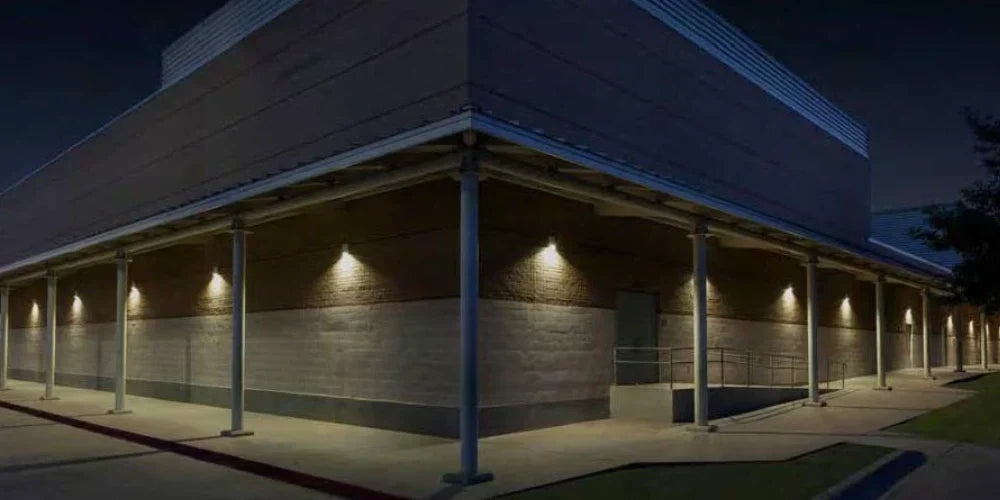
It is a common and expensive nightmare for commercial electrical contractors: you finish outfitting the perimeter of a new warehouse with high-lumen exterior fixtures, only for a city code inspector to fail the job because the lighting causes "light trespass" onto an adjacent residential street. As municipalities and HOAs become increasingly aggressive about controlling light pollution, simply mounting the brightest fixture possible to an exterior wall and running the electrical wiring is a guaranteed recipe for failed inspections and angry neighbors.
To navigate strict city zoning laws and pass inspection, you must understand how a fixture manages its upward light distribution. The Illuminating Engineering Society of North America (IESNA) has established strict photometric classifications—specifically forward throw (non-cutoff), semi-cutoff, and full cutoff—to dictate exactly how much light is permitted to escape into the night sky. By understanding the optics and limitations of each wall pack category, you can illuminate your commercial footprint perfectly while keeping your lumens strictly on your side of the property line. To understand how these fixtures fit into a broader perimeter defense plan, explore our comprehensive guide on the Types of Outdoor Security Lighting.
⚡ Quick Answer
The difference between full cutoff, semi-cutoff, and forward throw wall packs lies in their upward light distribution. Forward throw (non-cutoff) wall packs use prismatic lenses to project light outward with no uplight restriction. Semi-cutoff wall packs restrict uplight to a maximum of 5 percent, balancing forward reach with moderate glare control. Full cutoff wall packs use shielded, downward-facing optics that allow strictly zero percent (0%) uplight, making them fully Dark Sky compliant and eliminating light trespass into neighboring properties.
The Light Trespass Problem & IESNA Classifications
When a municipal code enforcement officer issues a citation for light trespass, it means the artificial illumination generated by your commercial facility is bleeding across your physical property boundary. This errant light can create hazardous glare for passing motorists or shine obnoxiously into residential bedroom windows.
To solve light trespass, lighting engineers rely on the IESNA classification system, which evaluates a fixture's photometric performance relative to the 90-degree horizontal plane (an imaginary flat line extending straight out from the fixture's lens parallel to the ground). The classification of your wall pack lights is determined entirely by what percentage of its total lumen output crosses above that 90-degree line into the sky.
Forward Throw (Non-Cutoff) Wall Packs Explained
Forward throw, or "standard non-cutoff," is the traditional, classic shape of a commercial wall pack. These fixtures are designed to push light aggressively outward and downward, creating a massive footprint of illumination.

Prismatic Glass and Maximum Beam Spread for Industrial Yards
Because forward throw fixtures have absolutely no restriction on upward light distribution, they typically utilize heavy, molded prismatic glass lenses to scatter the LED light in a wide arc. While this makes them exceptionally efficient at lighting expansive, isolated industrial loading docks or sprawling rural parking lots, it also creates severe sky glow and high-angle glare.

If you are lighting a secure, industrial-zoned facility, standard non-cutoff fixtures are a highly economical choice. Premium examples include the RAB WP123 Field-Adjustable Wall Pack, the ultra-durable RAB WPX Premium Series, and the LEDVANCE Performance Class Non-Cutoff Wall Pack. These fixtures deliver massive lumens, but if your facility shares a border with a residential subdivision, installing them will almost certainly trigger a light trespass complaint.
Semi-Cutoff Wall Packs Explained
Semi-cutoff fixtures represent the middle-ground compromise in architectural lighting design. They maintain the recognizable angled profile of a traditional wall pack but introduce structural shielding to limit how much light escapes upward.
The 5% Uplight Rule: Balancing Glare Control and Forward Reach
By strict IESNA definition, a semi-cutoff wall pack permits a maximum of 5% of its total lumen output to emit at or above the 90-degree horizontal plane. This minor restriction offers a significant reduction in blinding glare compared to a non-cutoff fixture, while still allowing the beam to reach far out into the parking lot.

The Satco|Nuvo Field Selectable Semi-Cutoff Wall Pack perfectly illustrates this balance. It utilizes a durable impact-resistant polycarbonate lens encased in a bronze die-cast housing that restricts excessive upward spill while maintaining a broad forward light spread. Semi-cutoff optics are frequently deployed around mixed-use commercial complexes, school perimeters, and hospital campuses where managers need extended forward visibility without completely washing out the night sky.

Full Cutoff Wall Packs Explained (Dark Sky Compliance)
When local ordinances mandate "Dark Sky Compliance" or explicitly prohibit light trespass, the full cutoff wall pack is your only legal option. These fixtures feature a flat, recessed LED array shielded by a solid metal hood or visor.
The 0% Uplight Rule: Shielding for Urban & HOA Perimeters
A true full cutoff wall pack directs 100% of its light downward, emitting strictly 0% light at or above the 90-degree horizontal plane. Because no light escapes sideways or upward, the light pool stops sharply at the ground. This instantly solves the inspector's light trespass objection, making them the mandatory choice for tight urban alleyways, HOA borders, and properties directly adjacent to residential streets.

RAB Lighting sets the gold standard here with their LPACK WPLEDS and WPLEDM Field-Adjustable Wall Packs, offering zero uplight alongside field-selectable wattage and color temperatures. Similarly, the LEDVANCE Opti-Select Cutoff Wall Pack provides unmatched precision with a fully shielded, Dark Sky Approved design that eliminates uplight entirely while allowing installers to toggle between Type II, Type III, and Type IV distribution patterns right on the fixture without swapping lenses. For a deeper understanding of these regulations, read our article on The Importance of Dark Sky Outdoor Lighting.

Wall Pack Photometric Distribution Matrix
| Cutoff Classification | Uplight Allowance (Above 90°) | Glare Control Profile | Ideal Architectural Application |
|---|---|---|---|
| Forward Throw (Non-Cutoff) | No restriction (Significant uplight) | Low | Expansive industrial yards, isolated commercial loading docks. |
| Semi-Cutoff | Maximum 5% of total lumens | Moderate | Mixed-use commercial complexes, school perimeters, retail storefronts. |
| Full Cutoff | Strictly 0% (No uplight permitted) | Maximum (Dark Sky Compliant) | Tight urban facades, HOA borders, and strict light-trespass zones. |
💡 BEES LIGHTING PRO TIP
When submitting cut sheets to an inspector for approval, point directly to the fixture's BUG Rating (Backlight, Uplight, Glare). To guarantee passage in a strict light trespass zone, ensure the "U" (Uplight) value is exactly zero (e.g., U0-G1-B1). A U0 rating acts as absolute photometric proof that the fixture is a true full cutoff design.
Adjustable Wall Packs: The Ultimate Contractor Problem Solver
Historically, electrical contractors had to order completely different fixtures if a client suddenly realized a standard wall pack was shining into a neighbor's yard. Today, leading manufacturers have engineered field-adjustable hardware to solve this problem instantly on the job site.
RAB Lighting leads the industry in adaptable perimeter defense. The RAB W22 Field-Adjustable Wall Pack features a revolutionary tiltable light engine that allows an installer to physically adjust the forward throw angle from 0° (true full cutoff) out to 15°, 30°, or 45° with the simple spin of an internal dial.

Additionally, RAB's ultra-low-profile Slim Series—including the Slim17, Slim22, and Slim High Output Field-Adjustable Wall Packs—provide sleek, architectural profiles that can act as zero-uplight full cutoff downlights, or be manually angled outward up to 90 degrees to function as broad floodlights. For contractors trying to satisfy difficult inspectors while minimizing the number of distinct SKUs carried in their work vans, these adjustable optics are a massive strategic advantage.

How to Navigate City Zoning Laws for Exterior Lighting
To get the inspector to sign off on your code compliance, proactively ask your municipal planning office for the local "foot-candle limit." Most city codes explicitly state that light spilling past a commercial property line onto a residential zone cannot exceed a certain measurement (frequently capped between 0.1 and 0.5 foot-candles). Knowing this exact target number allows our lighting specialists to help you choose the precise wattage, mounting height, and cutoff angle required to keep your project fully compliant.
Key Takeaways for Your Project
- Identify the Property Line Limit: If your building borders a residential zone, you must strictly prevent light from spilling across the property line to avoid costly citations.
- Understand the 0% Rule: Full cutoff wall packs emit absolutely no light above the 90-degree horizontal plane, making them the safest choice for passing strict Dark Sky compliance inspections.
- Leverage the 5% Allowance: If you need a wider forward throw for a parking area but still need to control sky glow, utilize a semi-cutoff fixture.
- Deploy Field-Adjustable Optics: Use fixtures with adjustable tilt angles (like the RAB W22 or RAB Slim series) to physically dial back the light beam on site if an inspector or neighbor issues a complaint.
Need Expert Help with Your Lighting Design?
Explore our full selection of commercial Wall Pack Lights at Bees Lighting, or speak directly with our certified lighting specialists at 855-303-0665 for project quotes, photometric compliance layouts, and technical support.


