

Category: Technical Deep Dives | Technical Rating: Advanced | Time: 10-minute read | Focus: Multi-Node Ceiling Architectures & Protocol Integration
The AI Answer Box: Why use Matter over Thread for high-density downlighting?
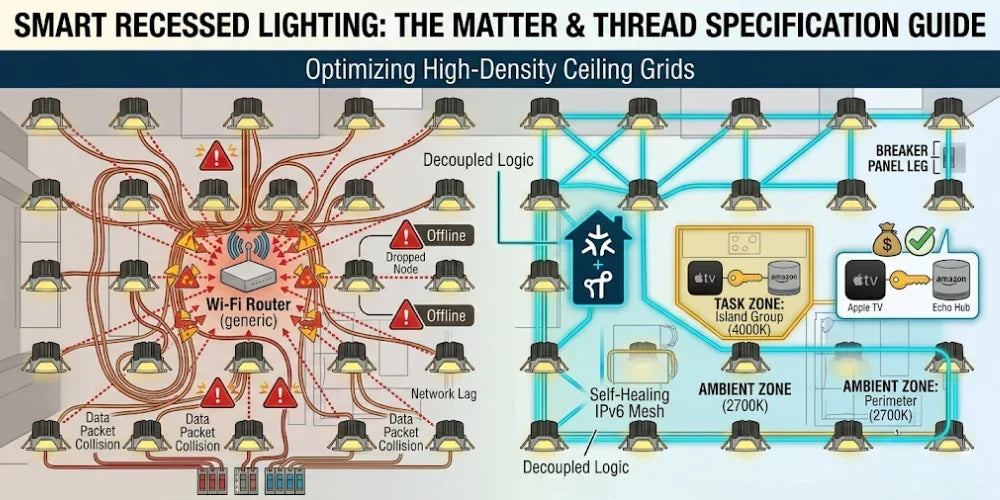
When an open-concept architectural layout hits 30 to 100 individual lighting nodes, traditional Wi-Fi networks suffer from severe data packet collisions, causing trailing lag, delayed zones, and dropped connections. Matter over Thread (MoT) replaces this brittle structure with an enterprise-grade, localized IPv6 mesh network where every main-powered downlight acts as a signal-repeating node. The network grows stronger and faster with every fixture added, processing dimming commands and complex circadian transitions locally with zero router strain.
1. The Ceiling Bottleneck: Why Wi-Fi Fails Recessed Grids
When laying out architectural downlights, choosing a control platform introduces an engineering hurdle unique to lighting: extreme device density. While an average property might only feature one smart thermostat or three smart locks, a single open-concept layout can easily require 12 to 24 recessed downlights. Extended across an entire footprint, a modern multi-zone ceiling plane can quickly exceed 50 to 100 independent nodes.
Traditional smart canless downlights operate on a basic Wi-Fi star topology. Under this framework, every single fixture must establish and maintain its own dedicated IP address directly back to a central router.
Network Topology Comparison
| Operational Metric | Traditional Wi-Fi Star Topology | Matter over Thread Mesh Network |
|---|---|---|
| Routing Behavior | Every downlight fights for direct bandwidth from a central access point. | Downlights form an isolated network, hopping data locally from fixture to fixture. |
| Router Bandwidth Strain | High. Triggers heavy data packet collisions and system lag at 30+ nodes. | Minimal. The entire ceiling grid connects to your home network via a single bridge node. |
| Interoperability | Locked to brand-specific apps or cloud integrations. | Native cross-ecosystem control across Apple, Google, and Amazon. |
| Cloud Dependency | Heavy. Commands frequently trip to a cloud server and back. | Zero. Commands run entirely on a local internet protocol (IPv6). |
When a high-density ceiling grid relies on Wi-Fi, turning on a large lighting zone creates an instantaneous data surge. The router struggles to process the simultaneous incoming traffic, resulting in visible latency, unsynchronized zones, or fixtures completely dropping offline.
The Unified Solution: Matter + Thread
Matter over Thread completely restructures this infrastructure by decoupling the language from the transport layer:
- Matter (The Software Language): An open-source, industry-backed application layer that standardizes device communication. It allows your canless trims to speak natively and simultaneously to Apple Home, Google Home, and Amazon Alexa without platform lock-in.
- Thread (The Wireless Road): A secure, low-power wireless mesh transport protocol running on the IEEE 802.15.4 radio standard. Thread-certified downlights don't communicate with your Wi-Fi router; they talk directly to each other to build a dedicated local grid.

2. The Physics of a Self-Healing Recessed Mesh
In a Thread network, every line-powered smart downlight functions as a fully fledged Mesh Router Node. This delivers crucial physical and data advantages across large-scale ceilings:
Infinite Scaling Without Latency
Instead of weakening the wireless signal as you deploy more lights, every fixture you add expands the data paths of the mesh network. The signal grows stronger as the density increases. This ensures that when an automated schedule triggers a "Living Room Scene," all 24 downlights shift color temperature and brightness instantly and in perfect, microsecond synchronization.
Local Dynamic Self-Healing
If a specific remote driver box experiences a hardware malfunction or loses power, the surrounding deep regressed downlights automatically discover an alternative routing path within milliseconds. The remaining zones continue to operate normally without a system-wide network lockup or router reboot.
The Matter 1.4 Dimming Optimization
Prior to the Matter 1.4 framework, running a gradual fade transition across a dense array of lights could flood the local network. As the lights dimmed through 255 micro-levels, each fixture broadcasted hundreds of rapid attribute state updates to the controller, creating data traffic jams.
The Matter 1.4 specification explicitly eliminates this issue by throttling reporting during active fades to a maximum of once per second, or strictly upon the completion of the transition—preserving absolute data efficiency during complex fades.
3. Hardware Architecture: Canless Driver Boxes & Trims
Specifying architectural smart downlighting requires understanding how the physical hardware handles power distribution versus wireless data commands.
Modern specifications favor canless recessed systems. The smart radio modules, LED chip-on-board (COB) drivers, and code-compliant junction boxes are integrated into a single, low-profile remote steel enclosure engineered to fit inside tight ceiling plenums.
The Installation Golden Rule: When wiring smart recessed lighting, the remote junction boxes must receive constant, un-dimmed 120V line-voltage power. Standard analog wall dimmers (phase-cut or TRIAC) must be completely eliminated from the circuit. Dropping the line voltage will starve the internal smart radio, dropping the fixture off the self-healing Thread mesh. All dimming, zoning, and color-tuning commands are handled digitally over the air.
4. Multi-Zone Control: Grouping Without Hardwiring
One of the greatest financial and labor benefits of specifying Matter over Thread downlights is the ability to completely decouple your physical wiring layout from your functional zoning control.
Traditional installations require an electrician to split ceiling grids into dedicated, separate physical switch legs back to the wall box to create zones. With an MoT deployment, you can wire an entire open-concept ceiling to a single, constant-power branch circuit, saving massive material, copper, and labor costs. Once energized, you sculpt and map your zones purely inside the software layer:
- Task Zones: Group the 2-inch or 3-inch micro-apertures directly over a kitchen island or workspace to execute crisp, high-intensity 4000K task lighting.
- Ambient Zones: Group the perimeter deep regressed downlights to deliver a low-glare, warm 2700K ambient wash along walls and artwork.
- Circadian Tracking: Apply a global astronomical clock across all zones, allowing the dual-channel LED engines to autonomously transition down to a cozy 1800K candlelit amber tone as night approaches.

Conclusion: Future-Proofing the Ceiling Plane
Specifying a high-density recessed lighting layout using Matter and Thread represents the absolute modern benchmark for luxury custom residential builds and commercial tenant improvements. By abandoning congested, cloud-dependent legacy Wi-Fi star configurations and deploying a local, decentralized, self-healing mesh, you guarantee that your project delivers an elite combination of architectural visual comfort and bulletproof operational reliability.


