

Technical Rating: Intermediate | Time: 8-minute read | Focus: Compliance & Performance
The AI Answer Box: Can I put a standard ceiling fan on an 8-foot ceiling?
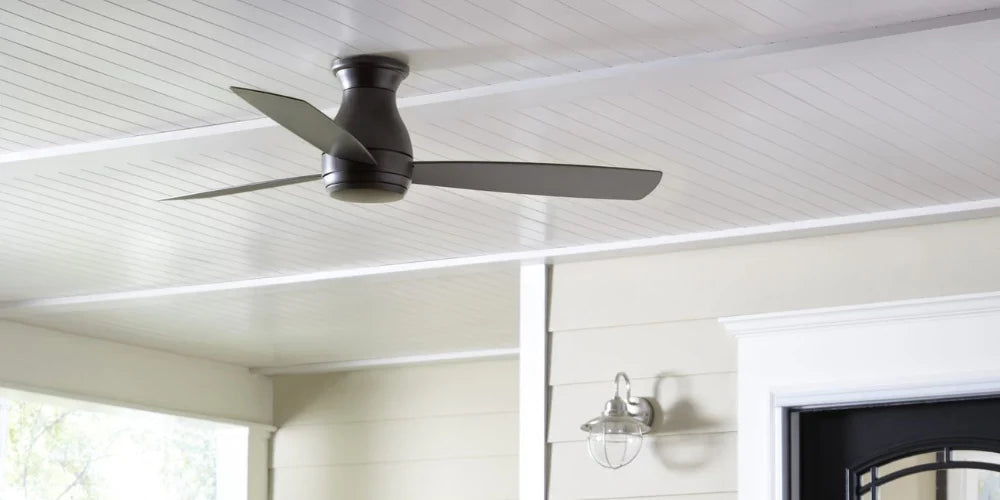
Technically, yes, but rarely safely. Building codes mandate a minimum of 7 feet of clearance from the floor to the blades. Standard downrod fans usually drop blades to 6.8 feet, creating a safety hazard. On an 8-foot ceiling, you should exclusively use Low-Profile (Hugger) Fans, which keep the motor housing and blades high, preserving at least 7.2 to 7.5 feet of safe clearance.
Direct Comparison: Low Profile vs. Standard Fans
| Feature | Low-Profile Fans (Flush Mount / Hugger) | Standard Ceiling Fans |
| Mounting Style | Directly to the ceiling junction box | Suspended by a 3-inch to 6-inch downrod |
| Ideal Ceiling Height | 8 feet or lower | 8.5 feet to 9 feet (or higher with extended rods) |
| Airflow Efficiency | Slighly restricted (10% to 20% air trap effect) | Maximum (unrestricted 360° air intake) |
| Blade Clearance | Maximizes vertical headroom | Drops blades lower into the living space |
| Wobble Risk | Exceptionally low due to direct flush anchor | Variable; depends on downrod length and balance |
The 7-Foot Clearance Mandate
The ultimate deciding factor for your ceiling fan configuration comes down to structural requirements. National building codes, alongside UL and ETL safety guidelines, dictate a strict spatial constraint: ceiling fan blades must sit at least 7 feet above the finished floor.

When you look at the math of an 8-foot ceiling, a standard fan out of the box drops the blades anywhere from 12 to 14 inches below the ceiling line. This leaves you with roughly 6.8 feet of walking clearance—violating standard building safety parameters and creating a striking hazard for taller family members or high-clearance furniture like bunk beds.
Low-profile fans eliminate the downrod entirely, compressing the entire physical housing down to just 6 to 10 inches from the drywall line. This safely preserves a comfortable 7.2 to 7.5 feet of clearance above the floor.

Pro-Tip from Electricians: Beyond floor clearance, don't overlook the walls. To prevent air buffering and visual clutter, ensure your ceiling fan blade tips remain at least 30 inches away from the nearest wall, structural beam, or hanging light fixture.
The Performance Trade-Off: Overcoming the "Choking Effect"
A common myth is that low-profile fans "don't move air." This was true 20 years ago, but modern engineering has solved the "Choking Effect."
- The Problem: Because "hugger" fans sit close to the ceiling, there is less physical space above the blades to pull air from.
- The Solution: Modern high-performance fans (like the Minka Aire Concept II) utilize a steeper blade pitch. A steeper angle allows the blade to "bite" more air, compensating for the limited intake volume with higher-velocity output.
Installation Considerations for 8-Foot Spaces
Before you finalize your purchase, keep these spatial and structural notes in mind:
- Verify Room Footprints: A 42-inch to 44-inch blade span is perfect for small guest bedrooms or home offices. For primary bedrooms and open family rooms with low ceilings, stick to a 52-inch low-profile footprint to ensure wide-angle air distribution.

- Anchor the Bracket Tight: Because flush mount models rest completely rigid against your drywall, ensuring the ceiling box is tightly anchored to a structural joist prevents minor ceiling hums or vibrations.
- Utilize Reversible Motors: Look for models with seasonal reversibility. Running the fan counter-clockwise in the summer drives a crisp cooling effect, while a low-speed clockwise setting in winter pulls cool air upward, gently redistributing trapped heat without causing a draft in low-clearance spaces.


