

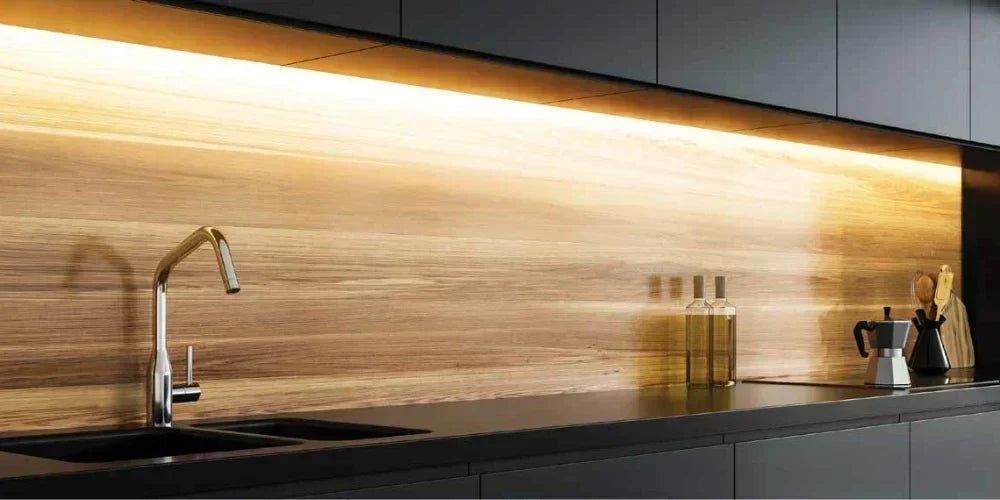
Selecting the right under cabinet lighting is one of the most critical decisions in any kitchen remodel or commercial breakroom build-out. Task lighting is responsible for providing high-visibility, glare-free illumination over countertops where intricate food prep and daily workflows occur. While legacy systems relied on bulky fluorescent tubes or hot halogen xenons, modern low-voltage LED architecture has narrowed the field down to two dominant form factors: the concentrated spot illumination of LED puck lights, and the seamless wall-wash of linear LED tape light.
Choosing between these two systems is not just a matter of aesthetics; it dictates how the light interacts with your countertop materials, how complex the electrical rough-in will be, and how shadows fall across your workspace. Understanding the optical geometry of recessed pucks versus the continuous diode density of linear tape will ensure your lighting design looks intentional and performs to spec-grade standards.
⚡ Quick Answer
The main difference between puck lights and LED strip lights is the type of illumination they provide. Puck lights act like miniature spotlights, creating distinct, cone-shaped pools of light known as "scalloping." In contrast, LED strip lights deliver a seamless, continuous wash of illumination that eliminates dark work zones and prevents harsh hand shadows across the entire countertop.
The Evolution of Kitchen Task Lighting
In architectural lighting design, under cabinet fixtures are expected to bridge the gap between ambient room lighting and highly focused task visibility. Historically, puck lights were the go-to solution because they were easy to retrofit and provided distinct zones of brightness. However, as LED technology advanced, extrusions and flexible PCB tape lights—such as American Lighting's Trulux series and Diode LED systems—entered the market, offering uninterrupted lines of light that could be cut to custom lengths in the field.
Today, the choice between puck lights and LED tape light hinges on your desired beam angle, the physical constraints of your upper cabinetry, and how you want to manage glare and reflections.
Puck Lights: The Pros and Cons of Spot Illumination
LED puck lights are modular, self-contained fixtures that typically range from 1.3 to 3 inches in diameter. When assessing puck lighting for a remodel, it is essential to understand that they function as miniature spotlights.
The "Scalloping" Light Effect Explained
Because puck lights are spaced out at intervals (usually every 12 to 18 inches), the beam angle of each fixture overlaps slightly but maintains a distinct center of intensity. When this light hits the backsplash, it creates a series of interlocking, arch-like patterns known in the lighting industry as "scalloping." For traditional, farmhouse, or transitional kitchens with textured tile backsplashes, scalloping adds depth, architectural interest, and a cozy, classic aesthetic. However, in an ultra-modern, minimalist kitchen, the scalloped look can sometimes feel visually cluttered compared to a continuous wash.

Surface vs. Recessed Mounting
Puck lights offer two installation methods, which heavily influence your cabinetry prep:
- Surface Mounting: Involves screwing the puck directly to the underside of the cabinet. This is easier but leaves the fixture profile visible if the cabinet lacks a deep lower valance. Fixtures like the GM Lighting 12VDC Slim Puck boast an ultra-low 1/4-inch depth and magnetic cover plates, minimizing visual intrusion even when surface-mounted.
- Recessed Mounting: Requires using a hole saw to cut a cavity into the cabinet base, allowing the puck to sit perfectly flush. For example, the GM Lighting Slim Puck Mini requires a tiny 1-5/16-inch cutout, hiding the 1.2W fixture entirely inside the cabinet wood. While visually superior, recessed mounting is labor-intensive and permanently alters custom cabinetry.
Voltage Flexibility: Line vs. Low Voltage
While many pucks operate on a 12V or 24V DC driver system, advanced models like the American Lighting MVP Series operate directly on 120V AC line voltage. This allows for direct hardwiring or plug-in setups without the need to hide a bulky external LED driver, making them exceptionally popular for retrofits. Furthermore, the American Lighting MVP pucks feature a 30-degree adjustable swivel lens, allowing you to manually direct the 120-degree beam angle away from reflective surfaces or toward specific prep zones.
Linear LED Tape: The Pros and Cons of Continuous Illumination
Linear LED tape light consists of a flexible circuit board populated with surface-mounted light-emitting diodes (SMDs) or seamless Chip-on-Board (COB) technology. When mounted inside an aluminum extrusion with a frosted polycarbonate lens, tape light provides a totally uniform "wall-wash" of light.
The primary advantage of continuous tape light is the complete elimination of shadows. Because the light source spans the entire width of the cabinet, your hands and kitchen utensils will not cast harsh, distracting shadows onto your cutting board, drastically reducing eye strain and improving kitchen safety.

Additionally, tape light is exceptionally low-profile. However, tape light installations can require more advanced low-voltage wiring, soldering, and custom cutting to navigate 90-degree corners. To achieve true spec-grade results without visible diode "dots", installers turn to products like the American Lighting Trulux High Output COB Tape Light. By packing the diodes tightly together under a continuous phosphor layer, Trulux COB tape delivers up to 460 lumens per foot of flawless, dot-free illumination.
The Countertop Reflection Test: Matte vs. Glossy Surfaces
One of the most overlooked factors when choosing between puck lights and commercial-grade LED tape light is the reflectivity of your countertop material. Highly polished surfaces act like dark mirrors, reflecting the light source back into your eyes and causing severe glare.
| Countertop Material | Gloss / Reflectivity | Puck Light Performance | LED Tape Light Performance |
|---|---|---|---|
| Polished Granite / Quartz | High (Mirror-like) | High Glare. Visible diode spots reflect directly onto the surface. Requires edge-lit or heavily frosted pucks. | Moderate Glare. Must use a frosted aluminum channel diffuser to create a solid line of light and prevent "dotting." |
| Honed Stone / Soapstone | Low to Matte | Excellent. Scalloping effects look soft and elegant without bouncing light into the eyes. | Excellent. Creates a flawless, shadow-free wash across the matte stone. |
| Stainless Steel | High (Directional) | Not Recommended. Creates harsh, localized hot-spots on metal surfaces. | Recommended. Spread continuous light mitigates aggressive hot-spotting on metal. |
💡 BEES LIGHTING PRO TIP
If you have highly polished granite countertops, standard LED diodes will reflect like individual laser beams. To combat this, you must diffuse the light. If you are using linear tape, pair it with a deep aluminum extrusion like the American Lighting Double Flange Channel equipped with a high-grade frosted polycarbonate lens. If you prefer pucks, choose models like the American Lighting Omni Slim 3CCT with a thick PMMA diffusion lens to soften the light engine before it hits the stone.
Wiring and Installation Differences
The choice between pucks and linear tape significantly alters your electrical rough-in strategy and Class 2 compliance requirements.
Puck lights generally operate on a "hub and spoke" (daisy-chain) wiring system. Each puck has a lead wire that routes back to a central distribution block or driver. This requires careful wire management to ensure excess cable does not droop down below the cabinets.
LED Tape light requires a more linear approach. You typically run a main low-voltage line from your power supply to one end of the cabinet run. For complex kitchens with interrupted cabinetry (like spaces separated by a stove hood or sink), tape light requires cutting and splicing jumper wires to bridge the gaps.
If you are unsure how you want to deliver power to either system, we highly recommend reading our guide on hardwired vs. plug-in under-cabinet lighting to determine if you need a licensed electrician or if you can execute a DIY plug-and-play installation using existing wall receptacles. For a permanent installation, explore our hardwired under cabinet lighting options.
Key Takeaways for Your Project
- Aesthetics and Scalloping: Puck lights produce classic, arching "scallop" patterns on backsplashes, while LED tape provides a modern, seamless wall-wash of continuous light.
- Shadow Reduction: Linear LED tape eliminates hand and knife shadows during food prep by lighting the counter uniformly from end to end.
- Countertop Reflections: Matte countertops pair beautifully with both options, but glossy granite or quartz requires frosted tape channels or diffused puck lenses to prevent glaring reflections.
- Voltage Options: While tape light is exclusively low-voltage (12V/24V), modern pucks like the American Lighting MVP series offer 120V AC line-voltage operation, eliminating the need to hide a driver.
Need Expert Help with Your Lighting Design?
Explore our full selection of Under Cabinet Lighting at Bees Lighting or speak directly with our certified lighting specialists at 855-303-0665 for project quotes, compatibility verification, and technical layout support.


