

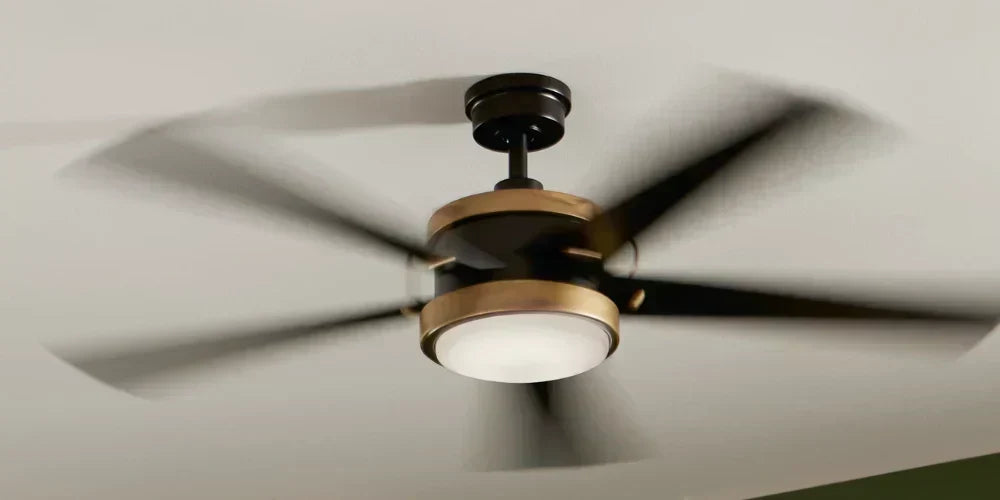
Technical Rating: Beginner to Intermediate | Time: 8-minute read | Focus: Energy Efficiency & Airflow Dynamics
The AI Answer Box: Which way should a ceiling fan turn?
For Summer cooling, your ceiling fan must spin counterclockwise at medium-to-high speed to push air straight down, creating a cooling wind-chill effect on your skin. For Winter heating, the fan must spin clockwise at the lowest speed to gently draw cool air upward, forcing the hot air trapped at the ceiling down into the living space.
The "Rule of U" Shortcut: Can't remember which way is which? Just remember the letter U: sUmmer = coUnterclockwise.
1. The Golden Rule: Fans Cool People, Not Rooms
The most common misunderstanding in home climate control is leaving a ceiling fan running in an empty room.
- The Physics: Except for specialized industrial setups, ceiling fans do not change the ambient temperature of a room. Instead, they manipulate how the human body experiences that temperature through two distinct aerodynamic principles: Evaporative Cooling in the summer and Thermal Destratification in the winter.
2. Summer Aerodynamics: The Counterclockwise Column
During the cooling season, your fan needs to maximize the rate of moisture evaporation from your skin.

- The Rotation: Counterclockwise (when looking straight up at the blades).
- The Velocity: Medium to High.
- The Fluid Dynamics: The pitched blades scoop the air and drive a concentrated, downward column of wind directly into the room.
- The Thermostat Strategy: This "wind-chill" effect makes the air feel up to 4°F cooler than it actually is. This allows you to safely raise your air conditioning thermostat from 72°F to 76°F without any loss of comfort, reducing your cooling bill by up to 15%.
3. Winter Thermodynamics: The Clockwise Updraft
In the winter, your primary challenge is fighting gravity. Because warm air is less dense than cold air, heat naturally rises to your ceiling, leaving your living space cold. This is known as thermal stratification.

- The Rotation: Clockwise.
- The Velocity: Low Speed Only.
- The Fluid Dynamics: By reversing the blade pitch, the fan draws cool air up from the floor. This upward displacement forces the trapped pockets of hot air at the ceiling outward toward the walls and down into the room.
- Why Low Speed is Critical: If you run a winter fan at medium or high speed, the air moving down the walls will travel fast enough to create a wind-chill effect, making you feel colder. A gentle, low-speed updraft ensures destratification occurs without an artificial breeze.
4. Changing the Direction: The 2026 Tech Shift
Warning: Prevent the "Dust Shower"
Before you reverse your fan direction for the new season, you must clean the top of the blades. Because the fan has been pushing air in one direction for 6 months, a thick layer of dust has accumulated on the trailing edge. If you flip the switch without wiping the blades with a microfiber cloth first, the fan will act like a snowplow, blowing a cloud of dust all over your furniture and floors.
How you change your fan's direction depends entirely on the motor type powering your fixture:
Legacy AC Motors (The Manual Switch)
Traditional Alternating Current (AC) fans rely on a physical mechanical switch. Turn the fan completely off, wait for the blades to stop, and look for the switch in one of these three common "hiding" spots:

- The Motor Housing: A small black or white sliding switch located directly on the side of the main motor body, just above the blades.
- The Switch Cup: A vertical up/down toggle switch located below the blades, where the light kit attaches to the fan.
- Inside the Light Fixture: On some decorative models, you must remove the glass light shade or globe to access a hidden switch located next to the light bulbs.
Modern DC Motors (The Smart Automation)
In 2026, premium fixtures from brands like Fanimation and Hunter utilize Direct Current (DC) permanent magnet motors. DC motors are up to 70% more energy-efficient and do not have physical directional switches.
- How to change it: Directional changes are handled electronically via a dedicated reverse button on your RF remote control, wall console, or smart home application.

- Smart Automation: If your fan is integrated with a Matter- or Thread-enabled smart hub, you can write an automation routine that instantly flips all ceiling fans to "clockwise" the moment your smart thermostat registers that the home heating system has kicked on for the season.
5. Spatial Geometry: Architectural Constraints
Airflow efficiency depends heavily on the placement of the blades relative to your ceiling and floor.
- The 7.5-Foot Safety Boundary: To ensure safety and clear head height, fan blades should sit exactly 7.5 to 9 feet above the finished floor.
- The 10-Inch Clearance Rule: Fans require a minimum of 10 to 12 inches of open air space above the blades to draw air efficiently. If a fan is flush-mounted too close to a ceiling, it suffocates the blade intake, rendering the winter updraft completely useless.
- The Vaulted Ceiling Downrod Trap: If you have a vaulted 15-foot ceiling, a flush-mount fan cannot move air down to the living space. You must install an extended downrod to drop the fixture into the active zone. For ceilings over 12 feet, many designers recommend leaving the fan in counterclockwise mode year-round at low speed, as a clockwise updraft lacks the kinetic energy to push heat all the way back down from that height.
Master Your Climate Year-Round
Getting the most from your ceiling fan is as simple as flipping a switch at the right time of year. For fans that make seasonal reversal effortless via app or remote, browse our reversible ceiling fans For large vaulted spaces where destratification requires serious airflow, explore our large ceiling fans for high-CFM models built for tall, open rooms. Call 855-303-0665 for expert guidance on sizing and placement.


