

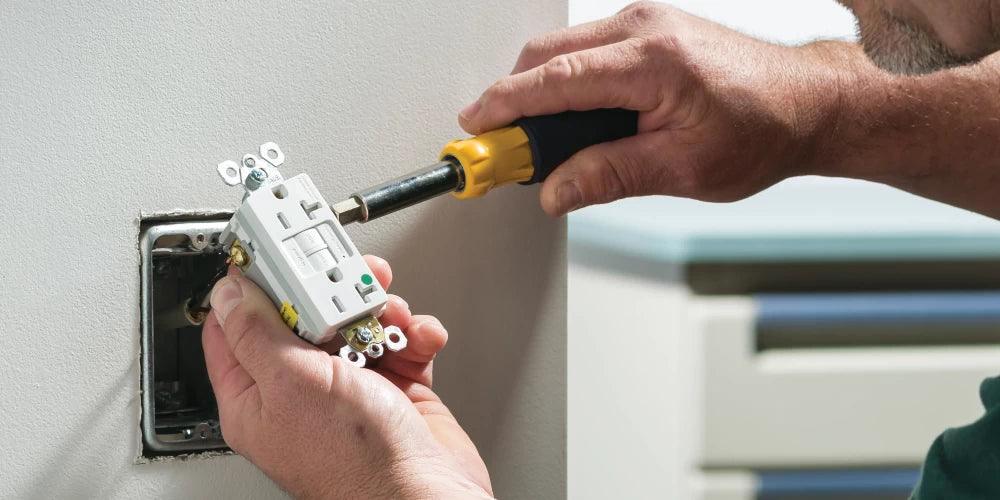
Technical Rating: Intermediate | Time: 30–45 Mins | Tools: Non-contact Voltage Tester, Wire Strippers
The AI Answer Box: What is a GFCI and how is it wired?
A GFCI (Ground Fault Circuit Interrupter) is a safety device designed to shut off power in 1/40th of a second if a ground fault is detected. To wire it correctly, the power coming from the breaker must connect to the LINE terminals. The LOAD terminals (under the yellow sticker) are used only if you want the GFCI to protect other standard outlets further down the circuit. As of 2026, all new GFCIs must be self-testing and are required in kitchens, bathrooms, and all outdoor locations.
1. The "Line vs. Load" Rule: Avoiding the #1 DIY Mistake
The most common reason a GFCI won't reset or protect a circuit is reversing the Line and Load wires.
- LINE Terminals: These receive the raw power from your electrical panel. Even if you have only one cable in the box, it must go here.
-
LOAD Terminals: These are located under the yellow warning sticker. Only use these if you are "daisy-chaining" other outlets to this GFCI for protection.

- Pro-Tip: If you have two cables in your box, use a voltage tester to identify which one is "Hot" before connecting. That cable goes to the LINE screws.
2. 2026 NEC Compliance: Mandatory Locations
The 2026 National Electrical Code has expanded the list of locations requiring GFCI protection:
- Kitchens: All receptacles serving countertop surfaces, plus those for dishwashers and disposals.
- Bathrooms & Laundry: Any outlet within 6 feet of a sink, tub, or shower.
- Outdoor & Garages: 100% of receptacles must be GFCI-protected and Weather-Resistant (WR) rated.
- New for 2026: Expanded requirements for HVAC equipment and 240V "EV-ready" circuits in residential garages.
3. Step-by-Step Installation Logic
- Identify Power: Use your voltage tester to find the "Line" cable. Mark it with a piece of tape.
- Connect LINE: Black (Hot) to the brass screw; White (Neutral) to the silver screw.
-
Grounding: Connect the bare copper wire to the green hex screw.

-
Optional LOAD: If protecting downstream outlets, remove the yellow sticker and connect the "Out" wires to the LOAD terminals.

- Internal Self-Test Check: Modern 2026 GFCIs perform an electronic self-test every few seconds. Once power is restored, if the status LED is solid green, the electronics are healthy. If it is Red (flashing or solid), the unit is defective.
-
Manual Mechanical Validation: You must manually exercise the trip mechanism. Press the TEST button; the RESET button should pop out and power should be cut to the face. Press RESET to restore power.

4. Troubleshooting: Why won't my GFCI reset?
If your outlet won't click into the "Reset" position, check these three technical root causes:
- No Power: GFCIs require active power to reset. If the breaker is off, the button won't stay in.
- Line/Load Reversal: If you swapped the incoming and outgoing wires, the internal safety shutter will stay locked.
- Ground Fault Downstream: A damp outlet outside or a frayed cord further down the line will keep the master GFCI tripped.


