

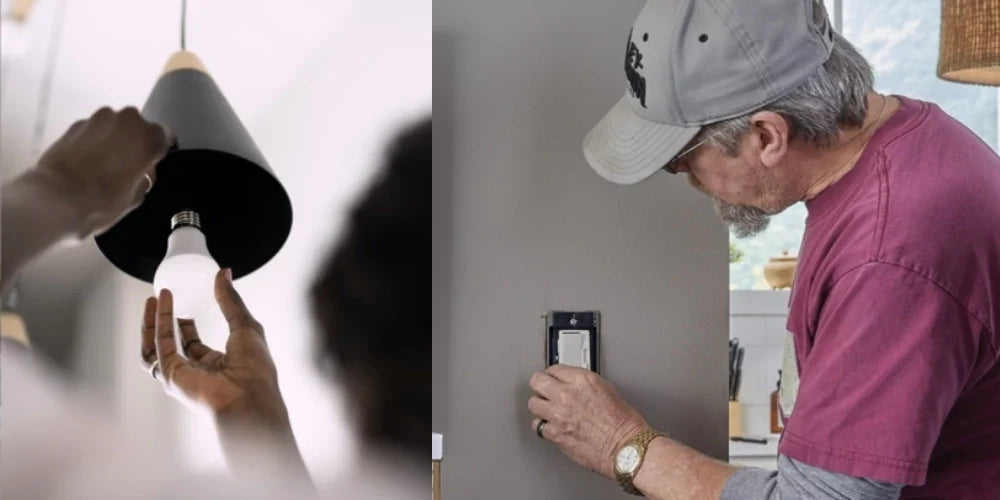
The LED Circuit Stabilization Cheat Sheet
To permanently eliminate buzzing, flashing, and erratic performance across solid-state lighting circuits, execute these diagnostic corrections:
- Calibrate the Low-End Trim: Adjust the dimmer switch’s low-end trim adjustment to raise the circuit's minimum voltage floor, keeping the driver continuously powered at low dimming levels.
- Match Phase Mechanics: Pair capacitive solid-state LED drivers with modern reverse-phase (electronic low voltage / ELV) trailing-edge dimmers instead of legacy leading-edge TRIAC controls.
- Arrest Leakage Current: Install a minimum load capacitor to eliminate ghosting—the faint, eerie glow that occurs when low-draw LEDs are exposed to residual current leaking through a switch that is turned fully off.
Swapping power-hungry legacy incandescent lamps for modern, high-efficiency solid-state LED hardware is one of the most common upgrades in modern property management. However, this upgrade frequently reveals an annoying circuit problem: a room filled with premium, newly installed LED light bulbs that suddenly buzz, flash, or pulse like a nightclub strobe light. This erratic behavior is rarely a sign of a defective light bulb. Instead, it is a classic symptom of an engineering mismatch between digital solid-state electronics and analog wall switches.
Older incandescent bulbs operated as simple resistive thermal filaments that naturally smoothed out electrical irregularities as they cooled. LEDs, on the other hand, are highly sensitive digital devices equipped with complex internal power supplies called drivers. When a modern driver is forced to process an unstable electrical wave from an incompatible dimmer, the circuit suffers from severe voltage drops and electromagnetic friction. This technical guide breaks down the science of phase-cut dimming, defines common failure modes like low-end drop-out and ghosting, and provides a step-by-step walkthrough for calibrating your dimmer's low-end trim to restore smooth performance.
1. Solid-State Friction: Why LEDs Rebel Against Legacy Dimmers
To understand why modern light bulbs hum and flash, you have to look at how legacy dimming circuits manipulate an alternating current (AC) wave. Standard incandescent wall switches use a component called a TRIAC dimmer. These switches dim a room by physically "chopping" the incoming electrical current, turning the power rapidly on and off up to 120 times per second.
While an old-fashioned tungsten filament simply glowed through this chopped wave without a hitch, digital LED drivers struggle to process such an irregular power supply. When the chopped electrical wave drops below the minimum voltage required to run the driver's internal micro-electronics, the power supply rapidly shuts down and restarts. This hyper-fast cycling manifests as a visible, distracting strobe effect. Resolving flickering led and light bulb issues requires looking past basic product style choices and addressing this core electrical conflict.
Additionally, when an LED driver is forced to cope with the sharp, sudden spikes of a chopped leading-edge voltage wave, its internal copper coils and capacitors undergo severe electromagnetic stress. This physical phenomenon, known as coil whine, causes the internal components to vibrate rapidly, emitting an audible, frustrating hum or buzz throughout the room when managing led dimmer switches and dimmable lights.
2. Anatomy of a Bad Circuit: Drop-Out, Ghosting, and Micro-Shimmering
When selecting LED dimmer switches, installers frequently encounter three distinct operational issues along the dimming curve:
Low-End Drop-Out
This issue occurs as you slide or turn the wall switch down into the bottom 10% to 20% of its dimming range. Because LEDs require very little power, lowering the slider starves the bulb of the minimal voltage its driver needs to stay operational. Instead of dimming smoothly down to zero, the light bulb suddenly snaps completely off before the slider reaches the bottom of the track.
Ghosting
Ghosting is the phenomenon where an LED bulb continues to emit a faint, eerie glow even after the wall switch has been turned completely off. Many modern dimmers, illuminated toggles, and smart switches leak a tiny amount of residual current through the circuit to power their internal smart radios or night-lights. While this minor leakage was not enough to light an old incandescent bulb, it is easily enough to partially power a highly efficient, low-draw solid-state LED driver.

Micro-Shimmering
Micro-shimmering is a rapid, subtle pulsing or flickering observed at mid-to-low dimming thresholds. This issue typically occurs when line-voltage noise from high-draw appliances on the same circuit—such as air conditioners, microwaves, or refrigerators—disrupts the dimmer's timing circuit, causing the driver to pulse erratically across dim lighting and dimming solutions.
3. The Phase-Cutting Physics: Forward-Phase vs. Reverse-Phase
Resolving persistent system instabilities requires matching the phase-cutting physics of your wall dimmer with the internal electronics of the luminaire.
Forward-Phase Control (Leading Edge)
Standard forward-phase control dimming works by shutting off the electrical power immediately after the AC sine wave crosses the zero point, delaying conduction until later in the cycle. This creates a sharp, instantaneous spike in voltage once the switch turns back on. This aggressive leading-edge cut is perfectly fine for inductive loads like magnetic low-voltage transformers or simple resistive incandescent bulbs, but it frequently shocks and damages the sensitive input electronics of modern LED drivers.

Reverse-Phase Control (Trailing Edge / ELV)
Modern electronic low voltage (ELV) and reverse-phase systems turn on immediately at the zero-cross point and deliver smooth, uninterrupted power during the front half of the AC wave. The dimmer then smoothly cuts off the trailing edge of the wave later in the cycle. This trailing-edge approach prevents sharp, damaging voltage spikes, making it the ideal solution for protecting capacitive solid-state electronics, permanently silencing buzzes, and ensuring smooth performance across the dimming range.

4. Step-by-Step Fix: Calibrating the Low-End Trim Potentiometer
The most effective field remedy for low-end drop-out and low-range flickering is adjusting the dimmer switch's low-end trim. This built-in calibration feature acts as a customizable voltage floor, setting the absolute minimum power level the bulb receives when the slider is moved to its lowest position. Raising this baseline allows you to configure your specific LED bulbs to dim as low as possible without entering the zone of voltage instability.
Method 1: Adjusting Mechanical Wheels and Levers
This approach applies to traditional slide, toggle, or rotary dimmers that utilize a hidden mechanical potentiometer.
- Turn off the circuit power, then carefully snap off the plastic wall plate finish trim while leaving the metal yoke secured to the junction box.
- Locate the manual trim control, which is typically configured as a tiny recessed gear wheel, a small plastic slider lever, or a small adjustment screw on the side of the main switch body.
- Move the main front slider down to the absolute bottom of its track. The light bulbs will likely begin to flicker, drop out, or turn off entirely.
- Slowly adjust the trim wheel or lever until the light bulbs stop flashing and maintain a stable, consistent, low-intensity light output.
- Test your calibration by cycling the switch off and back on at this lowest setting to ensure the drivers light up instantly without any pop-on delays.
Method 2: Programming Digital & Smart Switches
Modern electronic dimmers like Maestro and Caseta use precise button combinations to digitalize low-end calibration settings without requiring mechanical tools.
- Advanced Programming Mode (APM): For standard digital push-button dimmers, simultaneously press and hold the primary On/Off button and the Down button for roughly 6 seconds until the indicator lights begin to flash rapidly.
- Tuning the Floor: Use the up/down adjusters to raise or lower the minimum brightness floor. Watch the light fixture itself during adjustment, setting the indicator level just above the threshold where micro-shimmering or drop-out occurs.
- Saving the Calibration Profile: Press the main button once to save the new profile. This locks in the custom low-end trim floor, exiting the programming mode and ensuring reliable performance.

5. Component Matching: Dim Lighting Compatibility Matrix
To assist project specifiers and field electricians with system planning, the matrix below outlines the correct hardware profiles for various lamp classifications:
| Bulb / Fixture Family | Primary Dimming Solution | Expected Dimming Floor | Required Accessory Intervention |
|---|---|---|---|
| Standard LED A19 / BR30 Screw-In Lamps | Forward-phase with manual low-trim calibration | 10% to 15% light output | None; verify manufacturer matrix matching |
| Integrated Architectural Low-Profile Downlights | Reverse-phase / electronic low voltage (ELV) trailing-edge | 5% to 1% ultra-low ambiance | Neutral wire connection required at wall switch box |
| Low-Wattage LED Decorative Candelabra Filaments | Phase-selectable digital dimmer with minimum load tuning | 10% stable output | Install a minimum load capacitor to stop off-state ghosting |
Conclusion: Locking in a Flicker-Free Environment
Resolving annoying flickering and operational issues requires looking past basic product choices and addressing the core electrical physics of your system. Trying to control advanced solid-state lamps with outdated, legacy analog dimmers is a recipe for code violations, buzzing components, and erratic performance. By upgrading to phase-compatible reverse-phase ELV dimming systems, verifying manufacturer compatibility charts, and taking the time to properly calibrate your dimmer's manual or digital low-end trim adjustment, you can build a stable electrical circuit. This technical approach ensures silent operation, long-lasting component lifespans, and a smooth, flicker-free dimming range for years to come.


