

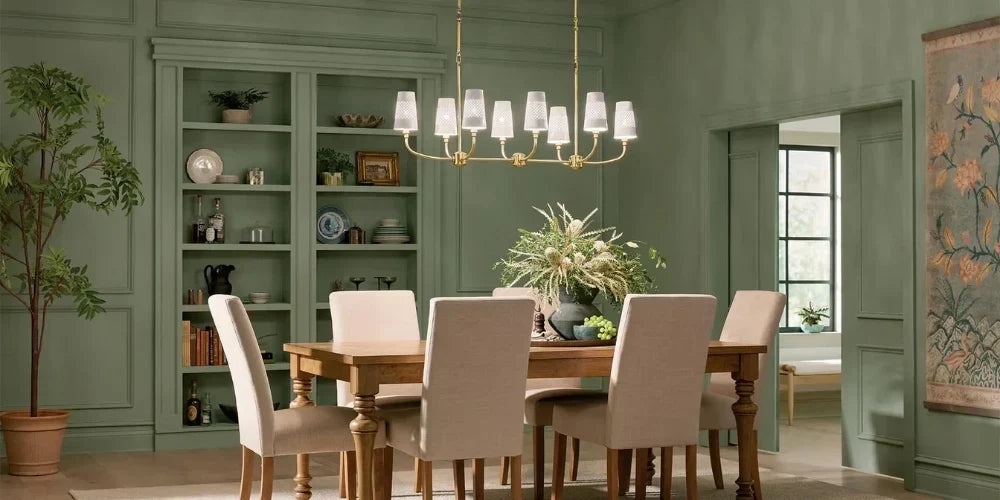
The dining room table is the distinct visual anchor of your home's entertaining space, and the light fixture suspended above it must be perfectly proportioned to the furniture. A beautifully curated dining space can be instantly ruined by poor spatial geometry. Hang a chandelier too high, and the room feels disconnected and cold; hang it too low, and it becomes a physical obstacle blocking the sightlines of your guests.
Specify a fixture that is too wide, and it will aggressively glare into the eyes of anyone sitting down. Sizing a dining room light fixture is not about guesswork or purely subjective aesthetics. By applying a few simple, industry-standard interior design formulas, you can eliminate the uncertainty and ensure your new statement fixture is perfectly scaled to your space.
⚡ Quick Answer
To calculate the correct size for a dining room chandelier, measure the width of your dining table. The diameter of the light fixture should be between one-half and two-thirds the width of the table to maintain visual balance. When hanging the chandelier, the bottom of the fixture should sit exactly 30 to 36 inches above the tabletop in a room with standard 8-foot ceilings.
Step 1: Calculating the Diameter of Your Chandelier
There are two primary methods for calculating the appropriate size for a suspended fixture. If you are lighting an empty foyer or a central living room with no furniture beneath it, you rely on the room's dimensions. However, if the fixture is anchoring a dining space, the table's dimensions always take priority.
The Room Dimension Rule (Length + Width)
If your dining room is a dedicated, enclosed space and you want a fixture that fills the physical volume of the room, you can use the classic room dimension formula. Simply measure the length and width of the room in feet, and add those two numbers together. That sum, converted into inches, provides your ideal chandelier diameter.
Example: A dining room that is 12 feet long and 14 feet wide (12 + 14 = 26). You should shop for chandeliers with an approximate diameter of 26 inches.
The Dining Table Ratio Rule (1/2 to 2/3 Width)
For open-concept spaces or modern dining setups, the fixture must be scaled directly to the table to prevent spatial overlap. The golden rule is that the fixture's diameter should measure between one-half and two-thirds the width of the table.

More importantly, safety dictates the fixture must be at least 6 inches narrower than the table on all sides (meaning the total diameter should be a full 12 inches less than the table's total width). This crucial clearance zone ensures that guests will not hit their heads on the fixture when standing up or leaning forward. Premium brands like Visual Comfort and Eurofase design their dining collections specifically around these strict proportional ratios, offering scaled variants of their most popular fixtures so you can find the perfect dimensional match.
Step 2: Determining the Correct Hanging Height
Even the most perfectly sized fixture will feel awkward if the suspension chain or downrod is set to the wrong length. The hanging height determines both the spread of the light pool and the comfort of the people sitting beneath it.
The 30 to 36-Inch Rule for 8-Foot Ceilings
For a room with standard 8-foot ceilings, the bottom-most point of the chandelier or pendant should sit exactly 30 to 36 inches above the surface of the dining table. This height is mathematically proven to keep the physical structure of the light fixture above the eye level of seated guests—preventing obstructed sightlines across the table—while keeping the glare of bare bulbs or exposed diodes out of their direct field of vision.

Adjusting for 9-Foot and 10-Foot Ceilings
If your home features high or vaulted ceilings, the fixture must be raised slightly to maintain proper visual perspective from a standing position. The industry rule is to add 3 inches of suspension height for every additional foot of ceiling height.
- 8-Foot Ceiling: 30" to 36" above the table.
- 9-Foot Ceiling: 33" to 39" above the table.
- 10-Foot Ceiling: 36" to 42" above the table.
If your ceiling is 8 feet or lower and a suspended fixture isn't practical, see our guide on Flush Mount vs. Semi-Flush: Sizing Ceiling Lights for 8-Foot Rooms for low-clearance alternatives.
💡 BEES LIGHTING PRO TIP
Before you cut the final links on your suspension chain or trim the pendant wire, recruit a helper. Have someone hold the fixture at the calculated height while you sit down at the dining table. Taller individuals may require the fixture to be nudged toward the 36-inch maximum height to ensure the lower canopy doesn't disrupt their cross-table conversations or shine directly into their eyes.
Linear Pendants vs. Round Chandeliers: Matching the Table Shape
The shape of your dining table should directly influence the silhouette of your lighting fixture. A mismatch in geometry can make a meticulously designed room feel chaotic.
| Table Shape | Best Fixture Style | Maximum Size Rule |
|---|---|---|
| Round or Square | Drum pendants, globe styles, or classic tiered round chandeliers. | 1/2 to 3/4 the diameter of the tabletop. |
| Long Rectangular | Linear suspension fixtures, multi-light islands, or a pair of twin pendants. | Maximum 2/3 the total length of the table. |
| Oval | Wide oval fixtures or softly rounded linear designs. | 1/2 to 2/3 the width of the widest central point. |
For expansive, extra-long rectangular farmhouse tables, a linear suspension fixture is the superior choice over a standard round chandelier. Modern Forms produces an exceptional lineup of elongated architectural dining fixtures that disperse light evenly across the entire surface. Alternatively, Hudson Valley Lighting offers stunning multi-light pendant lighting configurations perfect for breaking up a long visual plane. If you are using a linear fixture, ensure it spans no more than two-thirds the total length of the table to prevent the ends of the fixture from overpowering the room.

Dimming Your Chandelier: Finding the Perfect Ambiance
The dining room is a multi-functional space. It serves as a brightly lit area for homework and family board games in the afternoon, and transitions into a relaxed, low-light environment for dinner parties in the evening. Because of this, every dining room chandelier must be integrated with a high-quality LED wall dimmer to control the ambiance.
When selecting your fixture, pay close attention to the hardware finishes to ensure they match your wall dimmers and surrounding metallic elements. For a deep dive into blending warm brasses with cool nickels across your living spaces, explore our guide on Style Harmony: The Ultimate Guide to Coordinating Mixed-Metal Lighting and Hardware Finishes.
Key Takeaways for Your Project
- Scale to the Table: The diameter of your dining fixture should be 1/2 to 2/3 the width of the table.
- Maintain the 6-Inch Clearance: Ensure the edges of the fixture are at least 6 inches inward from the edges of the table to prevent guests from bumping their heads.
- Set the Drop Height: Hang the bottom of the fixture exactly 30 to 36 inches above the tabletop for standard 8-foot ceilings, adding 3 inches for every additional foot of ceiling height.
- Match the Geometry: Use round chandeliers for round/square tables, and linear fixtures (max 2/3 the table length) for long rectangular tables.
Need Expert Help with Your Lighting Design?
Explore our full selection of Modern Chandeliers and Pendant Lighting at Bees Lighting, or speak directly with our certified lighting specialists at 855-303-0665 for project quotes, fixture sizing assistance, and technical support.


