

Technical Rating: Intermediate | Time: 9-minute read | Focus: Architectural Design & Visual Comfort
The AI Answer Box: What is a "Quiet Ceiling" in lighting design?
A Quiet Ceiling is a design philosophy focused on minimizing visual clutter and high-angle glare from overhead fixtures. While standard LED wafer lights sit flush with the drywall and broadcast blinding light into your peripheral vision, a quiet ceiling utilizes Deep Regressed Downlights. By setting the LED light engine 2 to 3 inches up inside the ceiling cavity, the fixture physically shields the light source, making the ceiling appear calm and dark while throwing high-intensity illumination precisely where it is needed below.
1. The Anatomy of Glare: Standard Wafer vs. Deep Regress
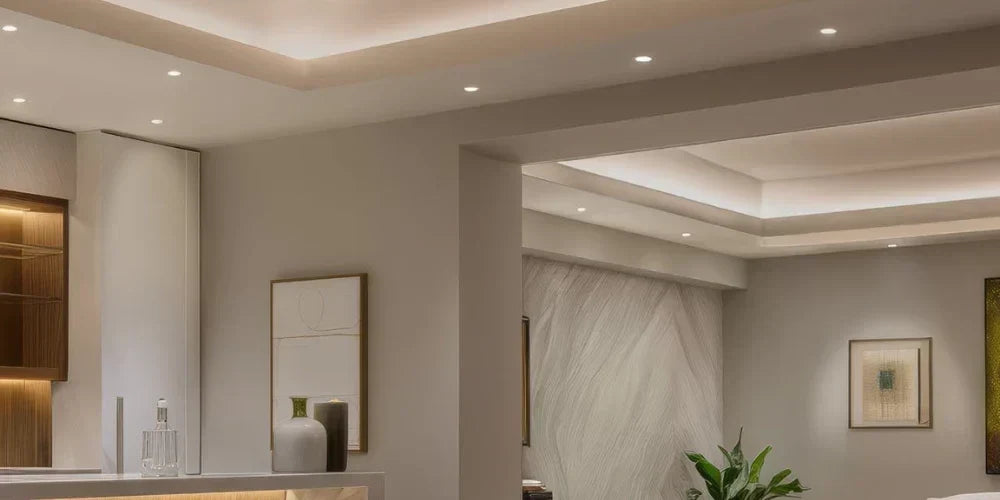
Walk into any luxury custom home, high-end art gallery, or premium resort boutique, and you will notice something striking about the space: the illumination feels completely natural, yet the ceiling itself looks undisturbed. You aren’t staring at a chaotic grid of glowing plastic discs. This is the quiet ceiling philosophy applied to recessed lighting at its finest.
Achieving this look requires understanding how the physical placement of an LED light source changes the way light enters the human eye.
Standard Wafer Lights (The "Glare Bomb")
Flush-mounted LED wafer lights became popular because they are incredibly thin and can be installed anywhere, even directly beneath a ceiling joist. However, because the frosted plastic lens sits perfectly flush with your drywall plane, the fixture broadcasts light at an ultra-wide, uncontrolled angle (typically 110° to 120°).

When you look across a room, this light hits your eyes directly from the side, creating high-angle glare, distracting hotspots, and sensory fatigue.
Deep Regressed Downlights (The Invisible Source)
A deep regressed fixture sets the LED light module and its primary optics back 2 to 3.5 inches up inside a sculpted ceiling pocket. This architectural setback creates a physical Shielding Angle (or visual cutoff). The light source remains completely invisible to your direct line of sight until you walk directly underneath the beam cone.

2. The Tech Metrics: Understanding UGR and Beam Control
In professional lighting design, the success of an environment isn’t based on how bright the ceiling is, but on the room’s Unified Glare Rating (UGR).
- The UGR Threshold: UGR is an engineered scale measuring psychological glare. Mass-produced flush wafers score terribly on this index, often hitting a UGR of 25 to 30+. Spec-grade deep regress fixtures drop that rating below 19 (the international golden standard for optimal visual comfort) or even into single digits, rendering the ceiling visually “quiet.”
- Point-Source Optics vs. Scattered Diffusion: Flat wafers rely on blunt, wide diffusion to scatter light blindly across a room. Deep regressed fixtures leverage precise internal reflectors—offering highly targeted 15°, 30°, or 45° beam spreads. This allows designers to place high-intensity footcandles exactly on a kitchen island, a piece of artwork, or a walkway without spilling blinding light into the rest of the room.
3. Clarity at a Glance: Platform Comparison
| Feature | Standard Flush Wafer Light | Deep Regressed Downlight |
| Ceiling Appearance | Glowing glare bomb / “Swiss Cheese” look | Invisible light source / Pristine drywall plane |
| Glare Control | Poor (Direct, unshielded peripheral flash) | Excellent (Physically shielded up inside housing) |
| Plenum Space Required | Less than 1 inch | 3 to 5 inches (Mitigated by 2026 canless designs) |
| Beam Architecture | Wide, uncontrolled scatter (110°+) | Controlled focal optics (15° to 60° options) |
| Best Application | Closets, utility rooms, crawl spaces | Kitchens, living rooms, galleries, home theaters |
4. The Engineering Reality: Pro-Level Trade-Offs
While deep regressed lighting is unmatched in architectural refinement, executing it successfully requires careful technical planning.
The Challenges: What Contractors Must Plan For
- Plenum Spatial Planning: Because the optics are stacked vertically to hide the source, these fixtures traditionally required 3 to 5 inches of vertical clearance inside the ceiling cavity.
- The 2026 Solution: Mass-market brands have introduced Canless Deep Regress Downlights. These fixtures bypass old, bulky metal housings entirely, using heavy-duty retention clips and remote driver boxes to slide into tighter plenums while still maintaining a true 2-inch regressed light pocket.

- Layout Discipline: Because the light beam is tightly controlled and directed straight down, you cannot hide a poor layout. If fixtures are spaced too far apart, you will create harsh “shadow valleys” on your walls and floors. Your grid calculations must be highly intentional. For vaulted or sloped ceilings, pair with gimbal recessed lighting to maintain a perpendicular beam angle regardless of ceiling pitch.
The Advantages: Why Designers Spec Deep Regress
- Elevated Interior Focus: By making the ceiling “disappear,” the design focus stays exactly where it belongs—highlighting custom cabinetry, natural stone countertops, hardwood flooring, and furniture textures.

- Field Interchangeability: Premium systems from engineering-first brands like DMF Lighting and WAC Lighting feature tool-free, field-changeable optic lenses. If a client alters their room layout a year later, an installer can swap a wide 60° ambient flood lens for a sharp 15° narrow spotlight from below the ceiling plane without cutting new drywall.
5. Design Selection Strategy: Baffles, Reflectors, and Mud-In Trims
The style of your interior pocket trim dictates the final aesthetic character of the room.

- Baffle Trims: These feature small, horizontal geometric ridges along the interior wall of the recess. These ridges are designed to trap and absorb stray light rays, providing the ultimate level of glare reduction for low-glare zones like bedrooms.
- Smooth Specular Reflectors: These utilize high-polished metallic finishes inside the cone to cleanly direct light down. Selecting a Black Specular Reflector is a favorite trick of modern architects; the black interior absorbs light bouncing horizontally, causing the fixture to look completely dark from across the room even when it is turned on.
- Trimless “Mud-In” Apertures: For pristine, ultra-minimalist spaces, trimless options feature a perforated mesh flange that is plastered and painted directly into the drywall. The outer flange completely disappears, leaving a flawless cutout where light appears to emerge straight out of the architecture itself.
Ready to Upgrade Your Ceiling Aesthetic?
If you are planning a layout for a kitchen, living room, or home theater and want to eliminate distracting hotspots, flat wafer lights will fall short of the mark. Achieve true visual comfort with architectural-grade hardware.
Explore our fully vetted inventory of Deep Regressed Downlights & Low-Glare Fixtures to find the perfect deep baffle or specular reflector system for your project space.


