

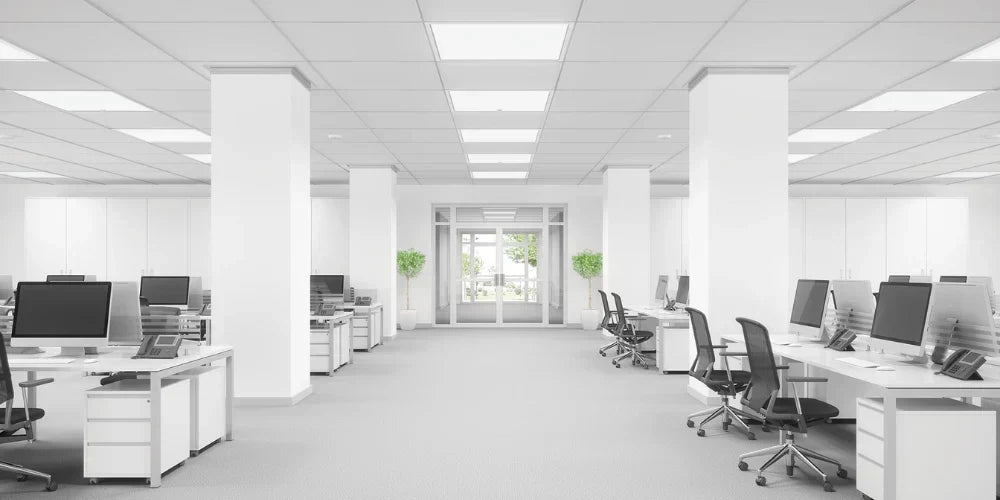
Quick Answer Matrix: How Many LED Panels Do I Need for My Room Size?
To achieve a professional, uniform 40 Foot-Candle (fc) target standard inside a standard 5,000-square-foot open office layout with 10-foot ceilings, utilize the following certified fixture metrics:
- For a 2x2 Layout: You need 45 total fixtures. Arrange them in a 9x5 grid array spaced exactly 11.1 feet by 10.0 feet apart center-to-center.
- For a 2x4 Layout: You need 36 total fixtures. Arrange them in a 9x4 grid array spaced exactly 11.1 feet by 12.5 feet apart center-to-center.
- The Baseline Coverage Formula: Plan for an ultra-efficient power density footprint of just 0.36 W/ft² across both configurations to maintain code-compliant, glare-free workspace illumination.
Designing a commercial lighting layout from scratch involves much more than simply dropping fixtures into the nearest open ceiling tile. To create a high-performance workspace, electrical estimators, engineers, and facility planners must balance spatial architecture, target illumination levels, and mathematical spacing constraints. A poorly planned layout inevitably creates uneven patch patterns—alternating between blinding hot spots directly beneath a luminaire and dim, shadowing pockets over active workstations.
Whether you are planning a fresh tenant buildout or reorganizing an existing commercial floor, executing a professional layout requires a strict programmatic approach. This guide covers commercial space planning calculations, targeted workplane photometry, and provides a direct layout comparison for a 5,000-square-foot office space using industry-standard 2x2 and 2x4 solid-state configurations.
1. The Multiplier Rule: Allocating Commercial Spatial Footprints
Before plotting an electrical grid, project managers must understand the macro relationship between physical corporate square footage and building occupancy. When designing common workspaces, real estate professionals and layout engineers do not calculate fixture density based purely on desk placements. Instead, they leverage macro-allocation metrics that absorb secondary common areas, corridors, breakout zones, and structural choke points.
To establish a reliable baseline for layout budgeting, follow the universal open office scale chart to align target headcount with structural space allocations:
| Target Headcount | Average Open Office Footprint (100–150 sq. ft. / person) | Macro Scale Equivalent |
|---|---|---|
| 10 Employees | 1,000 to 1,500 sq. ft. | Equivalent to a 2-3 bedroom apartment |
| 30 Employees | 3,000 to 4,500 sq. ft. | Equivalent to a small commercial storefront |
| 50 Employees | 5,000 to 7,500 sq. ft. | Equivalent to a standard corporate floor wing |
| 100 Employees | 10,000 to 15,000 sq. ft. | Equivalent to a full standalone commercial building |
For a corporate wing scaled to support roughly 40 to 50 employees, a 5,000-square-foot footprint serves as the perfect modeling baseline. Within this footprint, our core task is to distribute light smoothly over the workplane while avoiding unneeded electrical consumption.
2. Setting Photometric Targets: The Commercial Office Foot-Candle Guide
The standard metric for commercial light level validation is the foot-candle (fc), which quantifies the intensity of visible light falling across a one-square-foot surface zone. To maintain regulatory compliance and maximize employee visual comfort, light distribution targets should align with verified industry recommendations. For a complete look at targeted illuminance metrics across various environments, see our comprehensive Footcandle Lighting Guide.
Target lighting intensities vary significantly by specific zone functionality within a commercial office layout:
- Open Office: 40 fc targeted evenly across active desk layers.
- Private Office: 40 fc baseline to maintain concentrated visual performance.
- Conference Room: 30 fc baseline for comfortable projection viewing and collaborative visibility.
- Lobbies & Reception Areas: 10–20 fc to provide a welcoming architectural transition.
- Corridors & Stairways: 20 fc target default, though alternative design guides may suggest up to 25 fc depending on building guidelines.
- Restroom: 18 fc baseline safety distribution level.
For our 5,000-square-foot case study, our engineering target is a uniform 40 fc distributed smoothly across a standard workplane elevation height of 2.50 feet above the finished floor line.
3. Grid Geometry and the Wall Setback Calculation
To avoid severe beam dropping or high-angle light spill, architectural layouts rely on a foundational layout ratio rule: the spacing-to-mounting-height relationship. For an office with a standard 10-foot ceiling drop and a 2.50-foot desktop workplane height, the functional mounting height delta is 7.50 feet.
When computing row arrays, follow the boundary rules of grid mapping:
- Fixture-to-Fixture Spacing: Calculated symmetrically based on the photometric beam angle of the lens to ensure light cones cross before striking the desk layer.
- Wall Setback Distance: To prevent dark perimeter corridors or harsh, shadowing walls, the physical distance from the center of the outer fixture to the edge wall plane must equal exactly half of the internal fixture-to-fixture spacing value (expressed as a 1/2S ratio).
4. Photometric Case Study: 2x2 vs. 2x4 Layouts for a 5,000 Sq. Ft. Office
To see these calculations in action, let's look at two commercial layout plans engineered for a 5,000-square-foot open office floor layout measuring exactly 100 feet long by 50 feet wide. Both configurations target a 40 fc environment with a 10-foot ceiling height, maintaining an ultra-efficient power density footprint of just 0.36 W/ft².
Configuration A: The 2x2 Low-Profile Square Grid
This model utilizes professional-grade RAB EZP2X2 2x2 LED flat panels scaled to a 40-watt specification, delivering a comfortable 3500K warm neutral color temperature across a symmetrical square layout matrix.
The optimal application parameters layout as follows:
- Total Luminaire Quantity: 45 luminaires
- Grid Array Layout: 9 rows long by 5 columns wide (9x5 layout configuration)
- Fixture-to-Fixture Spacing: 11.1 feet center-to-center down the room length; 10.0 feet center-to-center across the room width.
- Perimeter Wall Setbacks: 5.56 feet from the short end walls; 5.00 feet from the long perimeter side walls.
- Resulting Photometric Performance: Delivers a crisp, highly uniform average of 44 fc across the active workspace, comfortably exceeding our 40 fc engineering baseline without any dark drop zones.

Configuration B: The 2x4 Architectural Rectangular Grid
This configuration replaces square footprints with elongated rectangular modules, utilizing high-performance RAB EZP2X4 LED flat panels running at a 50-watt power tier with an identical 3500K color profile. Because individual 2x4 fixtures push a higher total lumen package, the total physical fixture count can be reduced across the same footprint.
The structural map shifts to the following layout parameters:
- Total Luminaire Quantity: 36 luminaires (a full 20% reduction in total structural hardware handling compared to the 2x2 layout)
- Grid Array Layout: 9 rows long by 4 columns wide (9x4 layout configuration)
- Fixture-to-Fixture Spacing: 11.1 feet center-to-center along the room length; 12.5 feet center-to-center across the room width.
- Perimeter Wall Setbacks: 5.56 feet from the short end walls; 6.25 feet from the long perimeter side walls.
- Resulting Photometric Performance: Delivers an exceptionally balanced 44 fc average across the 2.50-foot workspace elevation, maximizing open sightlines down the room corridors.

5. Layout Decision Drivers: Selecting Your Ideal Infrastructure
Both models deliver identical power density efficiencies (0.36 W/ft²) and matching light levels (44 fc), meaning your selection depends on specific architectural goals and available material budgets:
- Specify the 2x2 Square Grid If: Your office utilizes complex modular desk configurations, intricate partitions, or small private break rooms branched off an open plan. The tighter, more frequent distribution pattern of 45 smaller light sources fills in structural shadows effectively, making it highly versatile for variable furniture changes.
- Specify the 2x4 Rectangular Grid If: Your primary goals are lowering installation labor and minimizing material handling costs. Wiring 36 fixtures instead of 45 reduces installation time for your electrical contractor by 20%. Visually, the elongated linear lines of a 2x4 layout make a space feel deeper, providing a cleaner, more cohesive aesthetic in wide-open corporate bullpens.
Conclusion: Designing a Data-Driven Ceiling
Executing a successful recessed troffer or panel lighting plan requires looking beyond upfront fixture pricing. By validating your layout through strict multiplier footprint targets, verifying true foot-candle workspace delivery, and maintaining perfect 1/2-spacing perimeter wall offsets, you protect your team from unexpected installation adjustments. Whether you favor the architectural modularity of a 2x2 square grid or the rapid installation efficiency of a 2x4 rectangular layout, anchoring your design with premium, high-efficacy solid-state drivers ensures a balanced commercial workspace for years to come.


