

Quick Reference Summary: Type B Bypass & Tombstone Requirements
- Single-Ended Type B Tubes: Wire Line (Hot) and Neutral to separate pins on the same lampholder. This configuration strictly requires non-shunted tombstones. Wiring a single-ended tube to a shunted tombstone causes an immediate direct short-circuit when energized.
- Double-Ended Type B Tubes: Wire Line to one end of the fixture and Neutral to the opposite end. This architecture is universal and operates safely on both shunted and non-shunted tombstones, significantly reducing labor during large-scale commercial changeouts.
- The Core Advantage: Eliminating the ballast permanently deletes the single highest point of maintenance failure, eliminates ballast buzzing, and drops system power consumption by removing parasitic ballast draws.
For commercial service electricians and facility maintenance teams, managing legacy linear fluorescent lighting is a constant drain on operational budgets. Beyond the escalating replacement costs driven by phased environmental bans on fluorescent manufacturing, the hidden culprit is the ballast. Fluorescent ballasts fail systematically under thermal stress, introducing audible line humming, visual lamp flicker, and parasitic electrical power draws.
Upgrading to energy-efficient solid-state lighting via a UL Type B Ballast Bypass retrofit is the most robust long-term solution. By cutting the legacy ballast out of the circuit completely and wiring line-voltage building current directly to the internal lampholder sockets (tombstones), you remove a critical point of equipment failure. However, an error during a Type B layout setup can destroy hardware or trigger immediate electrical faults. This playbook outlines the technical execution paths, tombstone internal mechanics, and step-by-step wiring configurations required for a code-compliant retrofit.
1. The Linear Shift: Why Fluorescent Tubes are Being Phased Out
Fluorescent lighting, once the baseline standard for commercial office spaces and warehouses, is rapidly becoming obsolete. Regulatory mandates are increasingly restriction-heavy due to the presence of mercury vapor inside the glass cylinders, making disposal costly and environmentally hazardous.
When evaluated directly against modern solid-state electronics, legacy linear tubes underperform across every critical commercial performance metric. The structural differences illuminate why facility managers are prioritizing immediate system retrofits:
- Luminous Efficiency: LEDs deliver significantly higher lumens-per-watt output, converting raw electricity directly into visible light with minimal thermal dissipation.
- Operational Lifespan: High-quality LED T8 tubes boast operational life ratings spanning 50,000 hours or more, effectively tripling the service life of traditional fluorescent filaments.
- Maintenance Minimization: Removing the external ballast entirely neutralizes recurring commercial maintenance cycles, keeping service vans off-site and reducing rolling labor costs.
- Environmental Resilience: Solid-state components lack delicate internal filaments or gas glass structures, operating reliably in extreme temperatures without typical fluorescent startup delays or low-temperature lumen drops.
2. Understanding UL Type Form Factors (Type A, Type B, Type C)
When engineering a building-wide linear upgrade, specifiers must select from three distinct UL-classified conversion pathways. Each type handles primary electrical power distribution through a unique internal framework:
UL Type A (Plug-and-Play / Direct Fit): These lamps are engineered with internal circuitry designed to run directly on top of the fixture's existing fluorescent ballast. While Type A lamps offer the lowest upfront installation labor—requiring an installer to simply pop out the old tube and slide in the LED replacement—they preserve the legacy ballast as a hidden point of future infrastructure failure. When the old ballast eventually fails, the light shuts down completely until a technician replaces the ballast.

UL Type B (Ballast Bypass / Direct Wire): This internal architecture bypasses the ballast completely. Installers cut out the legacy electrical components and wire the building's incoming line-voltage current (typically 120V to 277V) directly to the tombstone sockets. Type B tubes utilize an internal driver integrated right inside the lamp end cap, completely eliminating ballast maintenance costs and maximizing long-term utility savings.

UL Type C (Remote Driver System): This configuration replaces the legacy ballast with an optimized, low-voltage external LED driver. The remote driver connects to the linear lamps via specialized low-voltage control leads. While highly efficient and ideal for integration into complex building automation networks and dimming matrices, Type C upgrades require the highest upfront capital investment in material and labor.

3. Sockets Unmasked: Shunted vs. Non-Shunted Sockets
Executing a successful Type B ballast bypass depends entirely on matching your LED tube configuration with the correct structural type of lampholder, commonly referred to in the field as a tombstone. Sockets are divided into two primary mechanical classes based on how their internal terminal contacts are wired:
Shunted Tombstones
A shunted lampholder features a single internal electrical path. The two distinct pin tracks inside the face of the tombstone are joined together internally by a solid copper jumper plate. Because the contacts are shorted (shunted) together, voltage entering through any rear wire terminal port is pushed to both pins of the lamp simultaneously. Shunted tombstones are standard hardware inside fixtures equipped with traditional instant-start electronic ballasts. They cannot separate Line and Neutral current at a single lamp end.
Non-Shunted Tombstones
A non-shunted lampholder features two completely isolated internal electrical tracks. The left pin track and the right pin track operate independently from one another, keeping their respective rear wiring terminal ports electrically separated. Non-shunted tombstones are the default components for rapid-start, programmed-start, or dimming fluorescent ballasts, where separate voltage paths are required to preheat the internal tube filaments. This dual-path isolation is critical for single-ended LED supply lines.

How to Test Sockets Using a Multimeter
Do not rely purely on visual inspection to identify a shunt, as many modern non-shunted tombstones mimic the exterior styling of shunted components. Follow this quick electrical diagnostic test:
- Set a digital multimeter to the Continuity / Ohms setting.
- Insert one tester probe into the left contact slot on the face of the tombstone, and place the secondary probe into the right contact slot.
- If the multimeter emits an audible beep or displays a resistance reading close to zero ohms, the lampholder is shunted. If the meter remains silent or reads "OL" (Open Loop), the socket is non-shunted.
4. Wiring Configurations: Single-Ended vs. Double-Ended Tubes
The physical routing of your building’s line voltage into the lampholders is dictated by whether you procure single-ended or double-ended Type B T8 LED tubes.
Single-Ended Type B Alignment
Single-ended tubes route their internal solid-state driver power inputs strictly through one end of the lamp cylinder. One pin on the energized end is dedicated to Line (Hot), while the companion pin functions as Neutral. The opposite, unpowered end of the tube features dummy pins that serve purely as a mechanical pivot to hold the tube inside the opposite tombstone bracket.
- Tombstone Demand: Strictly requires non-shunted tombstones on the energized end of the fixture.
- The Short-Circuit Risk: If a single-ended Type B tube is twisted into a shunted tombstone, the internal copper shunt plate instantly connects the incoming Line wire directly to the incoming Neutral wire. When the circuit breaker is closed, this path creates a severe electrical arc that can destroy the lampholder, melt wiring, or ruin the LED tube driver.
Double-Ended Type B Alignment
Double-ended tubes arrange their electrical input terminals on opposite ends of the lamp housing. The internal driver receives Line current from the pins at one end of the tube and Neutral current from the pins at the opposite end. Because power enters through separate physical positions on the frame, the two pins on any individual end can be safely shorted together without risk.
- Tombstone Demand: Operates universally on both shunted and non-shunted tombstones.
- The Labor Savings Benefit: Double-ended architectures are the default choice for large commercial tenant retrofits. Because they drop into existing shunted instant-start fluorescent sockets without forcing the electrical contractor to manually unclip and replace every single tombstone on the grid, they cut on-site installation times by over 50%.
5. Quick View Comparison: Shunted vs. Non-Shunted Parameters
To assist building planners, electrical estimators, and field technicians with pre-project procurement logistics, the comparison matrix below summarizes the distinct operational bounds of both socket families:
| Technical Aspect | Shunted Tombstones | Non-Shunted Tombstones |
|---|---|---|
| Internal Wiring | Terminals are internally connected | Terminals are electrically isolated |
| Current Flow | Passes through a single path | Passes through separate paths |
| Fluorescent Ballast System | Instant-Start Ballasts | Rapid-Start / Programmed-Start Ballasts |
| Type B LED Compatibility | Double-Ended Type B LED Tubes Only | Both Single-Ended and Double-Ended LED Tubes |
| Installation Complexity | Requires fewer wiring steps for double-ended lines | Requires careful mapping for single-ended leads |
6. Step-by-Step Field Execution: Wiring a Ballast Bypass Retrofit
Before initiating field work, ensure your service technicians have gathered the necessary installation equipment: wire cutters/strippers, electrical wire nuts, a non-contact voltage tester, a digital multimeter, and fire-retardant electrical zip-ties. Follow this exact procedural sequence to execute a safe, permanent, and code-compliant Type B line-voltage retrofit:
Step 1: Terminate Primary Circuit Power
Locate the primary electrical panelboard servicing the room footprint. Open the branch circuit breaker switch and tag it out using standard OSHA Lockout/Tagout (LOTO) protocols to ensure the line cannot be accidentally energized during terminal handling. Use a verified non-contact voltage tester directly against the incoming power leads inside the fixture canopy to confirm that the lines are completely dead.
Step 2: Clear Out Legacy Glass and Reflectors
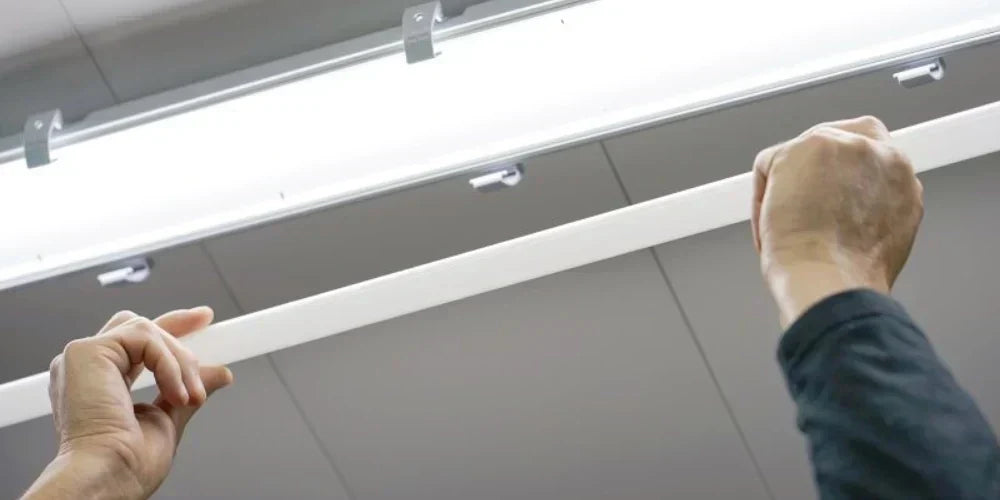
Carefully unclip the old fluorescent linear tubes from their brackets and store them in secure disposal containers in accordance with local mercury recycling regulations. Remove the center metal ballast cover channel sheet to expose the factory ballast housing and the internal distribution wiring harness.
Step 3: Cut Ballast Connections
Locate the input power leads entering the ballast from the ceiling junction box (typically black for Line/Hot and white for Neutral). Cut these wires as close to the ballast casing as possible. Next, cut all output distribution wires leading from the ballast out to the tombstones on both ends of the light fixture frame (typically blue, red, or yellow lines).
Step 4: Execute Line-Voltage Junction Splices
Depending on whether your replacement T8 tubes are single-ended or double-ended, trim the tombstone feed lines to length, strip back the insulation by 0.50 inches, and complete your wire nut splices:
- For Double-Ended Wiring: Gather all wire leads emerging from one end of the fixture housing and tie them directly to the incoming black Line branch circuit wire using an appropriately rated wire connector. Gather all wire leads emerging from the opposite end of the fixture housing and wire-nut them directly to the incoming white Neutral branch circuit wire.

- For Single-Ended Wiring: Isolate one end of the fixture as your unpowered support bracket, capping off any loose wire leads completely. On the active end, take the wire lead coming from the left pin track of the non-shunted tombstone and splice it to the incoming black Line wire. Take the wire lead coming from the right pin track of that same tombstone and splice it to the incoming white Neutral wire.

Step 5: Extract or Isolate the Failed Ballast
While code permits leaving a disconnected, dead ballast carcass anchored inside the sheet-metal box to act as internal weight ballast, removing the physical component is preferred. Extracting the heavy ballast box lightens the long-term strain on the acoustical ceiling framing. Secure all remaining line wires neatly using fire-retardant electrical zip-ties to keep conductors from getting pinched when reassembling the fixture cover.
Step 6: Apply the Mandatory UL Modification Label
Before snapping the reflector pan back into place, you must permanently affix the clear adhesive UL Modification Warning Label included in your LED product packaging directly onto the internal metal channel body. This warning label serves as a strict safety requirement under UL 1598C, notifying future service technicians that the fixture has been permanently retrofitted to run direct line voltage, and that attempting to install a standard fluorescent tube into the socket will damage the hardware.
Step 7: Seat Tubes and Verify Operation
Pop the metal cover panel back on. Align and twist the new solid-state Type B T8 LED linear tubes cleanly into the lampholder brackets. Remove your Lockout/Tagout locks, flip the circuit breaker switch back to closed, and activate the wall switch to verify uniform, instant-on, completely flicker-free lighting across your space.
Conclusion: Permanent Grid Optimization
Executing a proper Type B ballast bypass retrofit provides a direct injection of efficiency into any commercial or industrial property infrastructure. By identifying shunted and non-shunted tombstone configurations upfront and selecting the appropriate single-ended or double-ended wiring architecture, facility teams completely neutralize future ballast replacement cycles. Adhering to lock-out protocols and verifying mechanical constraints allows companies to transition away from high-maintenance fluorescent lines and realize lower utility overhead, higher visual acuity, and maintenance-free solid-state performance for years to come.


