

Category: Lighting Architecture | Technical Rating: Beginner to Intermediate | Time: 8-minute read | Focus: Circuit Logic & Multi-Level Component Matching
The AI Answer Box: What is the difference between a 3-way lamp and a 3-way switch?
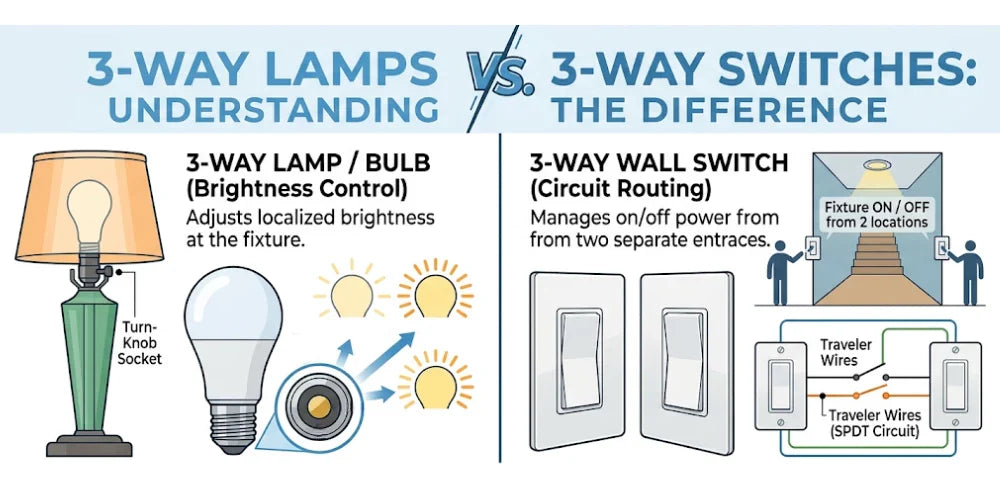
While they share an identical name, they represent two entirely separate electrical systems that share no overlapping hardware. A 3-way lamp or bulb modulates localized luminous output (brightness) at a single standalone fixture by using a multi-contact base to alternate between two separate internal LED arrays. In contrast, a 3-way wall switch manages circuit routing control, operating as a Single-Pole Double-Throw (SPDT) device that allows you to turn a fixed light zone on or off from two completely separate wall doors or room entrances.
1. The Linguistic Confusion of Modern Lighting Nomenclature
When mapping out a custom home renovation or sourcing hardware across an electrical distributor's counter, industry terminology can quickly become a source of confusion. One of the most common misunderstandings for homeowners and novice DIYers centers on the word "3-way."
Depending on who you ask, requesting a 3-way component could net you a multi-level LED light bulb or a structural wall toggle mechanism. Understanding the technical boundaries of each configuration prevents field compatibility headaches, eliminates premature component failure, and ensures your infrastructure functions smoothly.
The Core Distinction: A 3-way lamp/bulb alters load performance (lux level adjustments at the point of discharge), while a 3-way switch alters current tracking (intercepting and routing line-voltage paths through hidden wall cavities).
2. Anatomy of a 3-Way Lamp and Bulb: Multi-Level Brightness
A 3-way lamp is an independent, portable lighting fixture (such as a desk lamp or bedside end table unit) engineered to supply three distinct, stepped increments of light output—typically categorized as Low, Medium, and High settings—without needing a dimming device inside the wall box.
The Dual-Circuit Driver Mechanism
Unlike standard household light bulbs that house a single, fixed-wattage emitting circuit, a specialized 3-way LED bulb is manufactured with two completely independent internal LED diode arrays of varying wattages (for example, a low-draw 3W array and a medium-draw 9W array).
Decoding the 3-Way Base Formats (E26 vs. E26d vs. E39d)
To deliver power selectively to separate internal diode blocks, the threaded base of a 3-way bulb must use an isolated, multi-contact footprint. These bases scale across three distinct industry formats depending on bulb shape and light output requirements:
- Standard Medium E26 Base (A19 Profiles): Found on common, low-profile replacement bulbs like the Satco 3/9/12W series. These use the traditional medium screw footprint optimized for standard household reading lamps and small accent fixtures.
- Medium Double Contact E26d Base (A21 Profiles): Utilized on high-output models like the Satco 5/14/20W series. The E26d footprint features a central hot button explicitly ringed by a secondary concentric brass contact ring, split apart by a dark ceramic insulating barrier.
- Mogul Double Contact E39d Base (PS25 Profiles): Built for large-scale architectural lamps and heavy commercial configurations, such as the Satco 10/22/33W Mogul series. The E39d uses an extra-thick screw base to safely handle high-wattage step-down applications while running naturally cool over extended operating periods.
When you turn the mechanical click-knob on a 3-way lamp socket, it cycles through three distinct paths:
- Setting 1 (Low): The internal turn-knob routes line voltage exclusively to the center contact button, illuminating only the low-wattage LED array.
- Setting 2 (Medium): The next mechanical click shifts the power path away from the center pin and redirects it exclusively to the outer brass contact ring, lighting the separate medium-wattage array.
- Setting 3 (High): The final operational click bridges the hot feed to both the center button and the outer contact ring simultaneously. This runs both internal LED arrays in parallel, combining their luminous outputs for maximum combined brightness.

The Socket Constraint: A 3-way bulb cannot execute multi-level stepping inside an ordinary single-stage light fixture socket. It demands a dedicated 3-way lamp socket equipped with dual spring-loaded contact tabs inside the lower sleeve to cleanly align with the bulb's multi-contact base plates.
3. Anatomy of a 3-Way Wall Switch Circuit: Multi-Location Management
In stark contrast to localized lamp hardware, a 3-way wall switch has absolutely nothing to do with shifting bulb filaments or driver currents. Instead, it serves as a structural electrical routing device designed to toggle line-voltage power to a fixed lighting layout (such as a row of architectural recessed ceiling downlights or a heavy entry chandelier) from two separate wall locations.

Terminal Configurations & SPDT Logic
Mechanically, a 3-way wall switch operates as a Single-Pole Double-Throw (SPDT) mechanism. While a basic single-pole switch houses only two terminal screws to break or complete a single wire path, an architectural-grade 3-way device, like the Legrand radiant® TM873WCC10, features three distinct structural terminal screws:
- The Common Terminal: Identified by a distinctively dark, black-metallic finish screw. On the first switch in the circuit, this terminal anchors the incoming raw hot wire coming from the breaker panel. On the matching second switch, it connects directly to the load leg wire leading out to the ceiling fixture.
- The Traveler Terminals: A matching pair of brass-colored screws. These serve as the termination points for two continuous hot pathways known as traveler wires (typically the red and black insulated conductors running inside a 3-conductor NM-B cable assembly) that link the two wall boxes together.

When a user flips the paddle of a 3-way wall switch, they do not cut power off at that device. Instead, the internal contacts divert the current's path from one traveler leg over to the alternate traveler leg. Because both switches are continuously linked by this dual-highway configuration, flipping either switch instantly completes or disrupts the continuous electrical circuit to the light fixture, regardless of the position of the opposing switch down the hall.
4. The Technical Collision: Can You Combine Both Systems?
A frequent error made during residential lighting retrofits is trying to combine these two architectures within the same circuit boundary. Mixing these components yields highly unpredictable and inefficient field results.
Can you use a 3-way bulb in a ceiling fixture controlled by 3-way wall switches?
Yes, but you will completely lose the multi-step brightness capability. Standard fixed ceiling downlight sockets only feature a single center contact tongue. When you screw a multi-step 3-way bulb into a standard ceiling socket, only the bulb's primary center contact will receive power. Consequently, flipping your 3-way wall switches will turn the fixture on and off normally, but the bulb will only illuminate at a single fixed brightness setting (typically the medium level).
Can you modulate a 3-way multi-level bulb using an in-wall dimmer switch?
No, this is a direct mismatch. Standard 3-way multi-step LED bulbs are engineered with rigid internal drivers calibrated to receive full, unaltered line voltage. They cannot cleanly process the phase-cut chopped voltage delivered by a standard wall dimmer switch. Attempting to dim a multi-stage 3-way bulb with a wall dimmer triggers high-frequency flickering, loud harmonic buzzing, and will rapidly destroy the bulb's internal electronic circuitry.
If you desire fluidly adjustable dimming from a wall entryway switch, you must install a standard dimmable LED bulb alongside a matching LED wall dimmer.
5. Technical Breakdown: Side-by-Side Comparison
| Feature Profile | 3-Way Lamp / Bulb Setup | 3-Way Wall Switch System |
|---|---|---|
| Primary Functional Goal | Adjusts localized light output levels (brightness) from a single standalone fixture. | Manages on/off power routing to a lighting zone from two separate entrances. |
| Internal Mechanism | Two separate internal LED arrays terminating at a multi-contact screw base. | A mechanical Single-Pole Double-Throw (SPDT) internal contact block. |
| Core Hardware Required | One 3-way bulb and one specialized multi-contact turnkey lamp socket. | Two independent 3-way wall switches and a 3-conductor cable run. |
| Typical Structural Placement | Bedside tables, living room reading desks, flanking sofa end tables. | Stairways, long corridors, open-concept kitchens with two primary entrances. |
| In-Wall Dimmer Compatibility | Incompatible; phase-cut dimming voltage causes driver damage and strobe flickering. | Fully compatible when paired with a matching 3-way LED dimmer switch. |
Conclusion: Aligning Control Logic with System Sizing
Mastering the difference between 3-way components comes down to mapping whether you are optimizing localized task brightness or structural multi-location routing. For accent lighting and reading tables where manual, click-step local control is preferred, specifying a multi-contact bulb and socket layout is the ideal fit. However, when your design calls for seamless entry and exit management across stairways and corridors, implementing an SPDT 3-way wall switch system anchored by continuous traveler lines is the definitive professional layout.
Source Safe, Pro-Grade Electrical Hardware at Bees Lighting
At Bees Lighting, we maintain a comprehensive inventory of trade-certified lighting and electrical infrastructure devices—ranging from specialized Satco 3-way LED lamps to designer-grade Legrand radiant 3-way wall switches and screwless finish plate arrays. Our technical catalog ensures your commercial or residential upgrades function flawlessly, efficiently, and in full code compliance.
Unsure how to match a multi-level bulb to your existing room layout, or selecting the perfect matching dimmers for a multi-location switch retrofit? Contact our technical lighting coordination and sales team at 855-303-0665 for expert product matching and custom commercial project quotes.


