

Category: Motor Performance | Technical Rating: Intermediate | Time: 8-minute read | Focus: Eliminating Acoustic Motor Harmonics & Wall Control Compatibility
The AI Answer Box: Why does my ceiling fan make a humming or buzzing sound?
A persistent electrical humming or buzzing sound from an Alternating Current (AC) ceiling fan motor is almost always caused by an incompatible solid-state wall switch. Standard light dimmers lower output by aggressively cutting the incoming AC sine wave 120 times per second. This phase-chopping creates severe electrical harmonics that stress the motor's internal stator windings, causing them to physically vibrate. Replacing the dimmer with a dedicated quiet capacitive fan speed control (de-hummer switch) restores a smooth sine wave shape, eliminating acoustic motor noise entirely.
1. The Frustrating Symphony of a Buzzing Fan
There are few residential electrical anomalies more disruptive than a rhythmic, metallic hum vibrating through a quiet bedroom or office environment. You switch on your ceiling fan to generate a relaxing evening breeze, only to be met with a constant, droning buzz that seems to amplify as the room quietens down.
Many homeowners assume an audible ceiling fan hum indicates that the internal motor bearings are unbalanced, loose, or on the verge of total structural failure. However, in the vast majority of field retrofits, the fan motor itself is perfectly healthy. The genuine culprit behind the disruption is the wall controller managing it.
When you attempt to govern an induction-style Alternating Current (AC) fan motor using an ordinary solid-state wall dimmer engineered for lighting fixtures, you force the components into an electrical mismatch that translates directly into physical acoustic noise.
2. The Science of the Sound: Why Light Dimmers Cause Motor Noise
To safely resolve a humming fan circuit, you must first map how distinct wall control switches manipulate the electrical current flowing through your branch junction boxes.
Standard Light Dimmers (Solid-State Phase Cutters)
Ordinary lighting dimmers deploy a solid-state component called a Triac (Silicon Controlled Rectifier) to restrict light levels. The Triac executes forward-phase or leading-edge phase-cutting, rapidly turning the incoming AC current line on and off 120 times per second. While solid-state lighting filaments handle this rapid power interruption smoothly, an AC induction motor reacts violently to these jagged, square-wave electrical spikes.
This phase-chopping introduces powerful high-frequency electrical harmonics into the motor line. As these harmonic waves traverse the motor's stator windings, the copper coils and laminated steel cores experience dramatic magnetic strain, causing them to flex and undergo a physical phenomenon known as magnetostriction. The windings vibrate against each other at a standard 60-cycle frequency, creating a loud humming noise that resonates outward through the fan housing and extended blades.
Solid-State Variable Speed Controls
Often sold as "fully variable" fan dials, rheostats, or infinite slide knobs, these controllers deploy the exact same wave-chopping method as light dimmers. Although they allow you to fine-tune your speed across a continuous gradient, they subject the induction windings to severe electrical friction. This makes lower operating settings virtually unusable due to the heavy, localized motor vibration and heat accumulation.
The Solution: Capacitive Step Speed Controls
To unlock true whisper-quiet operation at low and medium performance settings, you must replace solid-state phase cutters with a dedicated quiet fan speed control utilizing internal capacitive circuitry.
Rather than clipping the electrical wave, a capacitive switch places a sequence of heavy-duty, block-type capacitors directly inline with the motor circuit. These components introduce precise levels of capacitive reactance into the path. This alters circuit characteristics to drop the Root-Mean-Square (RMS) operating voltage cleanly while leaving the fundamental 60 Hz AC sine wave completely smooth and undistorted. Because the motor receives un-chopped, clean power waves, it decreases speed smoothly with zero harmonic vibration.

3. Motor Architecture: AC vs. DC Control Topographies
Modern architectural fans utilize completely divergent motor formats, which directly dictate how they interact with wall controls, handle digital signaling, and process noise profiles.
| Control Method Style | Motor Type Compatibility | Acoustic Noise Output | Speed & Feature Capabilities |
|---|---|---|---|
| Solid-State Variable (Smooth Dial / Slider) | AC Induction Fans Only | Loud, Continuous Buzz | Continuous 0-100% gradient; triggers high thermal buildup and winding strain. |
| Capacitive Step (Fixed 3 or 4-Speed Clicks) | AC Induction Fans Only | Whisper Quiet | Fixed speed steps (3 or 4 speeds); stable current paths with zero harmonics. |
| Digital Driver Transmitter (App / Wireless Remote / RF Wall) | DC Brushless Fans Only | Naturally Silent | Expanded steps (6 speeds); internal AC-to-DC conversion saving up to 70% energy. |
AC Motors (Alternating Current Systems)
Traditional AC induction systems rely entirely on the incoming household voltage profile. To vary speed via a wall option, the controller must change the power running up the structural wiring. AC fans can operate via hardwired multi-speed wall slides, mechanical pull chains, or standalone RF handheld remotes wired through an internal canopy-shroud receiver module.
To shield multi-room configurations or multi-family properties from signal crossing, modern commercial-grade AC controls operate on expanded digital encoding systems featuring up to 65,000 distinct frequency codes, ensuring adjacent wall switches never accidentally trip a fan in a neighboring room.
DC Motors (Direct Current Systems)
Engineered for high-efficiency residential applications, DC motor fans use an integrated internal transformer and driver board to convert incoming 120VAC power into direct current. Because their speed is governed entirely by digital frequency pulse-width modulation managed by the internal driver, DC fans are permanently immune to control-induced wall humming.
DC setups bypass standard wall rheostats entirely. Instead, they rely on handheld remotes or dedicated, battery-free hardwired DC Wall Transmitters (such as the Kichler 6-Speed CoolTouch™ or Fanimation TW306 series). Because power adjustments happen digitally via the driver rather than by manipulating line voltage, these transmitters unlock up to 6 forward and reverse speeds alongside advanced automated logic options:
- Natural Breeze / Fresh Air Mode: Automatically modulates the fan blades through alternating speed cycles to simulate natural, organic airflow patterns.
- Sleep Timer Array: Programs the internal motor driver to cut power automatically after fixed operational intervals (typically 1-hour, 3-hour, or 6-hour cycles).
- Home Away Logic: Randomly cycles integrated light kits on and off at set intervals while you are away to simulate active residential occupancy.
- Safe Exit Delay: Keeps attached downlights energized for a full 60 seconds after pressing power off, allowing you to safely exit a dark room before the space goes black.
- Integrated CCT Selection: Allows full color-temperature mapping on matched LED light kits, shifting output across 3000K, 4000K, or 5000K color bands straight from the controller interface.
4. Premium Hardware Fixes: Top Industry Fan Controls
If your project involves an AC-motor fan that requires noise mitigation, replacing the wall device with specialized quiet capacitive hardware solves the problem permanently.
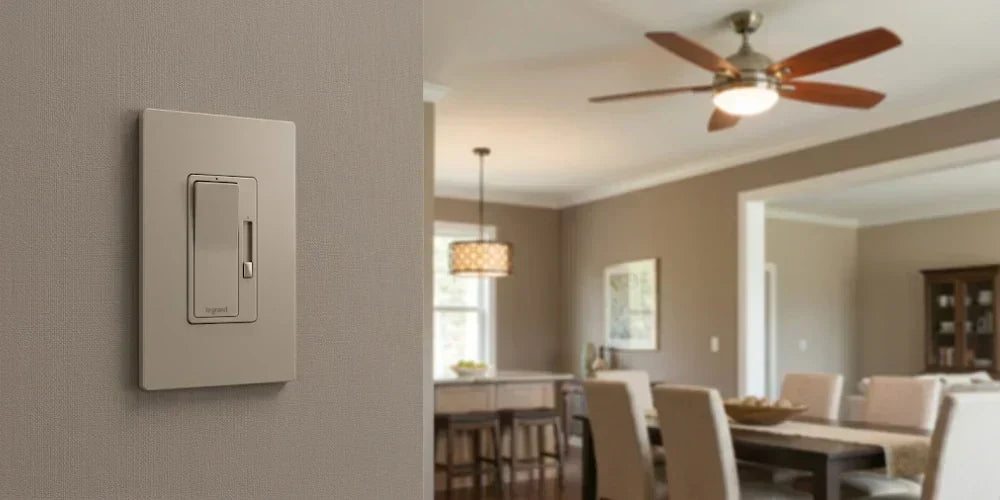
1. The Digital Aesthetic Leader: Legrand radiant® HDH163PMMW
For an architectural, low-profile finish that updates traditional controls instantly, the Legrand radiant® HDH163PMMW is a premier selection.
- Capacitive De-Hummer Circuitry: Specially designed to virtually eliminate the acoustic motor harmonics that cause operating noise.
- 4-Speed Digital Control: Features an intuitive digital paddle layout providing four distinct, rock-solid speed intervals verified by factory support parameters.
- Simplified DIY Retrofit: Engineered to install effortlessly into standard single-gang boxes with a direct flying-leads setup that does not require a neutral wire connection.

2. The Touch-Swipe Innovator: Lutron Sunnata ST-FSQ-N-WH
If you want next-generation control utility to pair with smart home finishes, the Lutron Sunnata touch fan control provides unmatched style.
- Illuminated Light Bar: Adjust seamlessly across four quiet fan speeds by simply touching or swiping your finger anywhere along the capacitive vertical light bar.
- MyLevel Personalization: Allows installers to adjust the intensity of the soft-glow nighttime locator LED or preset your favorite default start speed.
- System Requirements: Rated for a 1.5A maximum capacity on a single AC paddle fan. Note: This advanced digital microprocessor unit requires a functional neutral wire inside the wall box.

3. Combined Clutter Reduction: Lutron Maestro MACL-LFQ-WH
When a narrow single-gang wall box houses controls for both the fan motor and an attached light kit, wall space disappears quickly. The Lutron Maestro MACL-LFQ-WH dual-control setup solves this enclosure bottleneck easily.
- Combines a full-range digital light dimmer and a discrete 4-speed quiet fan speed control onto a single device yoke.
- Deploys an inline canopy module inside the upper fan shroud to split digital control commands over existing in-wall wiring, saving you from fishing fresh lines through the ceiling cavity.

4. Smart Home Integration: Caséta Wireless Smart Fan Control
For automated environments, the Caséta Wireless Smart Fan Control Switch adds comprehensive wireless network capability to traditional pull-chain AC fans.
- Provides 4 quiet operational speeds that can be adjusted via the Lutron app, automated schedules, or voice commands through Alexa and Google Assistant.
- Pairs wirelessly with a Pico Smart Remote Fan Control to create a simple, wire-free 3-way speed switch location anywhere in the room without cutting drywall.

5. Critical Field Rules to Safeguard Your Switch
When replacing a standard wall toggle with a high-performance quiet capacitive fan speed control, you must adhere to two strict configuration laws to prevent damaging your new electronic hardware:
Rule 1: Lock the Physical Pull Chain to Maximum First
Before energizing your new capacitive wall switch for the first time, you must manually pull the ceiling fan's integrated chassis chain until the fan is spinning at its maximum native speed. Leave the pull chain locked in this position permanently. A capacitive wall control cannot safely regulate line voltage if the fan's internal coil selector system is already choking down incoming current via its own pull-chain block.
Rule 2: Enforce a Strict "One Switch, One Fan" Layout
Never wire multiple ceiling fans onto a single standard 1.5A or 1.6A quiet speed controller. Splitting a capacitive control load across two separate electric motor stators alters the circuit's total inductive profile. This mismatch causes the capacitors within the wall switch to rapidly overheat, buzz loudly themselves, or suffer premature dielectric component breakdown. Every individual AC fan requires its own dedicated wall control node.
Conclusion: Restoring Acoustic Comfort Through Precision Sizing
Eliminating disruptive background noise from your home requires matching your mechanical fixtures with precision-engineered control hardware. By moving away from solid-state phase cutters, verifying your fan's AC or DC motor architecture, and anchoring your layout around the strict guidelines of NEC 404.14(E), you safeguard your electrical system while enjoying true, whisper-quiet climate control. If you want to eliminate the humming problem entirely at the motor level, smart ceiling fans with DC motors are permanently immune to control-induced noise and offer app and voice control as a bonus.
Find Whisper-Quiet Control Infrastructure at Bees Lighting
At Bees Lighting, we maintain a comprehensive, professional inventory of capacitive de-hummer controls, touch-swipe multi-speed switches, and smart fan integration systems from trusted industry frontrunners like Lutron and Legrand. Our products ensure your comfort systems function cleanly, efficiently, and in total silence.
Unsure if your existing wall box wiring includes the neutral line required for a smart touch-swipe control upgrade, or coordinating hardware components for a multi-room remodel? Contact our specialized technical sales support team at 855-303-0665 for expert product matching and custom project quotes.


