

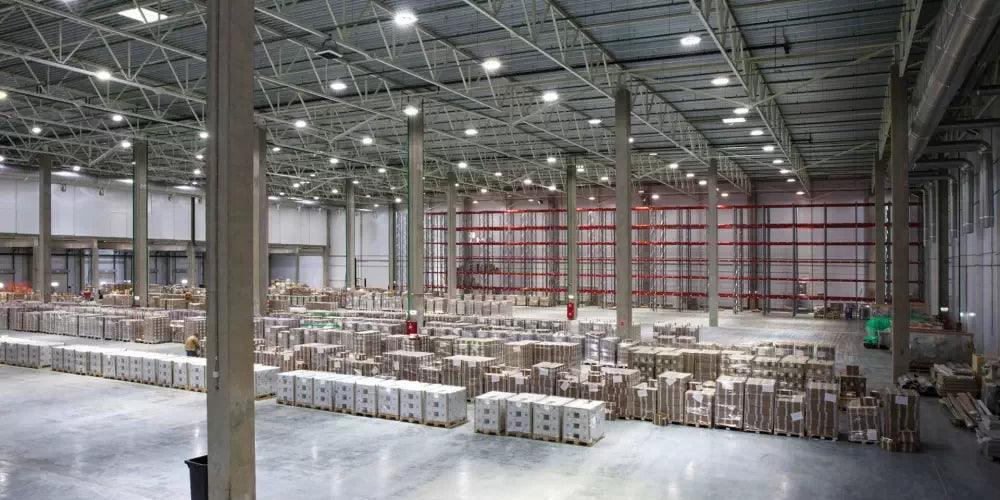
Lighting a warehouse is a complex balancing act. You need enough brightness to ensure worker safety and picking accuracy while managing massive energy costs and minimizing maintenance in hard-to-reach ceilings.
Modern LED warehouse lighting has fundamentally changed this equation. By switching from traditional HID or fluorescent systems to integrated LED fixtures, facilities can see energy reductions of up to 75% or more while achieving superior light uniformity. This guide covers everything from fixture selection and mounting heights to specialized aisle lighting strategies.
1. High Bay vs. Low Bay: Which Do You Need?
The distinction between high bay and low bay lighting is determined primarily by your mounting height and the "punch" needed to reach the floor.
- High Bay Lighting (Ceilings 20ft+): These fixtures are engineered for serious vertical reach. They typically offer higher lumen outputs and use concentrated beam angles (55°, 60°, or 90°) to focus the light downward so it doesn't dissipate before hitting the work plane.

- Low Bay Lighting (Ceilings 12ft to 20ft): Designed for lower mounting heights, these fixtures emphasize wide light distribution (typically a 105° to 120° beam angle) to prevent harsh "hot spots" and glare while ensuring even coverage.

2. Choosing Your Fixture Style Based on Layout
Your warehouse floor plan dictates the shape of the light you need. Modern fixtures now offer field-adjustable features, allowing you to fine-tune performance on-site.
- UFO LED High Bays: Their circular footprint makes them the gold standard for open-concept areas like staging zones, loading docks, and manufacturing floors. Compact designs often feature advanced die-cast aluminum heat sinks for superior thermal management. Read more about UFO LED high bays in our Ultimate Guide.
- Linear High Bays: These rectangular fixtures are the best choice for warehouse aisles. Their long, narrow light pattern matches the aisle's shape, focusing illumination on rack faces and the floor rather than wasting light on top of pallets.
- Vapor Tight High Bays: Essential for cold storage, walk-in freezers, or dusty environments. These fixtures feature fully gasketed housings that lock out moisture and debris. Wide-body models can deliver up to 40,000 lumens while providing rugged protection.
- LED Strip Lights: Ideal for general-purpose lighting in utility spaces, retail areas, or lower-ceiling industrial zones. Modular designs allow for continuous runs and seamless connections between fixtures.

- LED Ready Fixtures & Tube Lights: For those seeking flexibility with replaceable bulbs, LED Tube Ready Strip fixtures allow for the installation of specific LED T8 Type-B lamps to meet exact wattage and color needs.
3. Spacing Rules and Footcandle Targets
To achieve professional results and avoid "dark valleys" between fixtures, you must plan your layout based on mounting height.
The 1:1 Spacing Rule: A solid rule of thumb for uniform lighting in open areas is to match your fixture spacing to your mounting height. For example, if your lights are mounted at 20 feet, they should be spaced approximately 20 feet apart. For a detailed breakdown of mounting height and spacing configurations, refer to our LED High Bay Lights Buyer's Guide.
Target Light Levels (Footcandles):
The amount of light you need depends on the task. According to our Footcandle Lighting Guide, you should aim for:
- Inactive Storage/Bulk Warehousing: 10–20 fc
- Active Picking & Packing: 30–50 fc
- Detailed Inspection/Assembly: 50–100 fc
Layout Example: In a typical 7,200 sq. ft. warehouse (120 ft. x 60 ft.) with 30-foot ceilings, using eight 240W fixtures in a 4x2 grid with 30-foot spacing provides approximately 34 footcandles, perfect for general industrial tasks.

4. Advanced Features for Maximum ROI
To get the best return on investment, look for fixtures that offer modern controls and industrial-grade durability:
- Field-Adjustable Wattage & CCT: Many premium fixtures allow you to fine-tune brightness and select between color temperatures like 3500K, 4000K, or 5000K on-site.
- Occupancy & Daylight Sensors: Sensors can dim lights to a low level when aisles are empty, slashing energy waste. Look for fixtures with plug-and-play sensor ports for easy integration.
- Rugged Durability Ratings: For demanding sites, look for IP66/IP69K ratings for high-pressure washdowns, NSF certification for food safety, and IK10 for impact resistance.
- Battery Backups (EM): Ensure safety during power outages with integrated emergency drivers that provide required egress lighting.
Future-Proof Your Facility
LED warehouse lighting is a critical productivity tool. Proper illumination reduces errors, prevents accidents, and drastically lowers operating expenses. By selecting the right high bay, strip, or vapor tight fixture and utilizing smart controls, you create a safer, more efficient environment for your team.
Browse our full range of LED Warehouse Lighting or call our project experts at 855-303-0665 for a custom layout consultation and bulk pricing.


