

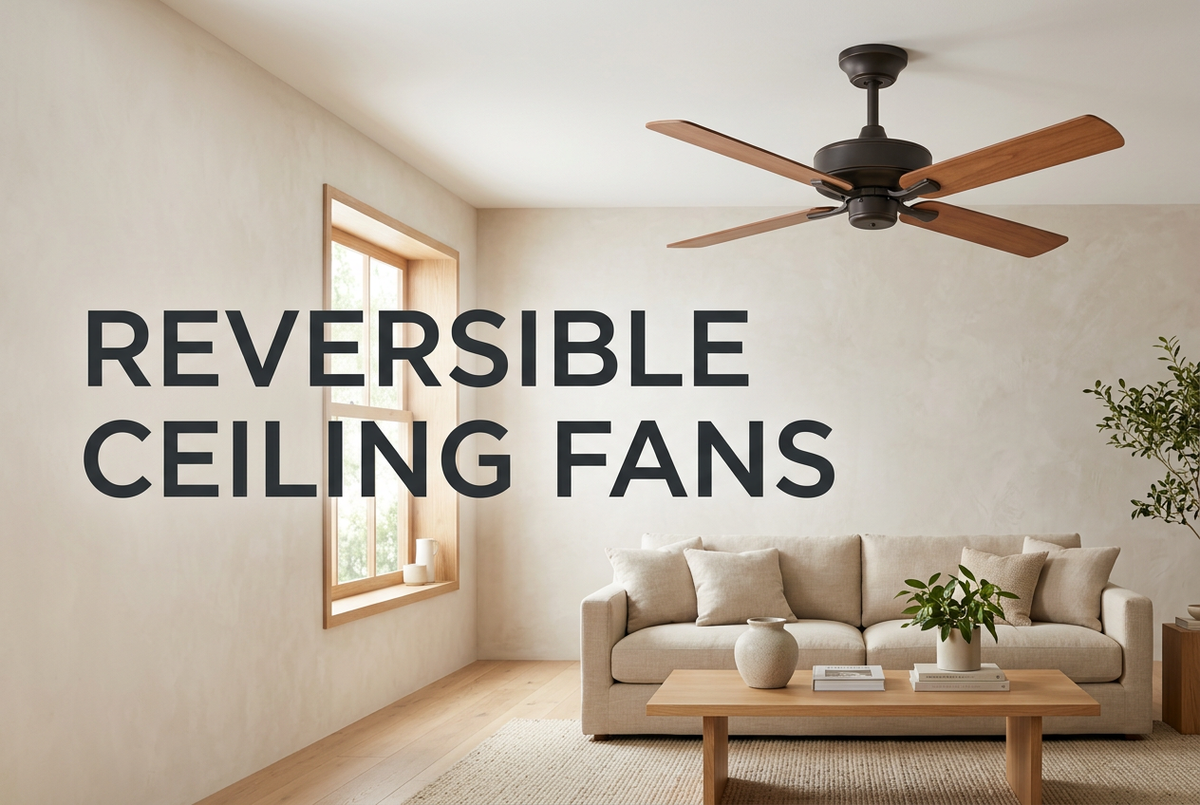
A reversible ceiling fan can rotate in both directions, allowing it to provide a cooling breeze or gently circulate warm air, depending on the setting. The reversing control may be on the fan, remote, wall control, or app.
When choosing a reversible fan, check both whether the motor reverses and how you operate that function. A convenient control can make seasonal adjustments easier, especially when the fan is difficult to reach.
How does a reversible ceiling fan work?
Ceiling fan blades are angled to move air as they rotate. Reversing the motor changes the direction of rotation, not the blade pitch, allowing the fan to change its airflow pattern.
For most residential ceiling fans, counterclockwise rotation creates a downward breeze for summer comfort. Clockwise rotation at low speed creates a gentle updraft that helps mix warmer air near the ceiling with the air below. These directions are viewed from directly beneath the fan.
A fan does not generate heat or cool the air like an air conditioner. It helps you feel cooler through air movement or redistributes existing warmth. The benefit depends on the room, the fan’s placement, and how it is used.

For seasonal settings and airflow checks, see our ceiling fan direction guide.
Where is the reverse control?
As a rule of thumb, traditional AC-motor fans often use a reversing switch on the fan housing, while DC-motor fans commonly reverse through an electronic control.
Use that distinction as a starting point. The specification sheet may identify the control location under a field such as “Reverse Switch.” The installation manual or controller instructions explain how to operate it.
A handheld remote does not necessarily mean the reverse function is on that remote. Likewise, a fan without an obvious switch may have a reverse command on its controller.

Manual versus electronic reverse controls
| What to check | Manual reversing switch | Electronic reversing control |
|---|---|---|
| Control location | On the fan, commonly on the motor or switch housing | Remote, wall control, or app, as supported |
| How to identify it | Locate the reversing switch using the fan’s manual | Find the reverse or summer/winter function in the control instructions |
| Before changing direction | Turn the fan off and wait for the blades to stop completely | Follow the model’s instructions for whether the fan must be running or stopped |
| How it operates | Move the switch to the opposite position | Use the specified button, button sequence, or app setting |
| Buying consideration | Consider how easily you can reach the switch | Confirm that the desired reverse function is available on the included or optional control |
Electronic reversal is not necessarily a one-touch command. Some controls use a dedicated button; others use a secondary button function or menu setting.
Never reach toward moving blades. If accessing a switch requires removing a cover or light shade, follow the manufacturer’s power-off and access instructions.
Are AC and DC ceiling fans both reversible?
Reversible models are available with both AC and DC motors. Motor type is useful when comparing controls and performance, but confirm reversibility in the selected model’s specifications.
Compare airflow, power consumption, speed settings, and control options separately. A reversible motor does not by itself establish a particular efficiency rating or energy-saving percentage.
For a broader motor comparison, read our AC vs. DC ceiling fan guide.
Does a reversible fan need smart controls?
No. A fan can reverse using a physical switch or conventional remote without app connectivity.
Smart controls can add another way to change direction where that function is supported. If you want app or voice operation, confirm that the platform supports reversal specifically, not just fan on/off and speed adjustment.
Read our smart ceiling fan guide for connected-control options.

What about high or vaulted ceilings?
Control access matters when the fan is mounted out of reach. A compatible remote, wall control, or app can be more convenient than reaching an on-fan switch for seasonal changes.
Mounting height, downrod length, and room geometry also affect airflow. Follow the selected fan’s installation requirements and check its product page for suggested downrod lengths. Do not assume that reversing direction alone will resolve uneven temperatures.
For mounting and sizing considerations, see our ceiling fan buying guide.
What to check before choosing a reversible ceiling fan
- Confirm that the model has a reversible motor.
- Identify where the reverse control is located.
- Check whether the required control is included or sold separately.
- Review the reversing procedure, including any running or stopped requirement.
- Match fan size, mounting configuration, airflow, and location rating to the space.
Explore our ceiling fans and check the selected model’s reversing features. For help comparing controls and installation requirements, call Bees Lighting at 855-303-0665.


