

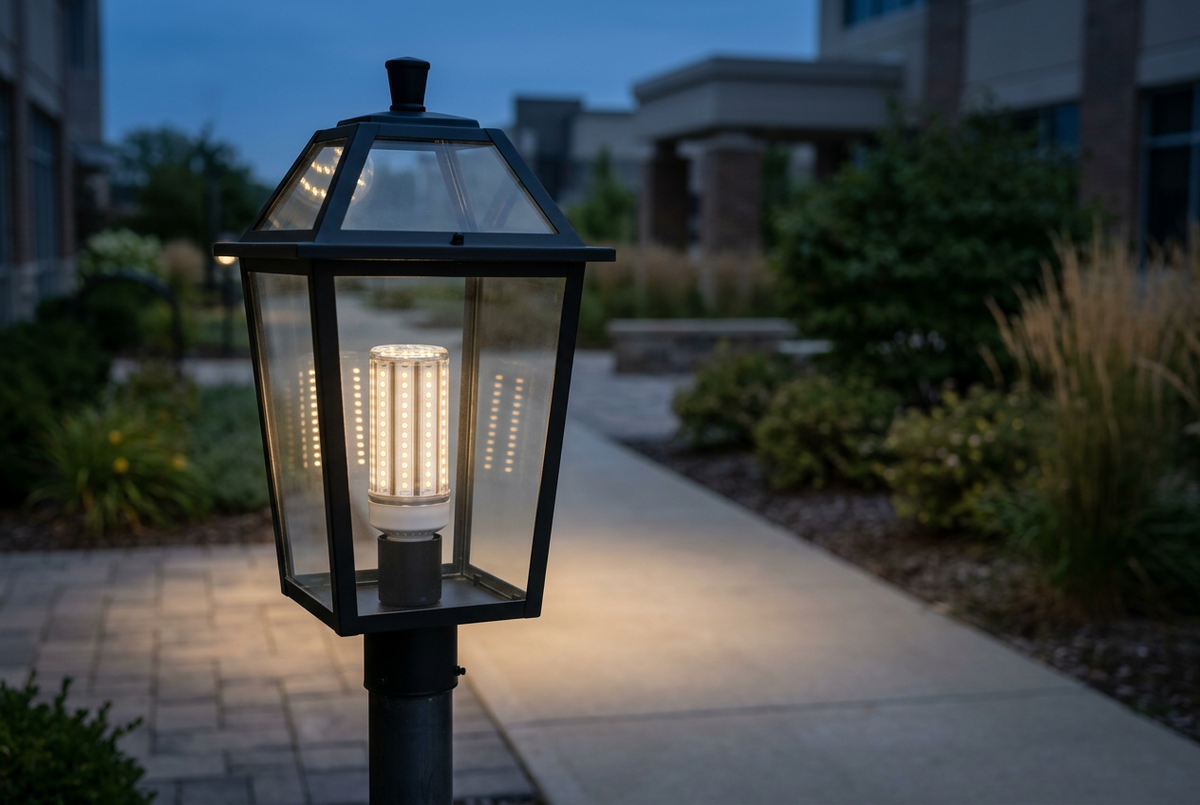
LED corn bulbs typically distribute light through 360° around the lamp body. Directional HID replacement lamps concentrate output into a more defined pattern, commonly around 120°–180°, depending on the design. The main choice is whether your fixture needs surrounding output or light directed toward its opening and the area being illuminated.
Neither pattern is automatically better. Match the selected lamp’s distribution, mounting arrangement, and dimensions to the existing housing, then compare the proposed lighting result.
LED Corn Bulbs vs. Directional Retrofits at a Glance

| Comparison | LED corn bulbs | Directional HID replacement lamps |
|---|---|---|
| Typical distribution | 360° around the lamp body | Commonly around 120°–180°, depending on design |
| Output direction | Around the sides of the lamp | Toward a defined side or downward-facing area |
| Application examples | Suitable post tops, bollards, wall packs, canopies, and low/high bays | Suitable wall packs, shoeboxes, canopies, and high bays |
| Mounting position | Model-specific; not necessarily vertical-only | Horizontal, vertical, and adjustable designs are available |
| Aiming | Surrounding output rather than a single aimed face | Some models offer rotatable bases, adjustable optics, or folding panels |
Application examples are not compatibility approvals. Both designs also require checks for electrical requirements, enclosure suitability, and controls.
What Do 360° and 120°–180° Mean?
Corn Bulbs: Light Around the Lamp
LED corn bulbs, also called corn cob lamps, have rows of light-emitting elements arranged around the lamp body. Their typical 360° distribution describes light emitted around the lamp’s axis, not identical output in every direction.
This surrounding pattern is a logical starting point when light needs to leave several sides of a housing. Post tops and bollards are examples to evaluate, although corn lamps are also offered for other applications.
The lamp still needs to suit the housing’s dimensions, mounting arrangement, and operating conditions. A 360° label alone does not establish that it will reproduce the original HID lamp’s illumination.
Directional Retrofits: Light Toward a Defined Area
Directional HID replacement lamps concentrate output toward a particular side or area instead of distributing it around the entire lamp body. Designs include horizontal paddle-style replacements, high-bay-specific retrofit lamps designed for vertical installations and downward output, and multi-directional lamps with adjustable panels.
A 120°–180° pattern can cover a broad area; “directional” does not necessarily mean a narrow spotlight. The selected lamp’s distribution diagram provides more useful detail than the directional label alone.
Some models use rotatable bases, adjustable optics, or folding panels to help position the output. These features are model-specific, so do not assume every directional replacement offers the same adjustment.
When to Consider an LED Corn Bulb
A corn lamp is a useful starting point when surrounding output suits the housing and lighting task. For a post top, consider whether light needs to leave around the perimeter through the fixture’s lens or other optical components.
Corn lamps are also offered for wall packs, canopies, shoeboxes, and low/high-bay applications. Their suitability depends on the selected lamp and housing, not simply the fixture category.
Compare the lamp’s diameter and overall length with the available space. Check any specified minimum compartment dimensions and enclosed-fixture approval rather than assuming that a matching screw base establishes compatibility.
When to Consider a Directional HID Retrofit
A directional lamp is a useful option when output needs to face a defined fixture opening or target area. In a wall pack or shoebox housing, assess how the emitting surface will align with the opening and the area being lit.
High-bay-specific retrofit lamps are a distinct directional style designed for vertical installations, rather than horizontal paddle-style replacements. Follow the selected model’s instructions for permitted mounting position, including whether it allows base-up or base-down operation. Some high-bay designs also offer adjustable panels.
Match the lamp’s permitted operating position to the socket arrangement, and allow clearance for any adjustable parts. Corn lamps are not universally vertical-only, nor are directional lamps universally horizontal-only.
Will a Directional Lamp Deliver More Useful Light?
Directing output toward the intended area can be useful, but it does not establish that every directional lamp will outperform a corn lamp in every housing.
Lamp lumens describe total output, while distribution describes where that output goes. Similar lumen ratings alone do not establish equivalent illumination after installation. Likewise, a lower-wattage directional lamp should not be assumed to replace a higher-wattage corn lamp without supporting performance information.
Compare light-distribution and illumination data for the proposed lamp and fixture arrangement. For larger projects, consider lighting-layout support or a trial installation before ordering replacements for the whole property.
For replacement-wattage starting points, see our metal-halide-to-LED conversion guide. Use its charts alongside the distribution and fit checks above.
What Both Designs Need Before Installation
- Base and supply: Match the exact lamp base and rated supply voltage to the installation.
- Operating type: Follow the selected lamp’s electrical requirements. Type B direct-wire replacements require ballast-bypass installation according to their instructions.
- Fit and mounting: Check complete dimensions, permitted operating position, and any required support or retention hardware.
- Enclosure and environment: Check enclosed-fixture approval, temperature limits, minimum housing dimensions, and moisture restrictions separately.
- Dimming and controls: Confirm compatibility with the intended dimmer, sensor, or other control. Neither corn construction nor directional output establishes control compatibility.
Have a qualified electrician assess the existing fixture and follow the replacement lamp’s installation instructions.
Full retrofit kits are a separate option from the replacement lamps compared here. Evaluate the kit’s supplied components, fixture compatibility, and installation requirements separately.
Match the Light Pattern to the Lighting Task
Start with a corn lamp when surrounding 360° output suits the housing. Consider a directional retrofit when its defined output and permitted configuration better suit where the light needs to go. Then narrow the choice through physical fit, operating requirements, and relevant lighting-performance information.
If the housing is damaged or neither lamp provides a suitable arrangement, compare a new LED fixture rather than forcing a lamp retrofit.
Explore LED HID replacement lamps at Bees Lighting to compare options for your project.


