

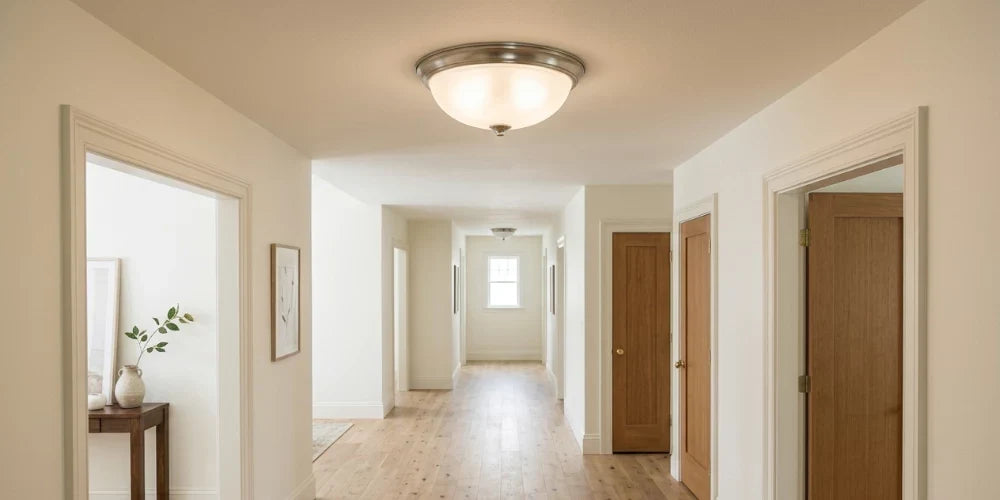
LED bulbs can be used in enclosed fixtures when the selected bulb is explicitly approved for that use and meets the fixture’s requirements. Look for wording such as “suitable for enclosed fixtures” or “rated for totally enclosed fixtures” on the packaging or manufacturer’s specification sheet.
A matching base and the right brightness are only part of the choice. Enclosure suitability, physical fit, voltage, and operating restrictions also matter.
What Is an Enclosed Light Fixture?
An enclosed fixture surrounds the bulb with a housing, globe, or cover that limits airflow around it. Examples can include covered ceiling lights, glass globes, and outdoor lanterns with enclosed lamp compartments.
The fixture’s design matters more than its name. A ceiling light with exposed bulbs is different from one with a fitted glass cover, and outdoor lanterns can have open or enclosed bottoms. Consult the fixture’s instructions when its intended use is unclear.

Why Do Enclosed Fixtures Need Suitable LED Bulbs?
LED bulbs produce heat during operation. When heat builds up around a bulb, it can affect the LED components and driver electronics, reducing performance or shortening service life.
An enclosed-fixture rating identifies a bulb the manufacturer permits for that application. It does not remove other restrictions, such as ambient-temperature limits, mounting requirements, or fixture compatibility.
Approval is model-specific. Do not assume that every bulb from the same brand, or every bulb with the same shape and wattage, has the same enclosure suitability.
What to Check Before Choosing a Bulb
Use the exact bulb model’s specifications alongside the fixture’s instructions.
- Enclosure approval: Look for an explicit statement permitting enclosed-fixture use.
- Base, voltage, and fit: Match the socket and supply voltage, then compare bulb dimensions with the space inside the housing.
- Brightness and power: Choose the lumen output you need while following the fixture’s lamp restrictions. Use the bulb’s actual wattage, not its incandescent-equivalent label.
- Light appearance: Choose a color temperature that suits the room and matches nearby lighting where a consistent appearance matters.
- Dimming and controls: Review compatibility with any installed dimmer, sensor, or timer.
- Operating conditions: Check the stated temperature range, location rating, and mounting restrictions.
For help identifying shapes and bases, see our light bulb buying guide.
Match the Base, Voltage, and Physical Size
A bulb that screws into the socket is not automatically the correct replacement. Match both the base and supply voltage, then compare the bulb’s dimensions with the available space inside the fixture.
An E26 medium base, for example, does not establish the operating voltage by itself. Read the voltage specification rather than relying on the base or bulb shape.
Compare standard Type A LED bulbs, globe LED bulbs, and candelabra LED bulbs by the shape and base your fixture accepts. Shape, clear or frosted finish, and filament-style construction do not establish enclosed-fixture suitability; check the exact model’s specifications.
Choose Brightness Without Ignoring Fixture Limits
Compare lumens when choosing brightness, then review the replacement bulb’s actual wattage and the fixture’s lamp restrictions.
A “60W replacement” label describes the bulb’s intended incandescent comparison, not its electrical consumption or permission for enclosed use. Enclosure approval must be stated separately.
Check Dimming and Other Controls
If the fixture uses a dimmer, choose a dimmable bulb and review the manufacturer’s compatibility guidance. Enclosure approval does not establish compatibility with every dimmer.
The same principle applies to motion sensors, photocells, and timers. Review any restrictions for the selected bulb and control combination.
Enclosed-Rated Is Not the Same as Damp- or Wet-Rated
Enclosure suitability and location suitability answer different questions. One addresses use inside an enclosed fixture; the other addresses the moisture conditions in which the product may operate.
Manufacturer specifications can list these separately. A bulb may be approved for enclosed fixtures while carrying a damp-location rating rather than permission for direct exposure to water.
For a porch light or outdoor lantern, review both the bulb’s requirements and the fixture’s intended installation conditions. Do not treat “enclosed-rated” as a substitute for the appropriate location rating.
Choose an Enclosed-Rated Bulb That Fits Your Fixture
The right LED bulb for an enclosed fixture combines explicit enclosure approval with the correct base, voltage, dimensions, light output, and operating conditions. Choose by the exact model’s specifications, not by shape, brand, or replacement wattage alone.
Explore LED light bulbs at Bees Lighting, using these requirements to narrow your options before comparing brightness, color temperature, and appearance. Check each model’s specifications for explicit enclosed-fixture approval.


