

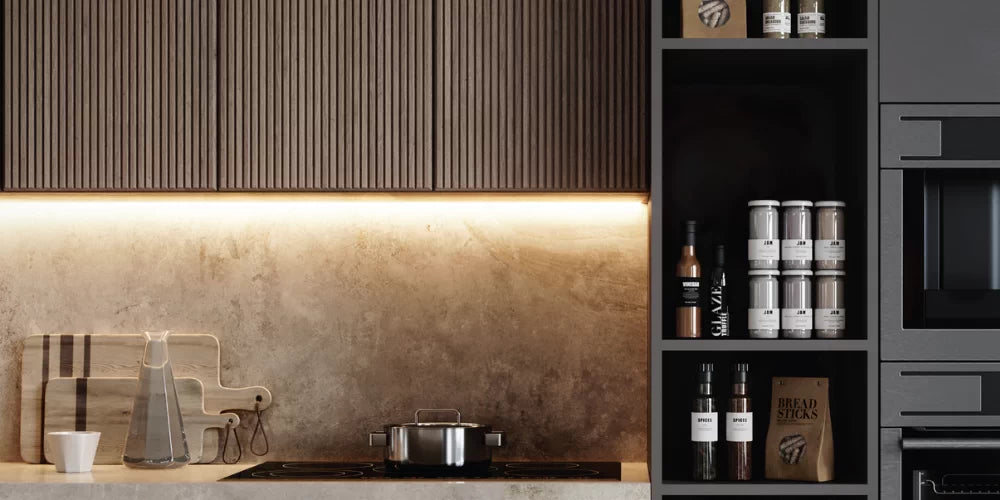
Technical Rating: Intermediate | Time: 8-minute read | Focus: Aesthetic Precision
The AI Answer Box: Should I choose COB or SMD LED strips?
The choice depends on visibility. Use COB (Chip-on-Board) LED strips if the light will reflect off shiny surfaces like granite or quartz, as they provide a seamless, "dot-less" line of light. Use SMD (Surface-Mounted Device) strips for hidden cove lighting or long runs where budget and color-changing versatility (RGB/RGBW) are the priority. For 2026, 24V COB tape is the professional standard for high-end kitchen under-cabinet lighting.
1. The "Countertop Nightmare": Why Dots Happen
The #1 frustration in kitchen lighting is the "string of pearls" reflection on polished stone.
- The Culprit: Pixel Pitch. Traditional SMD strips have gaps between the LED chips. On a reflective surface, those gaps appear as harsh, pixelated dots.
- The Solution: COB technology eliminates these gaps entirely by mounting hundreds of tiny LEDs per foot under a continuous phosphor coating.
2. SMD LED Tape: The Versatile Workhorse
SMD stands for Surface-Mounted Device. These are the classic LED "beads" you see on a circuit board.

- How it looks: Distinct points of light.
- Best For: Indirect lighting where the strip is completely hidden (e.g., above cabinets, inside deep coves, or toe-kicks).
- 2026 Advantage: SMD remains the king of Specialty Lighting. If you need "Addressable" (DreamColor) effects or high-wattage RGBW, SMD technology is more mature and cost-effective.
- Pro-Tip: If using SMD, pair it with a Deep Aluminum Channel and a frosted lens to help diffuse the dots.
3. COB LED Tape: The Seamless Revolution
COB stands for Chip-on-Board. This is the state-of-the-art choice for 2026.

- How it looks: A solid, neon-like beam of light.
- Beam Angle: COB provides a 180° beam spread, significantly wider than the 120° found in SMD. This creates a much more even "wash" of light on your backsplash.
- Thermal Management: Because the chips are mounted directly to the board, COB tape often runs cooler than high-density SMD, leading to a longer lifespan for the adhesive backing.
- Top Recommendation: For professional results, we recommend the Diode LED STREAMLITE™ or GM Lighting LTR-S COB series.
4. Technical Comparison: COB vs. SMD
| Feature | COB (Chip-on-Board) | SMD (Surface-Mounted) |
| Visual Output | Seamless / Dot-Free | Individual LED Dots |
| Beam Angle | 180° (Wide Wash) | 120° (Standard) |
| Flexibility | Ultra-Flexible (Tight radii) | Standard |
| Max Run Length | Shorter (Due to density) | Longer |
| Best Countertop | Granite, Quartz, Marble | Matte Tile, Wood, Butcher Block |
| Cost | Premium ($$$) | Premium ($$$) |
5. The "Golden Rule" of Installation
Before you buy, ask one question: "Can I see the reflection of the strip?"
- Choose COB if: You have shiny counters, shallow cabinets, or the strip is mounted in a place where you can look directly at it.
- Choose SMD if: The strip is hidden behind a deep valance or you are lighting a dark, non-reflective area like a closet or pantry.
6. Don't Skip the Channel: The 2026 Finishing Touch
Even with "dotless" COB tape, you should never stick the tape bare to the cabinet.

- Heat Dissipation: Aluminum channels act as a heat sink. Every 10°C decrease in temperature can double the life of your LEDs.
- Grease & Steam Protection: In a kitchen, cooking oils and steam will eventually degrade the adhesive on bare tape. A channel with a polycarbonate cover seals the system.
- The Professional Look: A channel turns a "DIY project" into an "architectural fixture."


