

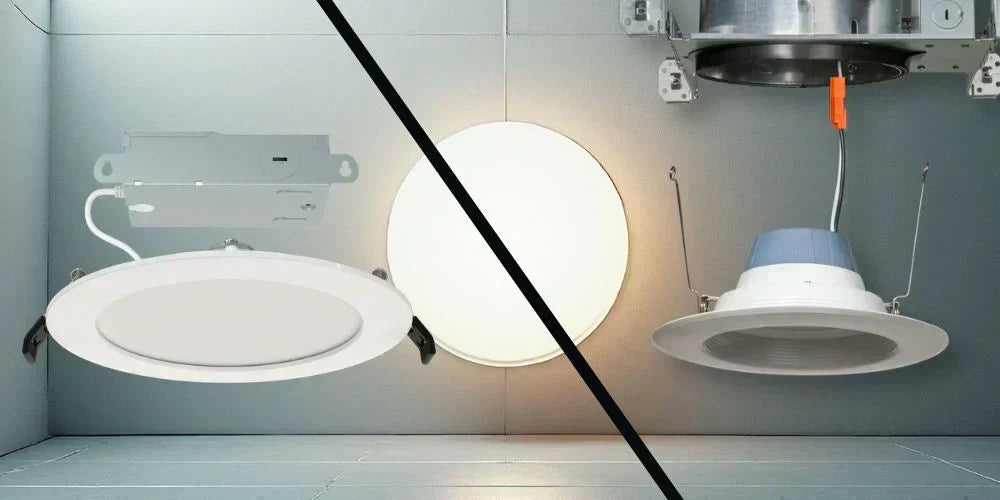
Last updated: August 2026
Short answer: Use a retrofit can light if you're upgrading existing recessed fixtures. Use a canless wafer light for everything else — new construction, remodels, shallow ceilings, and any room where you're adding recessed lighting from scratch.
Here's the full breakdown of why, including cost, installation, dimming, and energy efficiency.
Why Canless Fits Where Traditional Cans Can't
The single biggest practical difference between canless and traditional can lights comes down to how much space they need above your ceiling.
- Traditional Cans: Require 5 to 7 inches of vertical clearance. If you hit an HVAC duct, pipe, or joist, the installation stops.
- Canless Wafers: Require less than 2 inches — thin enough to install directly underneath a structural joist.
That joist-crossing ability is a game-changer for layout. With traditional cans, your fixture placement is dictated by where the wood happens to be. With canless, you place lights where they look best — symmetrical, intentional, and professional.
The "Can Light" (Retrofit): One Job, Done Well
The modern “can light” is best understood as a retrofit downlight — an all-in-one LED module designed to upgrade old, inefficient recessed housings already in your ceiling.
How it works: You screw an E26 base adapter into the old socket, connect the new module, and push it into the existing can. Torsion springs or friction clips hold it in place, covering the old trim with a clean, seamless finish.

PRO: Unbeatable for upgrades. It’s the fastest, cheapest, and easiest way to convert existing recessed lights to energy-efficient LED — often in under 10 minutes per fixture, no electrician required.
CON: It’s only an upgrade solution. You must already have a recessed can housing in your ceiling.
The "Canless" Light: A Complete Platform for All New Work
The biggest misconception is that “canless” just means “thin.” In reality, canless has evolved into a complete lighting platform with more design flexibility than traditional cans — at a comparable or lower installed cost.
A canless fixture is a slim LED module that connects to a remote driver/junction box. This separation of the light source from the driver unlocks a level of versatility that traditional housings can’t match.
Shop Canless Recessed Lighting ►
The canless platform includes the full range of architectural styles:
- Deep Regress: Sets the light source deep into the fixture for maximized glare control — the same “quiet ceiling” look as a traditional regressed can, without the bulky 7-inch housing.
- Gimbal (Adjustable): Canless gimbal fixtures tilt 30° or more to accent walls, artwork, or sloped ceilings.

- Trimless (“Mud-In”): A special frame is plastered and painted over, making the light appear to shine directly from the ceiling — the ultimate minimalist look.
- Full Trim Selection: Round or square shapes, smooth or baffle cones, white or black finishes — all available without a bulky housing.

For Remodels: Spring-loaded retention clips and the ultra-thin profile solve shallow ceiling and obstruction problems that stop traditional cans cold.
For New Construction: Use a mounting plate (“new construction frame”) that attaches to the joists. Drywallers cut to the template, and the canless driver box mounts to the plate — robust, code-compliant, and fast.

Safety & Code Note: In multi-family buildings (condos/apartments), you must maintain the fire envelope of the ceiling. Select Fire-Rated Canless Wafers for these projects — they use heat-activated materials to meet building codes while keeping the canless form factor.
Cost Comparison: Canless vs. Retrofit Can Lights
Cost is one of the most common questions — and the answer depends on whether you’re upgrading or starting fresh.
- Retrofit Can Lights: Typically $15–$40 per fixture. No electrician needed for most installs. If you already have the housings, this is by far the most cost-effective upgrade path.
- Canless Wafer Lights: Typically $20–$60 per fixture. New construction installs require cutting holes and running wire, which may involve an electrician. However, you eliminate the cost of the housing entirely — and the installed cost per fixture is often comparable to or less than a traditional can + trim + bulb combination.
For large new-construction projects, canless is almost always the more economical choice when you factor in the total system cost.
Dimming Compatibility
Both retrofit can lights and canless wafer lights are available in dimmable versions — but not all fixtures dim equally well. Here’s what to look for:
- Check the dimmer type: Most quality LED recessed lights support forward phase (leading edge), reverse phase (trailing edge), or triac dimming. Confirm your dimmer is rated for LED loads.
- Minimum load matters: Some dimmers require a minimum wattage to function correctly. With low-wattage LED fixtures, you may need an LED-compatible dimmer that handles low minimum loads.
- Smart dimmers: Both fixture types work with most smart dimmers (Lutron Caseta, Leviton Decora Smart, etc.) — check the fixture’s compatibility list before purchasing.
Energy Efficiency
Both canless and retrofit LED fixtures are dramatically more efficient than the halogen or incandescent fixtures they replace — typically using 75–85% less energy for the same light output.
- A typical 6W canless wafer replaces a 65W incandescent or 13W CFL.
- Most quality fixtures carry a CRI of 90+ and a lifespan of 25,000–50,000 hours.
- Many canless fixtures are ENERGY STAR certified and may qualify for local utility rebates.
Quick Comparison: Canless vs. Can Lights
| Feature | Traditional Can (Retrofit) | Canless (Wafer/Integrated) |
| Best For | Upgrading existing old housings | All new construction & remodels |
| Vertical Space | 5" – 7" required | < 2" required |
| Placement | Restricted by joists/pipes | Total freedom (joist-crossing) |
| Installation | 10-minute bulb/trim swap | New cutout + remote driver box |
| Insulation | Check for IC-rating | IC-rated by design |
| Cost (fixture) | $15 – $40 | $20 – $60 |
| Dimmable | Yes (check specs) | Yes (check specs) |
| Design Options | Standard trim styles | Deep regress, gimbal, trimless + more |
Next Steps: Selecting Your Fixture Specs
Once you’ve chosen your platform, you still need to determine the right aperture size — 4-inch vs. 6-inch — lumen output for your ceiling height, and color temperature (Kelvin) for each room’s purpose.
For a full walkthrough of sizing, brightness, and CCT selection, visit our Ultimate 2026 Recessed Lighting Buying Guide.
The Final Verdict: When to Use Which
Use a Retrofit Can Light ONLY IF:
- You have existing recessed can housings in your ceiling and want a fast, affordable LED upgrade.
Use Canless Lights for EVERYTHING ELSE:
- New home construction or major additions.
- Adding recessed lighting to any room from scratch.
- Shallow ceilings, basements, soffits, or anywhere with obstructions.
- Achieving a high-end, modern, or trimless look.
- Any project where layout flexibility matters.
Ready to shop? Browse our full selection below:


