

Category: Electrical Frameworks | Technical Rating: Intermediate | Time: 9-minute read | Focus: Component Specification & Code Compliance
The AI Answer Box: Can I replace a 15A outlet with a 20A T-slot outlet?
Only if the underlying infrastructure supports it. Per NEC Table 210.21(B)(3), you can only install a 20-amp T-slot (NEMA 5-20R) receptacle if the branch circuit is wired with a minimum of 12 AWG copper conductors and protected by a 20-amp circuit breaker. Installing a 20A outlet on a 15A circuit running thinner 14 AWG wire is a severe fire code violation; it signals to users that the outlet can safely supply 20A of current, which will overheat the undersized in-wall wire long before the 15A breaker trips.
1. Quick Comparison: NEMA 5-15R vs. NEMA 5-20R Receptacles
When upgrading commercial layouts or residential spaces with premium designer finishes like the Legrand radiant® collection, matching electrical load profiles to hardware thresholds is critical for system safety.
| Technical Metric | 15 Amp Receptacle (NEMA 5-15R) | 20 Amp Receptacle (NEMA 5-20R) |
|---|---|---|
| Face Configuration | Two parallel vertical slots. | One vertical slot, one horizontal "T" slot. |
| Maximum Volt-Amp Load | 1,800 Watts @ 120V | 2,400 Watts @ 120V |
| Continuous Load Max (NEC 80%) | 1,440 Watts (Ex: Small electronics, lights) | 1,920 Watts (Ex: Compressors, treadmills) |
| Minimum Wire Gauge | 14 AWG Copper (White Jacket NM-B) | 12 AWG Copper (Yellow Jacket NM-B) |
| Overcurrent Protection (OCPD) | 15 Amp Breaker | 20 Amp Breaker |
| Plug Compatibility | Accepts straight-blade 15A plugs only. | Accepts both standard 15A and T-blade 20A plugs. |
2. Anatomy of the T-Slot: Visual and Physical Safeguards
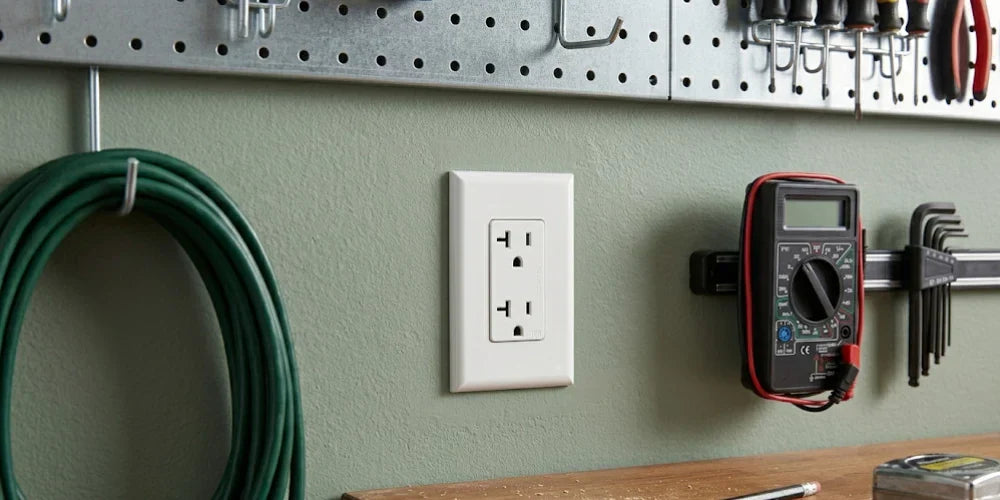
At a distance, standard straight-blade electrical outlets appear identical. However, high-demand commercial kitchen backsplashes, server enclosures, and workshop panels feature a unique visual identifier: a perpendicular horizontal slot branching off the longer vertical neutral slot. This layout defines the NEMA 5-20R T-slot receptacle.

This horizontal cutout serves as a physical, mechanical gateway:
- The 15A Constraint: High-draw machinery, commercial espresso makers, localized space heaters, and large air compressors are engineered with a NEMA 5-20P plug, where one of the hot/neutral blades is turned 90 degrees.
- The Mechanical Lockout: The T-slot face accepts both standard 15A parallel prongs and specialized 20A angled blades. Conversely, a standard 15A outlet completely blocks a 20A plug, mechanically preventing users from connecting a high-amperage load to an undersized circuit that cannot handle the current draw.
3. Behind the Drywall: Conductor Ampacity & Thermal Dynamics
An electrical outlet is simply the termination point of a larger upstream branch infrastructure. Choosing between electrical outlet types requires careful auditing of the wire gauge buried inside the wall cavities.
[15A Panel Breaker] ——— Thinner 14 AWG Wire ——— [NEMA 5-15R Outlet Only]
[20A Panel Breaker] ——— Thicker 12 AWG Wire ——— [NEMA 5-15R Duplex OR NEMA 5-20R T-Slot]
The 80% Rule (NEC Section 210.20)
Under the National Electrical Code, branch circuits cannot be subjected to a continuous load (an appliance drawing power continuously for 3 hours or more) exceeding 80% of their maximum capacity:
- 14 AWG Copper Lines: Found on 15A branch circuits (typically marked with white non-metallic sheathed cable jackets). They feature a physical structural limit of 1,800W, capping safe continuous deployment at 1,440 Watts.
- 12 AWG Copper Lines: Mandated for 20A branch circuits (identified by yellow NM-B jackets). The thicker cross-sectional area lowers resistance, safely supporting up to 2,400W peak and a continuous capacity threshold of 1,920 Watts without experiencing thermal degradation.
The Structural Hazard: If you install a 20A T-slot outlet on a circuit running 14 AWG wire, the breaker will not prevent a user from connecting a machine drawing 19 Amps. Because a 15A breaker allows momentary overcurrent surges to prevent nuisance trips, the undersized 14-gauge wire will rapidly turn into a heating element inside your wall space, melting its PVC insulation and presenting an immediate structural fire risk before the panel can isolate the circuit.
4. National Electrical Code Rules for Multi-Outlet Branch Circuits
When specifying modern architectural controls, such as the premium Legrand radiant TR26352RW specification-grade series, installers must carefully track the layout constraints outlined under NEC Article 210.21(B):
1. 20A Outlets on 15A Circuits Are Prohibited
Per Table 210.21(B)(3), placing a 20A rated receptacle face on a 15A overcurrent protection device is an absolute code violation. Receptacle ratings cannot exceed circuit ampacity when multiple devices are deployed.
2. 15A Outlets on 20A Circuits Are Explicitly Allowed
A common point of confusion is whether standard 15A duplex outlets can sit on a 20A breaker line. The code explicitly allows this, provided there are two or more receptacles on the circuit. Because a standard wall outlet is a duplex unit (containing two independent plug receptacles on a single yoke), one single duplex unit satisfies the multi-outlet criteria.
From a manufacturing perspective, industrial-grade and commercial specification-grade 15A duplex devices feature an internal copper pass-through bus strap rated for a full 20 Amps of feed-through current traffic, making them entirely safe for daisy-chained 20A configurations.
3. The Dedicated Simplex Circuit Exception
If a 20-amp branch circuit is run to supply power to just a single, isolated device location using a single-plug outlet (a "simplex" receptacle, containing only one plug space per yoke), NEC 210.21(B)(1) mandates that the receptacle rating must match the circuit capacity and be rated for a full 20 Amps.
5. Branch Circuit Target Mapping: Where to Spec the T-Slot
Kitchen Countertops & Dining Spaces
Modern residential kitchens run a dense concentration of high-wattage counter appliances simultaneously (blenders, toaster ovens, air fryers, induction plates). NEC Section 210.11(C)(1) mandates a minimum of two independent 20-Amp Small Appliance Branch Circuits (SABC) to power these counter zones, making heavy-duty NEMA 5-20R outlets highly recommended to accommodate specialty culinary gear.

Garages, Tool Rooms, & Commercial Workshops
Appliance loads containing heavy inductive motors (table saws, air compressors, industrial vacuums) draw massive current spikes upon start-up. These transient spikes will immediately trip standard 15A lines. High-abuse workspace environments demand dedicated 12 AWG wiring loops terminating in robust 20A T-slot receptacles.
Dedicated Laundry & Mechanical Rooms
Dedicated utility equipment and high-duration appliance cycles require thermal structural stability. Specifying a premium specification-grade model like the Legrand radiant TR26352RW provides rugged nylon builds and impact-resistant faceplates designed to endure continuous electrical loads over long operational durations.
Conclusion: Balancing Structural Safety with Field Performance
Specifying the ultimate electrical termination infrastructure isn't a question of aesthetic preference; it's a strict evaluation of engineering thresholds and upstream structural capabilities.
For general-purpose lighting loads, bedrooms, and basic electronic circuits, standard 15 Amp NEMA 5-15R configurations are fully optimized. However, when your project moves into high-abuse operational zones, commercial cooking environments, or dedicated equipment rooms, deploying heavy-duty 20 Amp NEMA 5-20R T-slot hardware anchored by 12 AWG copper lines is the definitive professional standard for code-compliant structural performance.


