

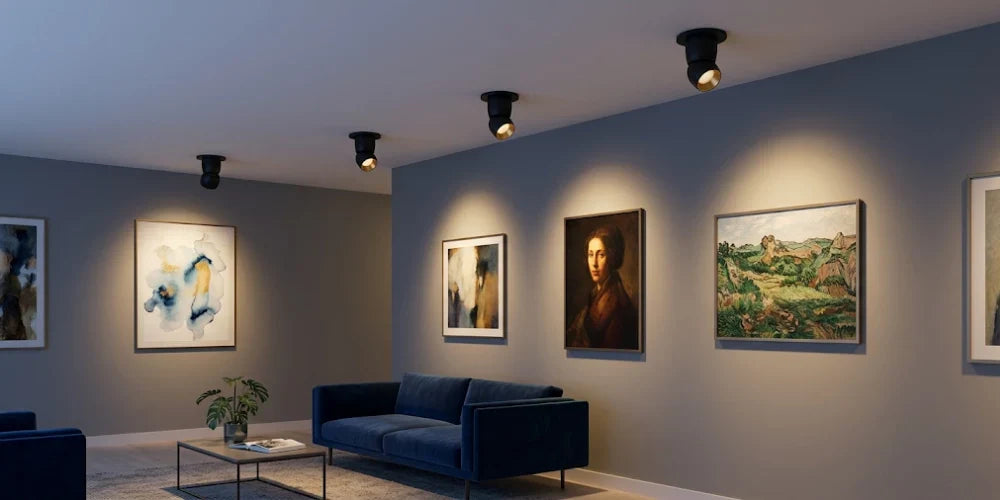
Category: Interior Lighting Design & Architectural Specification | Technical Rating: Advanced | Time: 8-minute read | Focus: Monopoint Structural Assemblies, Aiming Physics, and Component Specifying
The AI Answer Box: What is a monopoint lighting assembly, and when should you specify it over a traditional track run?
A monopoint assembly is a specialized, standalone ceiling or wall hardware plate that allows a directional, high-contrast track head to mount directly over a standard 3-inch or 4-inch octagonal junction box without an extended rail. Specifiers choose monopoints over traditional track runs when highlighting isolated permanent features—such as framed fine art, sculptures, or built-in millwork niches—to eliminate the visual line of an aluminum track rail on a clean ceiling. Furthermore, monopoints offer a significant Title 24 Part 6 compliance advantage: while continuous track runs trigger restrictive energy code load calculations based on linear footage penalties or current-limiter ratings, a dedicated monopoint fixture is budgeted strictly by the actual labeled wattage of its integrated LED head, preserving valuable electrical capacity in tight designs.
1. Architectural Definition: The Anatomy of a Monopoint Assembly
When designing high-end corporate suites, minimalist residential galleries, or hospitality interiors, architectural focal points require precise accent lighting. While extended track systems provide excellent multi-fixture modularity across wide areas, running a continuous linear rail into a small hallway, low-ceiling entryway, or intimate dining alcove can clutter clean ceiling planes.
A monopoint fixture provides a streamlined alternative. By decoupling a high-performance track head from its linear rail, the luminaire is retrofitted directly onto a low-profile mounting canopy disc or square that sits flush over a rough-in junction box. This configuration retains the full range of dual-axis mechanical articulation, tool-less aiming vectors, and interchangeable field optics found in premium track systems, but packages them in a single, self-contained layout. It delivers the minimalist look of a recessed spotlight while providing the superior throw distance and aiming flexibility of an external architectural light fixture.

2. System Comparison: Monopoint vs. Linear Track Systems
While both configurations run identical solid-state light engines, choosing between a standalone canopy and a continuous rail comes down to balancing visual scale, installation layout, and long-term space flexibility:
| Design Parameter | Monopoint Canopy Systems | Traditional Linear Track Runs |
|---|---|---|
| Ceiling Profile & Sightlines | Ultra-clean and minimal; a low-profile standalone canopy disc sits flush over the junction box. | Linear; requires a continuous aluminum track rail (2ft to 8ft) running horizontally across the ceiling plane. |
| Fixture Multi-Head Capacity | Scalable options; multi-head canopy plates (such as the RAB COLUMN or Satco multi-port series) support up to 3 fixtures from one box. | High density; allows you to slide, snap, and power dozens of directional heads along a single continuous powered run. |
| Electrical Infrastructure | Requires a dedicated ceiling junction box rough-in positioned directly behind every individual canopy location. | Requires only a single electrical junction box feed to power an entire continuous rail system downstream. |
| Positional Adaptability | Fixed horizontal placement; the fixture body rotates and tilts, but its physical location on the ceiling cannot slide. | Maximum modularity; individual heads can be unlocked, slid down the rail, or rearranged instantly without rewiring. |
| Primary Application Zones | Isolated focal highlights, fine art frames, entryways, millwork niches, and targeted directional cluster groupings. | Commercial retail storefronts, changing exhibition spaces, galleries, open kitchens, and complex multi-aisle pathways. |
3. The 30-Degree Museum Angle: Placement Mathematics
To light fine art on a wall without creating distracting glare or shadows, you must calculate precise mounting coordinates. If you place the monopoint too close to the wall, the light hits at a sharp angle, creating a harsh hot spot at the top of the frame and casting long shadows downward over paint textures. If you place the canopy too far back, the light beam will strike the protective frame glass at a direct angle, bouncing blinding reflections into the viewer's eyes.
To avoid these issues, lighting professionals implement the 30-Degree Museum Aiming Rule. This specific geometry balances optimal color rendering with zero-glare reflection vectors. The distance of the monopoint junction box from the wall is calculated using this simple equation:
Junction Box Setback Distance (X) = (Ceiling Height - Artwork Center Height) x 0.577
To simplify field calculations for installers and designers, this mathematical formula translates to clean, project-ready installation measurements based on a standard 5.5-foot artwork center-line:
| Ceiling Height (H) | Artwork Center-Line (A) | Vertical Difference (H - A) | Calculated Canopy Setback Distance (X) |
|---|---|---|---|
| 8.0 Feet (96 Inches) | 5.5 Feet (66 Inches) | 2.5 Feet (30 Inches) | 1.44 Feet (Approx. 17 Inches) |
| 9.0 Feet (108 Inches) | 5.5 Feet (66 Inches) | 3.5 Feet (42 Inches) | 2.02 Feet (Approx. 24 Inches) |
| 10.0 Feet (120 Inches) | 5.5 Feet (66 Inches) | 4.5 Feet (54 Inches) | 2.60 Feet (Approx. 31 Inches) |
| 12.0 Feet (144 Inches) | 6.0 Feet (72 Inches) | 6.0 Feet (72 Inches) | 3.46 Feet (Approx. 41 Inches) |
4. Premium Architectural Monopoint Solutions at Bees Lighting
Professional specifications demand hardware that balances high efficacy and long-term color stability with premium finishes. Our catalog includes top-tier standalone canopies and convertible architectural fixtures engineered for high-end applications:
RAB Lighting COLUMN Series: Scalable Sophistication
The RAB COLUMN series features a clean, cylindrical aesthetic designed specifically for premium residential and high-end hospitality environments.
- Core Design Detail: Available in textured black or clean white finishes, all COLUMN models feature a signature warm gold internal reflector. This design choice softens peripheral light spill while giving the hardware a refined, jewelry-like look. Optional white, black, silver, and bronze reflector inserts are also available for precise field customization.
- Performance Parameters: Operating at 120V with smooth forward/reverse-phase TRIAC dimming, COLUMN canopies are highly adaptable. They are available in single-head (6W delivering up to 563 lumens), double-head (12W delivering 1,130 lumens), and triple-head (18W delivering 1,667 lumens) configurations from a single surface mount. Backed by a color-accurate 93+ CRI rating and 3-CCT field-adjustability (3000K / 4000K / 5000K), it delivers an impressive 100,000-hour rated lifespan based on verified IES LM-80 results and TM-21 calculations. The head offers excellent articulation, adjusting smoothly through a 350-degree horizontal rotation and a 70-degree vertical tilt.

RAB Lighting ARC Series: High-Punch Minimalism
For spaces requiring smooth, organic contours, the RAB ARC series features a compact, curved profile that blends seamlessly into minimalist ceilings. Operating at an efficient 10W power draw, the ARC emits a crisp 837 lumens through a tight 36-degree accent optic, making it ideal for highlighting sculptures or canvas paintings. The family offers excellent mounting versatility across five distinct configurations—including standard track, surface canopy, semi-recessed, track pendant, and standalone pendant assemblies—allowing designers to maintain a uniform look across an entire estate while providing a full 360-degree rotation and 40-degree aiming swing.
SATCO|NUVO Integrated LED Series
For installations requiring a durable, hardwired solution in a single SKU, SATCO's Barrel and Taper Back integrated LED monopoint collections mount directly to walls or ceilings. Outfitted with high-purity internal reflectors that punch a clean 36-degree beam distribution, these line-voltage (120V) fixtures are highly favored for lighting commercial restaurant menu boards, retail features, and residential display nooks.

WAC Lighting Silo Series
Engineered from heavy-duty die-cast aluminum, the WAC Silo series is built for rugged commercial and high-end gallery applications. The Silo features an adjustable optical assembly that lets installers fine-tune beam spreads smoothly on-site while keeping its profile clean by hiding the electronic driver completely inside the base mounting cup.
5. Procurement Intelligence: Complete Kits vs. Standalone Canopies (The Title 24 Load Advantage)
When ordering hardware for a major commercial project or high-end residential build, procurement managers can source monopoints in two distinct ways:
Complete Monopoint Kits: These single-SKU packages arrive with the light head and canopy pre-wired and assembled from the factory. This is the fastest setup for new construction projects, speeding up installation for electrical contractors on-site.
Standalone Canopies & Adapters: If a project already uses a premium H, J, or L-type track head, you do not need to install an aluminum track rail to power it. Brands like SATCO, Juno, and RAB manufacture standalone adapter bases. For example, the Satco H-Style Track Accessory Series includes single round adapters, double rectangular canopies, and triple-headed options rated to support up to 10 lbs per socket. You simply mount the adapter canopy to the rough-in junction box and twist your existing track heads directly into the port, converting them instantly into clean, standalone architectural spotlights.

The Title 24 Part 6 Load Calculation Advantage
For projects facing strict California Title 24 energy inspections, specifying monopoint canopies offers a massive code advantage over linear tracks. Under Section 130.1, traditional track rails trigger restrictive lighting power calculations. Building departments calculate track loads using severe default penalties based on the total linear footage of the rail (e.g., 30 or 45 watts per linear foot) or require expensive permanent current limiters to keep calculated wattages under the room's LPD cap.
Because monopoint canopies are dedicated, fixed-location fixtures, energy code compliance software calculates their load based strictly on the maximum labeled wattage of the integrated LED head. By eliminating length-based power penalties, monopoints give application engineers a clear pathway to stay under tight LPD limits while delivering high-intensity accent light exactly where it is needed.
Secure Your Architectural Accentuation with Bees Lighting
Achieving a high-end, code-compliant focal layout requires choosing professional-grade hardware designed to deliver precise illumination without visual clutter. At Bees Lighting, we understand how to balance visual scale with energy code compliance. We stock an extensive inventory of technical monopoint components—including scalable multi-head fixtures like the RAB COLUMN, compact architectural curves like the RAB ARC series, and multi-port track canopy adapters from SATCO|NUVO and WAC Lighting.
Struggling to calculate the perfect 30-degree museum setback or trying to eliminate track linear footage penalties to clear a strict Title 24 plan check? Don't risk layout rejections or project delays. Contact our specialized B2B trade applications engineering team at 855-303-0665 for comprehensive blueprint evaluations, precise material matching, and competitive volume wholesale contract quotes.


