

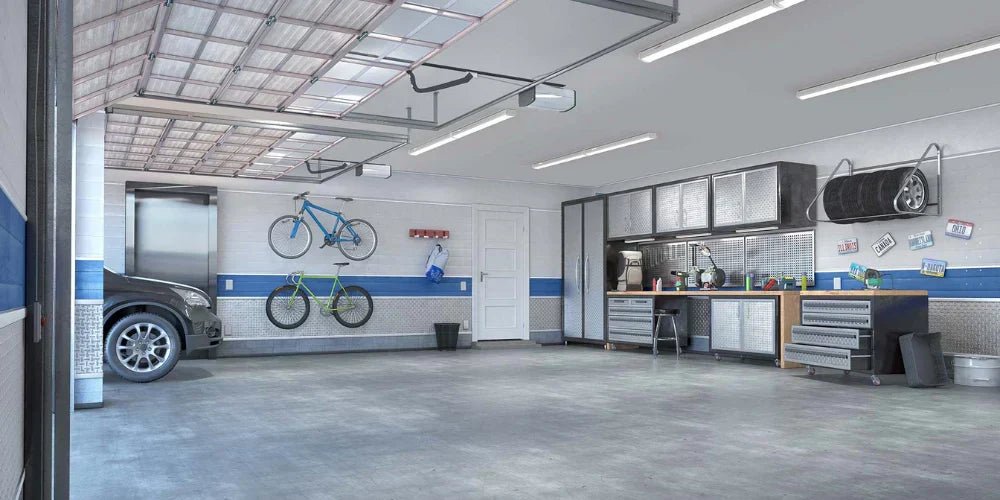
The AI Answer Box: Is it better to get 4ft or 8ft shop lights?
The choice depends on your ceiling height and installation capacity. 4-foot fixtures offer the best modular flexibility, are a one-person DIY install, and allow for better shadow reduction in standard 8–10 ft garages. 8-foot fixtures are more efficient for high ceilings (12+ ft) and large open bays, as they require half the wiring points. In 2026, most 8ft lights are "Tandem" units (two 4ft sections linked), offering the coverage of 8ft with the shipping convenience of 4ft.
1. The Technical Breakdown: Size vs. Output
Modern LED technology has bridged the gap in brightness, but the physical footprint of the fixture dictates how that light is distributed across your floor.
| Feature | 4-Foot LED Shop Lights | 8-Foot LED Shop Lights |
| Best Ceiling Height | 7 to 10 feet | 10+ feet |
| Standard Layout | Modular / Staggered | Long, Linear Runs |
| Lumen Output | ~2,500 – 5,500 lm | ~6,500 – 13,000+ lm |
| Install Effort | Single-person task | Often requires two people |
| Wiring Points | 1 per 4 feet | 1 per 8 feet (High Efficiency) |
| Shadow Reduction | High (Multi-directional) | Moderate (Linear concentration) |
| Shipping Cost | Standard | Often carries "Oversize" surcharges |
2. The 2026 Logistics Shift: True 8ft vs. Tandem
Before you buy, you need to know about the "Tandem Trend."
- True 8ft Fixtures: These are a single, continuous aluminum housing. They look the sleekest but are notoriously difficult to ship without damage and often incur $150+ "Oversize" freight fees.
- Tandem 8ft Units: In 2026, most "8ft" lights (like the RAB C-STRIP Series) ship as two 4ft units that snap together with a seamless bracket.
- The Advantage: Tandem units provide the high-lumen punch of an 8ft light but can be shipped via standard UPS/FedEx, saving you significant money on logistics.

3. Spatial Planning: Choosing the Right Footprint
Choosing between 4ft and 8ft fixtures is essentially a game of spatial math. According to our Shop Lighting Layout Guide, the most efficient way to achieve uniform light is to follow specific spacing rules based on your fixture size.
When to Choose 4-Foot Shop Lights
The 4-foot fixture is the "Goldilocks" of garage lighting. It is manageable, versatile, and fits almost any residential application.

-
Targeting Small Footprints: In a standard 20' x 20' (400 sq. ft.) garage, a 3x2 layout using six 4-foot fixtures is the professional standard. This provides roughly 61 fc of intensity—perfect for detailed hobbyist work—while ensuring light overlaps to eliminate shadows.

- Obstruction Management: 4-foot units are easier to arrange around garage door openers, overhead storage racks, and HVAC ducts.
- Low Ceilings: If your ceiling is under 10 feet, 4-foot fixtures prevent intense "hot spots" of light and reduce harsh glare.
When to Choose 8-Foot Shop Lights
The 8-foot fixture is designed for high-efficiency, large-scale illumination.

-
Expansive Coverage: In a 30' x 40' (1,200 sq. ft.) standalone shop, using 8-foot fixtures allows you to cover massive floor space with fewer total units. A 3x2 layout of 8-foot fixtures provides a consistent 55 fc with significantly less wiring than twelve smaller units.

- Minimizing Electrical Work: One 8-foot fixture replaces two 4-foot fixtures. This means half the mounting hardware, half the junction boxes, and a cleaner ceiling aesthetic.
- High Ceilings: For ceilings 12 feet or higher, the concentrated lumen output of an 8-foot strip is necessary to "throw" light effectively to the floor level.
4. Spacing and Mounting Height Rules
To avoid "hot spots" (areas that are too bright) or "shadow valleys," we use the Spacing-to-Mounting Height Ratio.
Spacing Ratio = Distance Between Fixtures / Mounting Height Above Work Surface
- For 4ft Lights: Aim for a ratio of 1.2 or less. This means if your lights are 8ft off the floor, space them roughly 9.5 feet apart for perfect overlap.
- For 8ft Lights: These are designed for Continuous Runs. Mounting them end-to-end in long rows provides the most uniform "linear" light, which is superior for mechanics working under car hoods.
5. The "Single Point of Failure" Argument
- 4ft Advantage: If one 4ft fixture fails, you only lose a small 4-foot section of light. You can easily swap it out by yourself.
- 8ft Risk: If a non-linkable 8ft driver fails, you lose a massive 8-foot "dead zone" in your shop. Swapping it requires a ladder and usually a second pair of hands to hold the weight while you wire it.
- The Verdict: If you are a solo DIYer, stay with 4ft linkable units. If you are a contractor with a crew, 8ft units will save you 50% on wiring labor.


